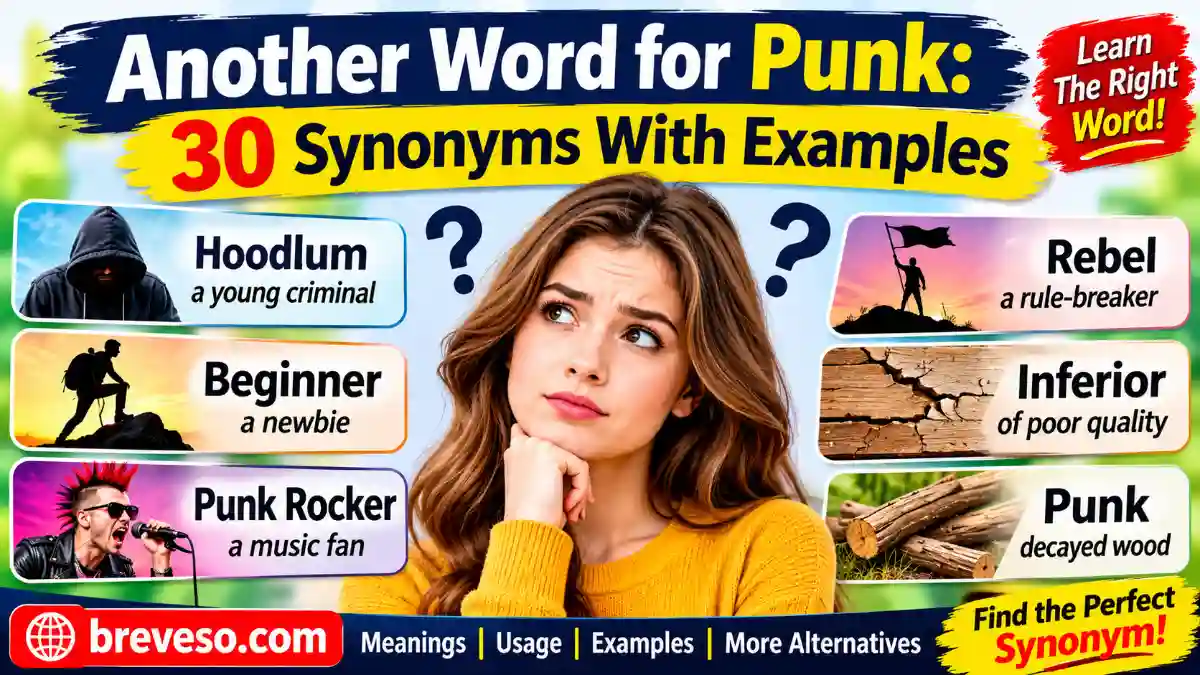
“Punk” has several unrelated meanings, so the best alternative depends on the context. When referring to a young criminal or troublemaker, the closest everyday words are hoodlum, thug, and hooligan. For a rude young person, suitable alternatives include brat or upstart. Someone who is just starting out can be called a novice or rookie. When describing something of poor quality, consider using inferior or poor.
The word also names a music style and a way of dressing, and it can mean decayed wood used to start fires. This article sorts those meanings so you can pick the right word each time.
Quick list: hoodlum, thug, hooligan, delinquent, brat, novice, rookie, rebel, inferior, poor
Below you will find 30 alternatives with meanings, IPA, usage notes, examples, and context. Some are direct synonyms. Others only fit one sense of “punk,” and the usage notes say so.
On this page
- At a Glance: Punk Synonyms and Related Alternatives
- Which Word Should You Use?
- Exploring the Multiple Meanings of “Punk”
- Analyzing 30 Punk Alternatives in Detail
- Punk vs. Hoodlum vs. Thug vs. Hooligan
- Punk and Opposite/Paired Word Pairs
- Common Word Partners of “Punk”
- Idiomatic Phrases Featuring “Punk”
- Word Formation of “Punk”
- Common Word-Choice Mistakes
- Frequently Asked Questions
- Conclusion
At a Glance: Punk Synonyms and Related Alternatives
| Alternative | Part of Speech | Meaning | Register / Tone | Ideal Context |
| Hoodlum | noun | a young, rough lawbreaker | Informal, negative | Crime, street gangs |
| Thug | noun | a violent, aggressive person | Strongly negative | Violence, intimidation |
| Hooligan | noun | a rowdy person who causes trouble | Neutral to negative | Public disorder, rowdy crowds |
| Brat | noun | a badly behaved, annoying young person | Informal, negative | Rude children and teens |
| Novice | noun | a person new to an activity | Neutral, formal | Learning, training |
| Rookie | noun | a beginner, often in sports or jobs | Informal, friendly | Teams, workplaces |
| Punk rocker | noun | a fan or player of punk rock | Neutral | Music, youth culture |
| Rebel | noun | a person who resists rules | Neutral, can be positive | Subculture, attitude |
| Inferior | adjective | lower in quality | Formal | Products, work |
| Rotten | adjective | very bad or decayed | Informal, strong | Quality, condition |
Which Word Should You Use?
| If you want to… | Use | Why |
| Describe a young street criminal | Hoodlum | It is the closest match to the dictionary sense of a petty gangster. |
| Describe someone violent | Thug | It stresses force and intimidation. |
| Describe a rowdy troublemaker in public | Hooligan | It suggests disorder more than serious crime. |
| Scold a rude young person | Brat | It is mild and works for children and teens. |
| Name a beginner politely | Novice | It is neutral and fits formal writing. |
| Name a beginner in a friendly way | Rookie | It sounds warm and casual. |
| Name a fan of the music style | Punk rocker | It avoids confusion with the insult. |
| Say that something is poor in quality | Inferior | It is clear and works in formal writing. |
Exploring the Multiple Meanings of “Punk”
1. A Young Criminal or Hoodlum
- Meaning: a usually petty gangster, hoodlum, or ruffian.
- Explanation: This is the older “tough guy” sense. It is an insult and suggests small-time crime or bad behavior rather than serious organized crime.
- Example: The shop owner chased the punks who had broken his window.
2. A Young, Inexperienced Person
- Meaning: a young person with little experience, especially a young man.
- Explanation: Here “punk” can mean “beginner” or “cocky kid.” It is often used to put someone down, so tone matters.
- Example: The coach called him a punk, but he soon proved himself on the field.
3. Punk Rock and Its Style
- Meaning: a loud, fast style of rock music, a musician who plays it, or a person who dresses in the related style.
- Explanation: Unlike the insult, this sense is neutral and can be positive. It also works as an adjective, as in “punk fashion.”
- Example: She wore a punk jacket covered in patches to the concert.
4. Poor Quality or Poor Health (Adjective)
- Meaning: very poor or inferior; also, in poor health.
- Explanation: This adjective sense is older and now rare. You may meet it in old books or regional speech.
- Example: He played a punk game of tennis.
5. Decayed Wood and Slow-Burning Sticks
- Meaning: wood so decayed that it is dry and crumbly and works as tinder; also a slow-burning stick used to light fireworks.
- Explanation: This is a separate noun with its own history. It has nothing to do with people or music.
- Example: He used a stick of punk to light the fuse.
6. Nonsense
- Meaning: nonsense or foolishness.
- Explanation: This sense is informal and uncommon today. It is mostly seen in dictionaries and older writing.
- Example: The advertisement was full of punk.
Sources: Merriam-Webster (punk); Etymonline (punk).
Analyzing 30 Punk Alternatives in Detail
Some alternatives below are close synonyms of one sense of “punk,” while others are related words that fit only certain contexts.
Hoodlums and Young Troublemakers
1. Hoodlum
IPA: US /ˈhʊdləm/ · UK /ˈhuːdləm/
Definition: A young, rough person who commits crimes or acts violently.
- Usage: This is the closest match to the “petty gangster” sense of punk. It is informal and negative.
- Example: A group of hoodlums spray-painted the school wall.
2. Thug
IPA: /θʌɡ/ (US and UK)
Definition: A violent person, especially one who hurts or scares others.
- Usage: It is a related alternative, not an exact synonym. “Thug” is stronger than “punk” and suggests real violence.
- Example: Two thugs blocked the doorway and demanded money.
3. Ruffian
IPA: /ˈrʌfiən/ (US and UK)
Definition: A rough, violent person who ignores the law.
- Usage: The word is a bit old-fashioned and often appears in stories. It is a close synonym for the criminal sense.
- Example: The ruffians were chased out of the village.
4. Hooligan
IPA: /ˈhuːlɪɡən/ (US and UK)
Definition: A rowdy person who causes trouble in public.
- Usage: It suggests disorder and noise more than serious crime. It is common in British English and in talk about unruly crowds.
- Example: Police removed several hooligans from the stadium.
5. Delinquent
IPA: /dɪˈlɪŋkwənt/ (US and UK)
Definition: A young person who breaks the law or behaves badly.
- Usage: The word is more formal and is often used in legal or social settings. It is a related alternative, since “punk” is more of an insult.
- Example: The program helps delinquents return to school.
Rude or Disrespectful Young People
6. Brat
IPA: /bræt/ (US and UK)
Definition: A badly behaved child or young person.
- Usage: It matches the “cocky kid” sense of punk but is milder and has no criminal meaning.
- Example: He was a spoiled brat who never said thank you.
7. Upstart
IPA: US /ˈʌpstɑːrt/ · UK /ˈʌpstɑːt/
Definition: A person who has recently gained position or success and acts too proudly.
- Usage: This is a related alternative. It fits a young person who acts arrogantly, but it does not suggest crime.
- Example: The old managers disliked the young upstart.
8. Whippersnapper
IPA: US /ˈwɪpərˌsnæpər/ · UK /ˈwɪpəˌsnæpə/
Definition: A young person who is too confident or thinks they are important.
- Usage: It is old-fashioned and often playful. Older people tend to use it about younger ones.
- Example: Some whippersnapper tried to tell me how to fix my own car.
9. Lout
IPA: /laʊt/ (US and UK)
Definition: A rude, clumsy, or aggressive person.
- Usage: Mainly British. It is a related alternative that stresses bad manners rather than youth or crime.
- Example: A drunken lout shouted at the waiters.
10. Troublemaker
IPA: US /ˈtrʌbəlˌmeɪkər/ · UK /ˈtrʌbəlˌmeɪkə/
Definition: A person who often causes problems or arguments.
- Usage: It is a general, everyday word. It is a good choice when you want to avoid a harsh insult.
- Example: The teacher moved the troublemaker to the front row.
Beginners and Newcomers
11. Novice
IPA: US /ˈnɑːvɪs/ · UK /ˈnɒvɪs/
Definition: A person who is new to an activity or skill.
- Usage: Merriam-Webster lists it as a synonym of punk in the “beginner” sense. It is neutral and suits formal writing.
- Example: As a novice chess player, she lost her first match.
12. Rookie
IPA: /ˈrʊki/ (US and UK)
Definition: A beginner, especially in a sport or a new job.
- Usage: It is casual and often friendly. It fits teams and workplaces.
- Example: The rookie scored in her first game.
13. Greenhorn
IPA: US /ˈɡriːnhɔːrn/ · UK /ˈɡriːnhɔːn/
Definition: A person who is new and inexperienced.
- Usage: It is informal and slightly old-fashioned. It can sound teasing.
- Example: The greenhorn did not know where to park the truck.
14. Apprentice
IPA: /əˈprentɪs/ (US and UK)
Definition: A person who learns a trade by working for a skilled worker.
- Usage: This is a related alternative. It fits trades and training, not insults.
- Example: He worked as a carpenter’s apprentice for three years.
Punk Rock, Style, and Attitude
15. Punk rocker
IPA: US /ˈpʌŋk ˌrɑːkər/ · UK /ˈpʌŋk ˌrɒkə/
Definition: A person who plays or loves punk rock.
- Usage: It is the clearest choice for the music sense because it avoids the insult. It is a longer form of “punk” rather than a true synonym.
- Example: The punk rocker dyed her hair bright green.
16. Rebel
IPA: /ˈrebəl/ (US and UK)
Definition: A person who resists rules or authority.
- Usage: It is a related alternative. It captures the attitude of punk culture, not the music or clothing.
- Example: He saw himself as a rebel against the system.
17. Nonconformist
IPA: US /ˌnɑːnkənˈfɔːrmɪst/ · UK /ˌnɒnkənˈfɔːmɪst/
Definition: A person who does not follow accepted rules or customs.
- Usage: A formal, neutral word for the attitude. It is not an exact synonym.
- Example: The nonconformist refused to wear a uniform.
18. Hardcore
IPA: US /ˈhɑːrdkɔːr/ · UK /ˈhɑːdkɔː/
Definition: A faster, harder style of punk music (as part of “hardcore punk”).
- Usage: It names a style within punk, not a replacement for the word. Use it only when you mean this kind of music.
- Example: The band played hardcore in a small basement.
19. Edgy
IPA: /ˈedʒi/ (US and UK)
Definition: Bold, unusual, or a little shocking.
- Usage: A loose, related adjective for a “punk” look or attitude. It does not mean the music.
- Example: She wore an edgy leather jacket.
Poor Quality Alternatives (Adjective)
20. Inferior
IPA: US /ɪnˈfɪriər/ · UK /ɪnˈfɪəriə/
Definition: Lower in quality or value.
- Usage: It matches the adjective sense “very poor” and is safe in formal writing.
- Example: The cheaper cloth was clearly inferior.
21. Poor
IPA: US /pʊr/ · UK /pɔː, pʊə/
Definition: Not good enough in quality.
- Usage: The simplest everyday replacement for the old adjective punk.
- Example: He gave a poor performance.
22. Lousy
IPA: /ˈlaʊzi/ (US and UK)
Definition: Very bad.
- Usage: Informal and strong. It fits casual speech.
- Example: We had lousy weather all week.
23. Shoddy
IPA: US /ˈʃɑːdi/ · UK /ˈʃɒdi/
Definition: Badly made or done with little care.
- Usage: It is best for goods and workmanship, not people.
- Example: The shoddy shelf fell apart in a week.
24. Substandard
IPA: US /ˌsʌbˈstændərd/ · UK /ˌsʌbˈstændəd/
Definition: Below the normal or required level.
- Usage: Formal. Often used for housing, work, or products.
- Example: The inspector reported substandard repairs.
25. Rotten
IPA: US /ˈrɑːtn/ · UK /ˈrɒtn/
Definition: Decayed; also, very bad.
- Usage: This word links to the “decayed wood” origin of punk. It works for both the literal and figurative meaning.
- Example: What a rotten day this has been.
Unwell, Nonsense, and Tinder
26. Unwell
IPA: /ʌnˈwel/ (US and UK)
Definition: Sick or not in good health.
- Usage: It fits the dated sense “in poor health.” It is polite and modern.
- Example: She stayed home because she felt unwell.
27. Nonsense
IPA: US /ˈnɑːnsens/ · UK /ˈnɒnsəns/
Definition: Words or ideas that make no sense.
- Usage: It matches the rare noun sense “foolishness.” It is neutral and common.
- Example: The article was full of nonsense.
28. Rubbish
IPA: /ˈrʌbɪʃ/ (US and UK)
Definition: Worthless or foolish talk or things.
- Usage: More common in British English. It is informal.
- Example: That claim is total rubbish.
29. Tinder
IPA: US /ˈtɪndər/ · UK /ˈtɪndə/
Definition: Dry material that catches fire easily.
- Usage: It fits the “decayed wood” sense of punk. It is a related word, since tinder can be other materials.
- Example: They gathered dry leaves as tinder.
30. Touchwood
IPA: /ˈtʌtʃwʊd/ (US and UK)
Definition: Decayed wood used as tinder.
- Usage: An older word close to the “decayed wood” sense. It is uncommon today.
- Example: The camper lit a spark on a piece of touchwood.
Sources: Merriam-Webster (punk, thesaurus entries); Etymonline (punk).
Punk vs. Hoodlum vs. Thug vs. Hooligan
These four words are often mixed up. They overlap, but each has a different focus.
| Word | Main Focus | Level of Violence | Typical Context |
| Punk | Disrespect, petty crime, youth | Low to medium | Informal insult |
| Hoodlum | Rough young lawbreaker | Medium | Street crime |
| Thug | Violence and threats | High | Intimidation |
| Hooligan | Rowdy, disorderly behavior | Low to medium | Crowds, public places |
Sources: Merriam-Webster (punk).
Punk and Opposite/Paired Word Pairs
| Word | Paired Word | Note |
| Punk (beginner) | Veteran | A veteran has long experience. |
| Punk (poor) | First-rate | Opposite in quality. |
| Punk (hoodlum) | Law-abiding citizen | The contrast is in behavior. |
| Punk rock | Mainstream pop | Contrasts style and audience. |
| Punk | Post-punk | Related styles that came after punk. |
Punk has no single natural opposite, because its meanings are so different. The pairs above show contrasts for each sense instead of forcing one antonym.
Sources: Merriam-Webster (punk).
Common Word Partners of “Punk”
| Pattern | Common Partners | Example |
| punk + noun | rock, band, music, scene, fashion | She loves the local punk scene. |
| adjective + punk | young, little, hardcore, pop | The pop punk band toured in summer. |
| prefix + punk | post-, cyber-, steam- | He reads cyberpunk novels. |
| punk + out (verb) | punk out | He punked out at the last minute. |
Sources: Merriam-Webster (punk); Etymonline (punk).
Idiomatic Phrases Featuring “Punk”
“Punk” has few true idioms. The items below are established expressions.
1. Punk out
- Meaning: To back out of something, often from fear. Informal and mainly American.
- Example: He said he would jump but punked out at the edge.
2. Do you feel lucky, punk?
- Meaning: A famous movie line that has become a tough-guy catchphrase. People now use it jokingly.
- Example: He grinned and said, “Do you feel lucky, punk?” before the card game.
3. Feeling punk
- Meaning: Feeling unwell. This is dated and rarely used now.
- Example: I’m feeling a bit punk today, so I’ll rest.
4. Punk’s not dead
- Meaning: A slogan saying the punk movement and spirit are still alive.
- Example: The festival banner read, “Punk’s not dead.”
Sources: Merriam-Webster (punk); Etymonline (punk).
Word Formation of “Punk”
Etymology & Structure
“Punk” is a short, one-syllable word. Its origin is uncertain, and the different senses may have different roots. Etymonline says the “bad, inferior” adjective and the “rotten wood” noun may come from a Delaware (Algonquian) word meaning “dust” or “ashes,” though a Gaelic source has also been suggested. Merriam-Webster says the origin of the person sense is unknown and that the “decayed wood” noun may come from “spunk.” The “worthless person” sense may come from the earlier “criminal’s apprentice” slang or from an older word of unknown origin.
Date and History
- Older meaning (now archaic): late 1500s.
- “Rotten wood used as tinder”: 1670s to 1680s.
- “Chinese incense”: 1870.
- Adjective “inferior, bad”: 1896.
- “Criminal’s apprentice” slang: by 1904.
- “Worthless person,” especially a young hoodlum: 1917.
- “Punk rock”: by 1971, widely popular from 1976.
Word Class Variations
- Noun: punk, punks
- Adjective: punk, punkish
- Verb: punk out (informal, “to back out”), recorded by about 1920
- Combining form: -punk, as in cyberpunk and steampunk
No common adverb form is standard.
Sources: Merriam-Webster (punk); Etymonline (punk).
Common Word-Choice Mistakes
- “He is a punk” for a music fan: use punk rocker, because “punk” alone can sound like an insult.
- “The hoodlum child was rude”: use brat, because “hoodlum” suggests crime.
- “She is a punk at her new job” as a polite description: use novice or rookie.
- “A thug is just a rowdy fan”: use hooligan, because “thug” suggests real violence.
- “The shirt was punk quality”: use poor or inferior, since the adjective sense is now rare.
- “Every rebel is a punk”: use nonconformist unless the person is tied to punk culture.
- “Tender for the campfire”: the word is tinder, not “tender.”
Frequently Asked Questions
1. What is the closest synonym for punk?
For the common insult sense, hoodlum is the closest. For a beginner, it is novice.
2. Is “punk” always an insult?
No. As a music or fashion term, it is neutral and often proud.
3. What is a formal alternative to punk?
Delinquent works for young lawbreakers, novice for beginners, and inferior for poor quality.
4. What is the difference between a punk and a thug?
A thug is more violent. A punk is usually petty, young, or disrespectful.
5. What is another word for a punk rocker?
You can say punk musician or punk fan. “Rebel” is related but means something different.
6. Can “punk” mean a beginner?
Yes, Merriam-Webster lists “a young inexperienced person” as one sense, though the tone can be insulting.
7. Can “punk” mean bad quality?
Yes, as an older adjective. Today people usually say poor or lousy instead.
8. What does “punk” mean in “punk out”?
It means to back out of something, often because of fear.
9. Is “punk” the same as “hooligan”?
Not exactly. A hooligan is rowdy in public, while a punk can also be a young, cocky person.
10. What is the opposite of punk?
It depends on the sense: veteran, first-rate, or law-abiding citizen.
Conclusion
The closest alternatives to “punk” are hoodlum, thug, and hooligan for lawbreakers, brat and upstart for rude youths, and novice and rookie for beginners. For poor quality, use inferior or poor.
Context matters because “punk” has several separate meanings. It can name a person, a music style, a way of dressing, or even decayed wood. A word that fits one sense may sound wrong in another.
To choose well, first decide which meaning you need. Then pick a word that matches the tone: formal, friendly, or harsh. When you mean the music or style, use “punk rocker” to avoid confusion.
Related reading
- Another Word for Ghosted
- Another Word for Gentlemen
- Another Word for Interviewee
- Another Word for Laid

Ali Bismal is the founder and writer behind Breveso.com, where he helps readers find the perfect synonym for every word. What started as a simple love for words turned into a growing library of “another word for ___” guides covering emotions, actions, slang, and everyday language.
Ali believes the right word can sharpen a sentence, and the wrong one can blur it. That is why every Breveso guide is written in plain, simple English, grouped in a way that actually makes sense, and checked for real-world use.
He writes for students, writers, and anyone who has ever stared at a sentence thinking there must be a better word for this. Clean, useful content that answers the question fast, that is the whole mission.