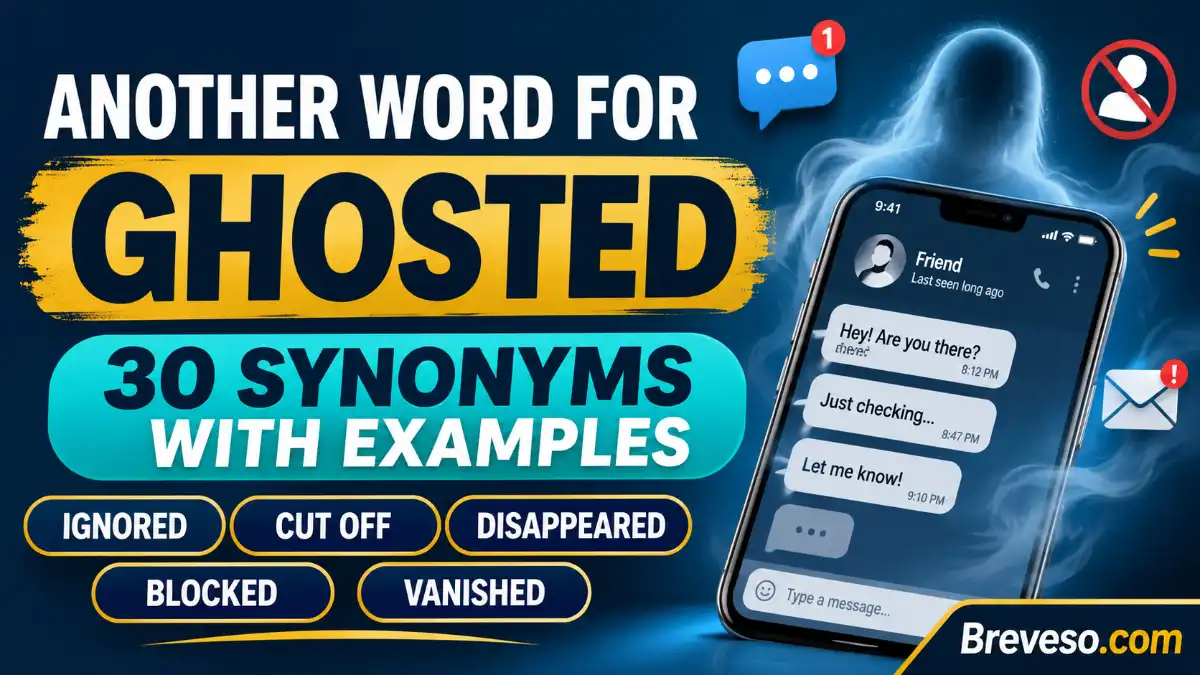
If you want another word for ghosted, the closest everyday choices are ignored, cut off, and dropped. All three describe someone who stops replying with no warning. Each one fits a slightly different situation, so the best choice depends on what actually happened.
The word covers more than dating. People say ghosted when a friend, a recruiter, or a group chat goes silent, and when someone leaves a party without saying goodbye. Older senses of the verb describe moving silently like a ghost or writing a book for someone else.
Quick list: ignored, cut off, dropped, dumped, blocked, avoided, snubbed, disappeared, stonewalled, abandoned
This article looks at 30 alternatives with meanings, IPA, usage notes, examples, and context, so you can match each word to the situation.
Table of Contents
- At a Glance: Ghosted Synonyms and Related Alternatives
- Which Word Should You Use?
- Exploring the Multiple Meanings of “Ghosted”
- Analyzing 30 Ghosted Alternatives in Detail
- Ghosted vs. Ignored vs. Blocked vs. Stood Up
- Ghosted and Opposite/Paired Word Pairs
- Common Word Partners of “Ghosted”
- Idiomatic Phrases Featuring “Ghosted”
- Word Formation of “Ghosted”
- Common Word-Choice Mistakes
- Frequently Asked Questions
- Conclusion
At a Glance: Ghosted Synonyms and Related Alternatives
| Alternative | Part of Speech | Meaning | Register / Tone | Ideal Context |
| ignored | verb (past tense) | Paid no attention to someone’s messages | Neutral | Unanswered texts or calls |
| cut off | phrasal verb | Stopped all contact | Neutral | Clear, direct statements |
| dropped | verb | Ended a connection suddenly | Casual | Friends and dates |
| dumped | verb | Ended a relationship, often bluntly | Informal | Breakups with some message |
| blocked | verb | Stopped someone from reaching you on a phone or app | Neutral | Phones and apps |
| vanished | verb | Disappeared suddenly | Vivid, dramatic | Stories and retellings |
| snubbed | verb | Treated someone coldly on purpose | Neutral | Social slights |
| stonewalled | verb | Refused to answer or engage | Firm | Arguments and avoided talks |
| stood up | phrasal verb | Failed to show up for a planned meeting | Informal | Dates and appointments |
| ditched | verb | Left someone or something behind | Very informal | Plans, events, people |
Which Word Should You Use?
| If you want to… | Use | Why |
| Say someone ended all contact | cut off | It is clear and neutral, and it works in any setting. |
| Describe messages nobody answered | ignored | It fits a silence that may not last forever. |
| Describe a breakup that came with a message | dumped | Ghosted means no message at all, so dumped is more accurate. |
| Describe a missed date | stood up | It points to one missed meeting, not a long silence. |
| Describe someone who left a party or plan | ditched or bailed | Both sound casual and fit sudden exits. |
| Describe someone who refuses to talk during a conflict | stonewalled | It shows a firm refusal to engage. |
| Write in a formal tone | neglected or withdrew | Both sound calm and professional. |
| Tell a story with drama | vanished | It paints a strong picture of a sudden disappearance. |
Exploring the Multiple Meanings of “Ghosted”
1. Cutting Off All Contact Without Explanation
- Meaning: To end contact with someone suddenly and give no reason, especially in a romance.
- Explanation: Merriam-Webster describes ghosting as leaving a relationship of some kind by ending all contact, especially texts, emails, and chats. So the word also covers friends and other relationships. The key point is silence with no explanation.
- Example: We went on three dates, and then he ghosted me.
2. Leaving a Social Event Without Saying Goodbye
- Meaning: To leave a gathering suddenly without telling anyone.
- Explanation: Dictionary.com lists this sense next to the relationship one. Merriam-Webster traces a similar sense of leaving without a goodbye back to 2004.
- Example: I felt tired, so I ghosted the party at nine.
3. Moving Silently Like a Ghost
- Meaning: To move quietly and smoothly, often without anyone noticing.
- Explanation: Collins lists this sense, and Merriam-Webster says the modern relationship sense grew out of it. The Oxford English Dictionary records phrases like “ghost it” and “ghost away” from the 1800s, meaning to steal away like a ghost.
- Example: The striker ghosted past two defenders and scored.
4. Haunting Like a Ghost
- Meaning: To haunt a person or place the way a ghost does.
- Explanation: Merriam-Webster lists this as the first transitive sense of the verb and dates the verb to around 1616. Today the sense sounds literary and rare.
- Example: In the story, a sad spirit ghosted the old hotel every winter.
5. Writing for Someone Else
- Meaning: To write a book, speech, or article that another person publishes under their own name.
- Explanation: Merriam-Webster treats this as a form of ghostwriting. The usual spelling is ghostwrite, and ghost works as a shorter form.
- Example: A professional writer ghosted the singer’s memoir.
Sources: Merriam-Webster; Dictionary.com; Collins English Dictionary
Analyzing 30 Ghosted Alternatives in Detail
Some alternatives below are direct synonyms of ghosted, while others are related words that fit only certain situations.
Core Alternatives for Cutting Off Contact
1. Ignored
IPA: US /ɪɡˈnɔːrd/ · UK /ɪɡˈnɔːd/
Definition: Paid no attention to someone or something on purpose.
- Usage: This is the closest everyday synonym, but it is weaker. Ignored can describe a short silence, while ghosted suggests the contact ends for good. The register is neutral.
- Example: She ignored my texts all week, then replied as if nothing had happened.
2. Dropped
IPA: US /drɑːpt/ · UK /drɒpt/
Definition: Ended a connection with someone, often suddenly.
- Usage: Dropped works as a casual synonym when contact ends without a talk. It fits friends as well as dates. Add details if you need to show total silence.
- Example: After his promotion, he dropped his old friends without a word.
3. Cut off
IPA: US /kʌt ˈɔːf/ · UK /kʌt ˈɒf/
Definition: Stopped all contact or communication with someone.
- Usage: This direct, neutral synonym works well in the phrase “cut off all contact.” Unlike ghosted, it can also describe a decision the person states out loud.
- Example: He cut her off after the argument and never called again.
4. Blocked
IPA: US /blɑːkt/ · UK /blɒkt/
Definition: Stopped someone from contacting you on a phone or app.
- Usage: Blocked is a related alternative, not an exact synonym. Blocking is a tool, while ghosting is the silence itself. The two often happen together, but a person can ghost without blocking.
- Example: He blocked my number, so I could not even send a goodbye.
5. Avoided
IPA: /əˈvɔɪdɪd/ (US and UK)
Definition: Kept away from someone or something.
- Usage: This related alternative describes behavior such as dodging calls or crossing the street. It works when you still see the person, which is not always true with ghosting.
- Example: She avoided him at work for weeks after their last date.
Ending a Relationship
6. Dumped
IPA: /dʌmpt/ (US and UK)
Definition: Ended a romantic relationship, often suddenly or bluntly.
- Usage: Dumped is a related, informal word. It says the relationship ended but not how. Someone who dumps a partner may send a text or talk in person, whereas ghosting means no message at all.
- Example: He dumped her by text on Friday and gave a short reason.
7. Jilted
IPA: /ˈdʒɪltɪd/ (US and UK)
Definition: Left a lover suddenly, especially after promising to commit or marry.
- Usage: Jilted is a related word with a formal, slightly old-fashioned tone. It suits broken promises better than casual dating silence.
- Example: The novel opens with a bride who jilted her fiancé at the church.
8. Abandoned
IPA: /əˈbændənd/ (US and UK)
Definition: Left a person or place completely, with no plan to return.
- Usage: Abandoned is a related word with a heavy, serious tone. It suggests a duty to care for someone, so it sounds stronger than ghosted.
- Example: He abandoned his partner soon after they moved to a new city.
9. Deserted
IPA: US /dɪˈzɜːrtɪd/ · UK /dɪˈzɜːtɪd/
Definition: Left someone or something, especially when you had a duty to stay.
- Usage: Deserted is a related, formal word. People often use it for soldiers or spouses, and it feels more serious than ghosted.
- Example: She felt he had deserted her when she needed help most.
10. Stood up
IPA: /stʊd ʌp/ (US and UK)
Definition: Failed to arrive for a planned date or meeting.
- Usage: Stood up is a related, informal phrase. Standing someone up is one missed event, while ghosting is a longer silence. A person who gets stood up may be ghosted afterward.
- Example: She waited at the café for an hour, but he stood her up.
Disappearing Without a Word
11. Vanished
IPA: /ˈvænɪʃt/ (US and UK)
Definition: Disappeared suddenly and completely.
- Usage: Vanished is a close figurative match when someone drops out of sight with no warning. The tone is dramatic.
- Example: After the third date, he vanished from my phone and my life.
12. Disappeared
IPA: US /ˌdɪsəˈpɪrd/ · UK /ˌdɪsəˈpɪəd/
Definition: Went out of sight or stopped being present.
- Usage: Disappeared is a plain, neutral way to express the same idea. It sounds less vivid than vanished.
- Example: My old teammate disappeared from the group chat last spring.
13. Faded
IPA: /ˈfeɪdɪd/ (US and UK)
Definition: Became slowly weaker or less present.
- Usage: Faded is a related word for a slow version of ghosting. Replies get shorter and rarer until contact stops, with no sudden break.
- Example: He faded from my life, replying less each week until he stopped.
14. Withdrew
IPA: /wɪðˈdruː/ (US and UK)
Definition: Pulled back from contact or involvement.
- Usage: Withdrew is a related, formal word with a calm tone. It suits clubs, teams, or workplaces, and it sounds less hurtful than ghosted.
- Example: She withdrew from the club and stopped answering its emails.
15. Evaded
IPA: /ɪˈveɪdɪd/ (US and UK)
Definition: Avoided someone or something by clever or sneaky means.
- Usage: Evaded is a related word that suggests active dodging, such as skipping calls or questions. It feels stronger than avoided and appears less often in dating talk.
- Example: He evaded her calls until she gave up.
Cold Treatment and Rejection
16. Snubbed
IPA: /snʌbd/ (US and UK)
Definition: Treated someone rudely by ignoring them on purpose.
- Usage: Snubbed is a related word that captures the insulting side of ghosting. A snub usually happens in person or in public, while ghosting happens quietly.
- Example: He snubbed her at the party and walked past without a hello.
17. Shunned
IPA: /ʃʌnd/ (US and UK)
Definition: Avoided someone on purpose, often because of dislike or disapproval.
- Usage: Shunned is a related word with a stronger, more formal tone. It often describes a whole group turning away from one person.
- Example: The team shunned him after he broke the rules.
18. Cold-shouldered
IPA: US /ˌkoʊld ˈʃoʊldərd/ · UK /ˌkəʊld ˈʃəʊldəd/
Definition: Treated someone in an unfriendly, distant way.
- Usage: Cold-shouldered is a related, informal word. It fits a person who still sees you but acts distant, so it is not the same as vanishing.
- Example: After the argument, she cold-shouldered me for days.
19. Stonewalled
IPA: US /ˈstoʊnwɔːld/ · UK /ˈstəʊnwɔːld/
Definition: Refused to answer, talk, or cooperate.
- Usage: Stonewalled is a related word with a firm tone. It describes a refusal to engage during a conflict, not a sudden disappearance.
- Example: He stonewalled every question about where he had been.
20. Rejected
IPA: /rɪˈdʒɛktɪd/ (US and UK)
Definition: Refused to accept, take, or consider someone or something.
- Usage: Rejected is a related word that tells the reader the answer was no. It says nothing about how the person delivered that answer, so it does not show silence.
- Example: The company rejected my application and never explained why.
Formal and Literary Alternatives
21. Neglected
IPA: /nɪˈɡlɛktɪd/ (US and UK)
Definition: Failed to give proper care or attention.
- Usage: Neglected is a related, formal word. It fits duties and responsibilities more than romance.
- Example: He neglected her messages for months.
22. Disregarded
IPA: US /ˌdɪsrɪˈɡɑːrdɪd/ · UK /ˌdɪsrɪˈɡɑːdɪd/
Definition: Paid no attention to something or treated it as unimportant.
- Usage: Disregarded works as a formal near-synonym of ignored. It suits written style and sounds less personal than ghosted.
- Example: The candidate disregarded two follow-up emails from the school.
23. Spurned
IPA: US /spɜːrnd/ · UK /spɜːnd/
Definition: Rejected someone or something with scorn.
- Usage: Spurned is a strong, literary word. It suggests contempt, while ghosting often comes from avoidance. Use it only when scorn is clear.
- Example: The poet wrote about a lover who spurned every letter.
24. Forsaken
IPA: US /fərˈseɪkən/ · UK /fəˈseɪkən/
Definition: Given up on and left behind, especially someone who needed you.
- Usage: Forsaken is a related, emotional word that belongs mostly in stories and speeches. People rarely say it in daily talk.
- Example: She felt forsaken when her closest friend stopped calling.
25. Estranged
IPA: /ɪˈstreɪndʒd/ (US and UK)
Definition: No longer close or friendly with someone after a separation or conflict.
- Usage: Estranged is a related word that describes the lasting gap, not the sudden act. It often appears in talk about family.
- Example: The brothers became estranged after years of silence.
Casual and Slang Alternatives
26. Ditched
IPA: /dɪtʃt/ (US and UK)
Definition: Got rid of or left behind someone or something.
- Usage: Ditched is a very informal word and a close casual synonym. It covers people, plans, and places.
- Example: He ditched us at the mall and went home without a text.
27. Bailed
IPA: /beɪld/ (US and UK)
Definition: Backed out of a plan or event, usually at the last minute.
- Usage: Bailed is an informal word that pairs with “on.” It fits canceled plans better than long silence.
- Example: She bailed on dinner an hour before we met.
28. Flaked
IPA: /fleɪkt/ (US and UK)
Definition: Failed to keep a promise or show up, without warning.
- Usage: Flaked is informal and mostly refers to plans and meetups. It points to unreliability more than total silence.
- Example: Two friends flaked on the trip, so we went alone.
29. Blew off
IPA: US /bluː ˈɔːf/ · UK /bluː ˈɒf/
Definition: Chose not to go to or deal with something or someone.
- Usage: Blew off is informal and common in American English. It fits ignored plans or messages.
- Example: He blew off my invitation and never answered.
30. Left hanging
IPA: /ˌlɛft ˈhæŋɪŋ/ (US and UK)
Definition: Gave no answer or closure to someone who was waiting.
- Usage: This informal expression is related to ghosted. It fits a waiting period or an unanswered question, not a full end of contact.
- Example: She left me hanging for a week after I asked about the job.
Sources: Merriam-Webster; Collins English Dictionary; Dictionary.com
Ghosted vs. Ignored vs. Blocked vs. Stood Up
These words overlap, but each one describes a different action.
| Term | What happens | Does contact end? | Typical setting |
| Ghosted | Someone stops all contact and gives no explanation | Yes, often for good | Dating, friendships, job searches |
| Ignored | Someone does not answer or acknowledge you | Not always | Texts, calls, face-to-face moments |
| Blocked | Someone stops you from reaching them on a phone or app | Yes, through the tool | Phones and social apps |
| Stood up | Someone does not show up for a planned meeting | Only for that event | Dates and appointments |
| Dumped | Someone ends a relationship, usually with a message | Often yes | Romantic relationships |
The main test is the explanation. If the person gave a reason, even a short one, the word ghosted does not fit as well. If the person only missed one event, stood up is the better choice.
Sources: Merriam-Webster; Dictionary.com
Ghosted and Opposite/Paired Word Pairs
| Word | Paired Word | Note |
| ghosted | replied | The simplest contrast, because ghosting means no reply at all. |
| ghosted | stayed in touch | A natural opposite for ongoing contact. |
| ghosted | broke up with | A breakup includes a clear message, while ghosting leaves it out. |
| ghosting | closure | A common pairing in discussion, since ghosting leaves out a clear ending. It is not a strict dictionary opposite. |
Ghosted has no single dictionary antonym. The best opposite depends on what you want to contrast, such as silence, contact, or a clear ending.
Sources: Merriam-Webster; Dictionary.com
Common Word Partners of “Ghosted”
| Pattern | Common Partners | Example |
| ghosted + person | me, him, her, them | He ghosted me after our second date. |
| get / get ghosted + by | a date, a friend, a recruiter, an employer | She got ghosted by a recruiter after two interviews. |
| adverb + ghosted | completely, totally, suddenly | They completely ghosted us after the interview. |
| ghosted + after | a date, an argument, an interview | He ghosted her after the first date. |
| ghosted + for + time | weeks, months | He ghosted her for months before he wrote back. |
| felt + ghosted | felt, still feels | I felt ghosted when nobody answered my message. |
Sources: Merriam-Webster; Dictionary.com; Collins English Dictionary
Idiomatic Phrases Featuring “Ghosted”
The form ghosted appears in few fixed idioms. The expressions below use the root word ghost, and one of them is slang.
1. Give up the ghost
- Meaning: To die, or, for a machine, to stop working.
- Example: The old car finally gave up the ghost on the highway.
2. Ghost of a chance
- Meaning: The smallest possible chance. People usually use it in negative sentences.
- Example: Without a plan, we do not have a ghost of a chance.
3. Get ghost
- Meaning: Slang for leaving quickly or disappearing. Dictionary.com links it to 1990s hip-hop and suggests it may have influenced the modern sense of ghosting.
- Example: Everyone got ghost when the music stopped.
4. Ghost it / ghost away
- Meaning: Old expressions for slipping away like a ghost. The Oxford English Dictionary records them from the 1800s.
- Example: He tried to ghost it out the back door before dinner ended.
Sources: Etymonline; Dictionary.com; Oxford English Dictionary (as cited by Dictionary.com)
Word Formation of “Ghosted”
Etymology & Structure
Ghosted is the verb ghost plus the ending -ed, which makes the past tense and past participle. The noun ghost comes from Old English gāst, which meant breath, spirit, or soul. Etymonline traces it to a Proto-West Germanic form and suggests a deeper root linked to excitement, amazement, or fear. The silent “h” is not original. It likely came from Flemish influence and became standard after 1700.
Date and History
Merriam-Webster dates the noun to before the 12th century and the verb sense “to haunt like a ghost” to around 1616. The Oxford English Dictionary records “ghost it” and “ghost away” from the 1800s. Merriam-Webster traces the sense of leaving suddenly without a goodbye to 2004, and Dictionary.com notes an Urban Dictionary entry for the relationship sense on November 23, 2007. Dictionary.com also says the exact origin of the relationship sense remains unknown.
Word Class Variations
- Verb: ghost, ghosts, ghosted, ghosting
- Noun: ghost (a spirit); ghosting (the act of cutting off contact)
- Adjective: ghostly, ghostlike, ghosty
- Adverb: ghostily (rare)
Sources: Etymonline; Merriam-Webster; Dictionary.com
Common Word-Choice Mistakes
- He ghosted to me: say “He ghosted me.” The verb takes a direct object with no “to.”
- She was ghost by her date: use the past participle “ghosted.”
- He ghosted me after saying goodbye: if there was a goodbye, use “dumped” or “broke up with.”
- He ghosted me for a day when he was just slow: use “was slow to reply,” because ghosting means no contact at all.
- She stood me up by blocking me: use “stood up” for a missed meeting and “blocked” for stopping messages.
- She jilted me by not texting back: jilted usually means breaking a promise of commitment, so use “ghosted” for silence.
- He was ignored from the group chat: use “removed” if someone took him out, or “ignored” if people just did not answer.
Frequently Asked Questions
What is the closest synonym for ghosted?
The closest everyday synonyms are cut off and ignored. Cut off fits total silence best, while ignored fits a silence that may not last.
What is the difference between ghosted and ignored?
Ignored can describe a short pause or a single message. Ghosted means someone ended all contact without a reason.
Is ghosted the same as stood up?
No. Stood up describes one missed meeting. Ghosting describes a longer silence, and the two can happen in sequence.
Is ghosted the same as blocked?
Not exactly. Blocking stops messages through an app or phone, while ghosting is the silence itself. A person can ghost someone without blocking them.
What is a formal alternative to ghosted?
Withdrew, neglected, and disregarded work in formal writing. You can also write “ended all contact.”
What is a literary alternative to ghosted?
Forsaken and spurned fit stories and poems. Forsaken is gentle and sad, while spurned adds scorn.
Can ghosted be used for friends or jobs?
Yes. Merriam-Webster describes ghosting as leaving a relationship of some kind, so it also covers friends, coworkers, and hiring contacts.
Can ghosted mean leaving a party?
Yes. Dictionary.com lists leaving a social event suddenly without saying goodbye as a sense of the verb.
When did ghost get its relationship meaning?
Merriam-Webster traces the “leave suddenly” sense to 2004, and Dictionary.com notes a 2007 Urban Dictionary entry for the relationship sense. The exact origin remains unknown.
What is the opposite of ghosted?
There is no single opposite. Replied and stayed in touch work for contact, and broke up with works when someone gives a clear ending.
Conclusion
The closest alternatives to ghosted are ignored, cut off, and dropped. Words like dumped, blocked, and stood up are related, but each describes a different action. Snubbed, stonewalled, and vanished add other shades of meaning.
Context decides which word fits. Ask if the person gave a reason, if contact ended for good, and if it happened in person or by message. Those answers separate ghosting from a breakup, a missed date, or a short silence.
For everyday writing, start with cut off or ignored. Choose a formal word like withdrew for work settings, and a casual word like ditched for friends. Keep ghosted for the moment when contact simply stops with no explanation.
If someone was left without help rather than simply going quiet, see our guide to another word for stranded for words that fit that situation.

Ali Sultan is a writer and editor at Breveso.com, where he covers synonyms for emotions, everyday speech, and modern slang. He has spent years playing with words, first as an English literature student and later as a content editor. Ali believes no one should get stuck on a single word. His guides break synonyms down by tone and situation, so readers can pick the word that fits, not just the first one they find. He is currently building out Breveso’s collections on feelings, actions, and casual speech. His rule is simple: if a guide does not help a real person write a better sentence, it does not get published.