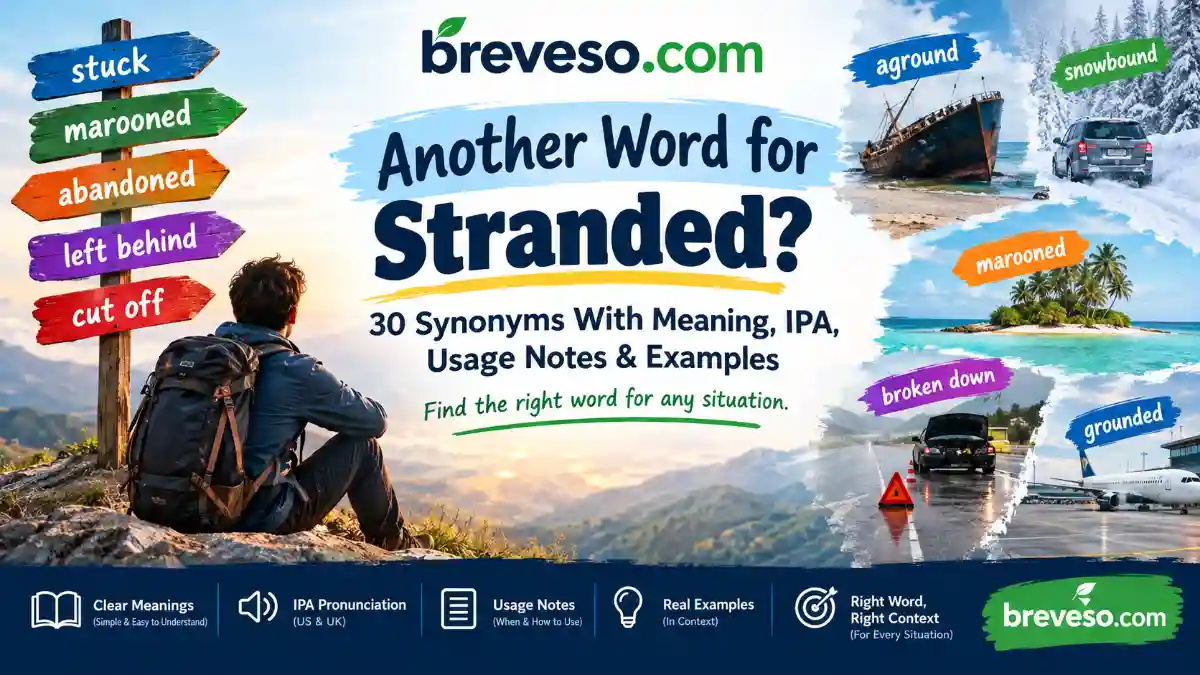
If you need another word for stranded, the closest everyday choices are stuck, marooned, abandoned, left behind, and cut off. Each one shows a different side of the situation. Stuck stresses that you cannot move. Marooned stresses isolation in a remote place. Abandoned and left behind stress that someone else walked away.
The best word depends on context. A ship on a beach sits aground. A traveler in a storm turns snowbound or grounded. A person without help feels helpless or in the lurch. This article covers travel and weather, sea and shore, isolation, and figurative use.
Quick list: stuck, marooned, abandoned, left behind, cut off, helpless, isolated, aground, snowbound, high and dry
Below, you will find 30 alternatives with meanings, IPA, usage notes, examples, and context. Later sections cover word partners, idioms, word history, and common mistakes.
At a Glance: Stranded Synonyms and Related Alternatives
| Alternative | Part of Speech | Meaning | Register / Tone | Ideal Context |
| Stuck | adjective | unable to move or leave | Informal, neutral | Everyday situations, travel, traffic |
| Marooned | adjective | alone in a place you cannot leave | Neutral, slightly dramatic | Islands, floods, remote places |
| Abandoned | adjective | left by someone and given no help | Neutral, serious | People or animals without care |
| Left behind | adjective phrase | not taken along when others go | Neutral | Groups, trips, travel |
| Cut off | adjective phrase | separated from help, contact, or escape routes | Neutral | Floods, storms, war, bad signal |
| Aground | adjective / adverb | touching the bottom of shallow water | Technical | Boats and ships |
| Snowbound | adjective | trapped by heavy snow | Neutral | Winter travel, mountain towns |
| Helpless | adjective | unable to help yourself | Neutral, emotional | Emergencies, vulnerable people |
| High and dry | idiom | without help or resources | Informal | Money, jobs, plans |
| In the lurch | prepositional phrase | in a hard spot after someone fails you | Informal | Letting someone down |
Which Word Should You Use?
| If you want to… | Use | Why |
| Say someone cannot leave a place | stuck | It is the simplest and most common choice |
| Describe a person on an island or in a flood | marooned | It adds a sense of isolation |
| Say others chose to leave someone | abandoned or left behind | Both show that others walked away |
| Describe a ship in shallow water | aground | It is the exact nautical term |
| Describe winter travel trouble | snowbound | It names the cause |
| Describe a flight problem | grounded or delayed | Both fit airports and airlines |
| Say someone lost help or money suddenly | high and dry | It is a common figurative expression |
| Write in a formal or literary style | forsaken or bereft | They sound serious and old-fashioned |
Exploring the Multiple Meanings of “Stranded”
1. Left Aground on a Shore
- Meaning: Driven or left on a beach, shore, or shallow bottom.
- Explanation: This oldest sense applies to ships, whales, and fish. It means physically beached, not only stuck.
- Example: The falling tide left the whale stranded on the sand.
2. Left Helpless in a Place
- Meaning: Unable to leave a place or get help.
- Explanation: This sense dominates modern English. It covers travelers, drivers, and hikers. Weather, a broken vehicle, or a canceled flight can cause it.
- Example: The storm stranded thousands of passengers at the airport.
3. Left Without Resources
- Meaning: Without money, support, or a way forward.
- Explanation: Writers use this figurative sense when someone lacks help. The person may not sit in any physical place at all.
- Example: She arrived in a new city with no money and no friends, completely stranded.
4. Cut Off From Value or Use
- Meaning: Unable to keep its expected value or use.
- Explanation: This sense appears in business and energy. The term “stranded assets” covers assets that lose value much earlier than expected.
- Example: Analysts warn that some coal plants could become stranded assets.
5. Made of Strands
- Meaning: Formed from threads or fibers twisted together.
- Explanation: This sense comes from a different noun, strand, meaning a thread. It usually appears in compounds such as “three-stranded rope” or “single-stranded DNA.” It has no link to being stuck.
- Example: The bracelet used a thick, multi-stranded cord.
Sources: Dictionary.com; Etymonline
Analyzing 30 Stranded Alternatives in Detail
Some alternatives below work as close synonyms, while others fit only certain situations. Each Usage note says which is which.
Core Everyday Alternatives
1. Stuck
IPA: /stʌk/ (US and UK)
Definition: Unable to move, go forward, or leave a place.
- Usage: The closest everyday synonym. It sounds informal and works for cars, people, and situations. It does not always suggest danger or isolation.
- Example: We stayed stuck at the station for four hours.
2. Left behind
IPA: /ˌlɛft bɪˈhaɪnd/ (US and UK)
Definition: Not taken along when others leave.
- Usage: A close synonym when others have departed. It does not always mean the person has no help, only that the group moved on.
- Example: The bus pulled away and left two tourists behind.
3. Abandoned
IPA: /əˈbændənd/ (US and UK)
Definition: Left completely, especially by someone responsible for you.
- Usage: A close synonym when someone chose to leave. It sounds stronger and more emotional than “left behind.”
- Example: The abandoned travelers waited by the road for help.
4. Helpless
IPA: /ˈhɛlpləs/ (US and UK)
Definition: Unable to help yourself.
- Usage: A related alternative. It describes the person’s condition, not the place or the cause. It does not say why they cannot act.
- Example: Without a phone, he felt helpless on the empty mountain road.
5. Cut off
IPA: US /ˌkʌt ˈɔf/ · UK /ˌkʌt ˈɒf/
Definition: Separated from other places, people, or sources of help.
- Usage: A close synonym when roads, signals, or supplies stop working. It can also describe lost contact.
- Example: The flood cut the village off for three days.
Isolation and Abandonment
6. Marooned
IPA: /məˈruːnd/ (US and UK)
Definition: Left alone in a place that is hard or impossible to leave, often an island.
- Usage: A close synonym with a stronger sense of isolation. It also fits floods, snow, and remote places.
- Example: The shipwreck left the sailors marooned on a small island for a week.
7. Isolated
IPA: /ˈaɪsəleɪtɪd/ (US and UK)
Definition: Far from other people or places, or set apart.
- Usage: A related alternative. “Isolated” describes distance or separation, not an inability to leave. A person can live in an isolated house without being stranded.
- Example: The storm left the isolated farm without power.
8. Deserted
IPA: US /dɪˈzɜrtɪd/ · UK /dɪˈzɜːtɪd/
Definition: Empty, or left by the people who lived or stayed there.
- Usage: A related alternative. It usually describes a place, such as a deserted island, but it can also describe a person left alone. It does not mean unable to leave.
- Example: The travelers found themselves on a deserted road at midnight.
9. Castaway
IPA: US /ˈkæstəweɪ/ · UK /ˈkɑːstəweɪ/
Definition: A person who has survived a shipwreck and landed somewhere with no way out.
- Usage: A related alternative, and mostly a noun. It names the person, not the state. It fits sea stories and survival tales.
- Example: The castaway lived on the island for two years before a ship found him.
Sea and Shore
10. Aground
IPA: /əˈɡraʊnd/ (US and UK)
Definition: Touching the bottom in shallow water, so a ship cannot move.
- Usage: A close synonym for ships only. It gives the exact term for the original sense of stranded.
- Example: The cargo ship ran aground near the harbor.
11. Beached
IPA: /biːtʃt/ (US and UK)
Definition: Driven or pulled up onto a beach.
- Usage: A close synonym for boats and sea animals. Sailors sometimes beach a small boat on purpose, so the word does not always mean trouble.
- Example: Workers found a beached whale on the shore this morning.
12. Shipwrecked
IPA: /ˈʃɪprɛkt/ (US and UK)
Definition: Left in a place after a ship sank or broke apart.
- Usage: A related alternative. It names a specific cause, a wrecked ship, so it covers less ground than “stranded.”
- Example: The shipwrecked crew reached the rocks at dawn.
13. Adrift
IPA: /əˈdrɪft/ (US and UK)
Definition: Floating without control, or without direction.
- Usage: A related alternative. It fits boats with no power and also describes people without a plan. It stresses drifting, not staying in one place.
- Example: After the engine failed, the small boat floated adrift for hours.
14. Icebound
IPA: /ˈaɪsbaʊnd/ (US and UK)
Definition: Trapped or blocked by ice.
- Usage: A related alternative for ships, ports, and travelers in freezing weather. It names the cause, ice, so it fits fewer situations than “stranded.”
- Example: The icebound ship waited until spring to move.
Weather and Travel
15. Snowbound
IPA: US /ˈsnoʊbaʊnd/ · UK /ˈsnəʊbaʊnd/
Definition: Trapped or blocked by heavy snow.
- Usage: A related alternative. It names the cause, which makes it clearer than “stranded” in winter stories.
- Example: We stayed snowbound in the cabin for two days.
16. Grounded
IPA: /ˈɡraʊndɪd/ (US and UK)
Definition: Not allowed or not able to fly.
- Usage: A related alternative for aircraft and their passengers. It names a stop in the air travel system, not a general state of being stuck.
- Example: Fog grounded every flight, and the passengers waited in the terminal.
17. Delayed
IPA: /dɪˈleɪd/ (US and UK)
Definition: Made late, or kept from leaving on time.
- Usage: A related alternative, and weaker than “stranded.” A delayed traveler may arrive late without ever facing real trouble.
- Example: The delayed passengers waited at the gate.
18. Broken down
IPA: US /ˌbroʊkən ˈdaʊn/ · UK /ˌbrəʊkən ˈdaʊn/
Definition: Not working, especially of a car or machine.
- Usage: A related alternative. It describes the vehicle, not the person. It explains why a driver ends up stranded.
- Example: Our broken-down car sat on the highway until a tow truck came.
19. Immobilized
IPA: US /ɪˈmoʊbəlaɪzd/ · UK /ɪˈməʊbɪlaɪzd/
Definition: Unable to move or to move something.
- Usage: A related and more formal alternative. It fits people, vehicles, and equipment. British spelling often uses “immobilised.”
- Example: Heavy snow immobilized hundreds of vehicles.
Figurative and Informal Alternatives
20. High and dry
IPA: /ˌhaɪ ən ˈdraɪ/ (US and UK)
Definition: Without help, money, or support.
- Usage: A close figurative synonym. The phrase comes from a ship left on dry land. It sounds informal and often appears as “left high and dry.”
- Example: When the company closed, it left its workers high and dry.
21. In the lurch
IPA: US /ɪn ðə ˈlɜrtʃ/ · UK /ɪn ðə ˈlɜːtʃ/
Definition: In a hard situation after someone fails to help.
- Usage: A related figurative alternative. It almost always appears in the phrase “leave someone in the lurch.” It stresses the let-down, not a physical trap.
- Example: She left her partner in the lurch just before the deadline.
22. In limbo
IPA: US /ɪn ˈlɪmboʊ/ · UK /ɪn ˈlɪmbəʊ/
Definition: In an uncertain state, waiting for a decision.
- Usage: A related figurative alternative. It describes waiting with no clear answer, not being alone or helpless.
- Example: The refugees waited in limbo while officials checked their papers.
23. Bogged down
IPA: US /ˌbɑɡd ˈdaʊn/ · UK /ˌbɒɡd ˈdaʊn/
Definition: Unable to make progress because of a problem.
- Usage: A related alternative. It mostly fits work, plans, and talks. It does not suggest physical danger.
- Example: Arguments over the budget bogged the project down.
24. At a standstill
IPA: /æt ə ˈstændstɪl/ (US and UK)
Definition: Not moving or making progress.
- Usage: A related alternative. It describes traffic, talks, or business. It does not say that anyone stays alone.
- Example: Traffic came to a standstill after the accident.
Formal, Literary, and Limited-Fit Alternatives
25. Forsaken
IPA: US /fɚˈseɪkən/ · UK /fəˈseɪkən/
Definition: Abandoned completely, especially in a sad or serious way.
- Usage: A literary alternative. It sounds older and more emotional than “abandoned.”
- Example: The forsaken village stood silent after the flood.
26. Bereft
IPA: /bɪˈrɛft/ (US and UK)
Definition: Deprived of something, or without it.
- Usage: A formal and related alternative. It stresses the loss of something such as hope, money, or help, so it fits only the figurative sense.
- Example: The travelers sat bereft of food and water.
27. Friendless
IPA: /ˈfrɛndləs/ (US and UK)
Definition: Having no friends or people to help.
- Usage: A related alternative. It describes a lack of support, not a place or a trap.
- Example: He arrived in the city friendless and without a plan.
28. Derelict
IPA: /ˈdɛrəlɪkt/ (US and UK)
Definition: Empty and in poor condition, as a building or a ship.
- Usage: A related alternative for places and ships, not people. A derelict ship has no crew and no owner who cares for it.
- Example: The derelict boat drifted for months before a crew found it.
29. Stalled
IPA: /stɔːld/ (US and UK)
Definition: Stopped moving or working, especially suddenly.
- Usage: A related alternative. It fits engines, cars, and plans. It describes the stop, not the person left behind.
- Example: Their stalled car blocked the road.
30. Destitute
IPA: US /ˈdɛstɪtuːt/ · UK /ˈdɛstɪtjuːt/
Definition: Without money, food, or shelter.
- Usage: A related alternative, and much stronger. It describes severe poverty, not just a lack of transport. Use it only when the loss of basic needs matters most.
- Example: The storm left many families destitute.
Sources: Dictionary.com; Etymonline
Stranded vs. Marooned vs. Castaway vs. Shipwrecked
These four words often appear in survival stories, but they differ in focus.
| Word | What it means | Usually used for |
| Stranded | Left in a place with no easy way out or no help | Travelers, ships, animals, general use |
| Marooned | Left alone in an isolated place | Islands, floods, remote areas |
| Castaway | A person who lands on a shore after a shipwreck | Sea stories, survival tales |
| Shipwrecked | Left after a ship sank or broke apart | Sailors and passengers |
“Stranded” is the broadest word. “Marooned” adds isolation, “castaway” names the person, and “shipwrecked” names the cause.
Sources: Dictionary.com
Stranded and Opposite/Paired Word Pairs
| Word | Paired Word | Note |
| Stranded | Rescued | The most natural contrast; rescuers find and help the person |
| Stranded | Freed | Fits cases where someone clears snow, ice, or another block |
| Aground | Afloat | The ship returns to the water |
| Cut off | Connected | Contact or access returns |
| Left behind | Taken along | Shows who goes and who stays |
| Stranded | Safe | A general contrast of condition |
English has no single exact opposite of “stranded.” The best contrast depends on what ends the problem: a rescue for a person, a thaw for a snowy road, or a high tide for a ship.
Sources: Dictionary.com
Common Word Partners of “Stranded”
| Pattern | Common Partners | Example |
| stranded + noun | passengers, motorists, travelers, tourists, hikers, whale | Stranded motorists waited for help. |
| be / get / become + stranded | be stranded, get stranded | Drivers often end up stranded in heavy snow. |
| leave + someone + stranded | left stranded | The strike left thousands stranded. |
| stranded + preposition | at the airport, on an island, in a foreign country | Several tourists spent the night stranded at the airport. |
| stranded + without | without money, without a car, without help | Without a phone, she sat stranded on the roadside. |
| stranded + adverb | overnight, abroad | Rain kept the group stranded overnight. |
Sources: Dictionary.com
Idiomatic Phrases Featuring “Stranded”
“Stranded” appears in few true idioms. The best-known idiom for the same idea uses “high and dry.” The items below include one established expression, one established term, and one familiar fixed phrase, and each carries the right label.
1. Left stranded
- Meaning: An established expression meaning to leave someone in a place with no way out or no help.
- Example: The bus broke down and left us stranded for hours.
2. Stranded assets
- Meaning: An established term in business and energy for assets that lose value much earlier than expected. It works as a technical term, not an idiom.
- Example: Investors worry that some oil reserves could turn into stranded assets.
3. Stranded on a desert island
- Meaning: A familiar fixed phrase for total isolation. People use it in games and hypothetical questions, not as an idiom.
- Example: Which book would you bring if you ended up stranded on a desert island?
Sources: Dictionary.com
Word Formation of “Stranded”
Etymology & Structure
“Stranded” comes from the verb strand plus the ending -ed. The verb grows out of the noun strand, meaning “shore” or “beach.” That noun comes from Old English strand and Proto-Germanic *strandaz. Its deeper origin remains uncertain, though it may connect to a root meaning “to stretch out.” A separate noun strand, meaning a single thread or fiber, has a different origin.
Date and History
Old English already had the noun strand for “shore,” before the year 1000. The verb meaning “to drive aground on a sea-shore” appears in the 1620s. The figurative sense of leaving someone helpless developed later from that original meaning.
Word Class Variations
- Verb: strand, strands, stranded, stranding
- Adjective: stranded (a stranded car)
- Noun: stranding (the act or event, as in whale strandings)
- Related noun: strand (shore, or a thread)
Sources: Etymonline; Dictionary.com
Common Word-Choice Mistakes
- “I stranded at the airport”: say “The storm stranded me at the airport.”
- “Stranded to the island”: say “stranded on the island.” Use on for islands and at for airports and stations.
- “A strand of passengers”: say “a group of stranded passengers.” A strand means a thread.
- “My muscle stranded”: say “I strained my muscle.” The two words look alike but have no link.
- “Traffic marooned us”: say “We sat stuck in traffic.” “Marooned” suggests isolation, not a traffic jam.
- “A car breakdown made him a castaway”: say “He sat stranded after his car broke down.” “Castaway” suggests a shipwreck.
- “The airline abandoned my flight”: say “The airline canceled my flight.” “Abandoned” suggests leaving someone, not canceling a plan.
Frequently Asked Questions
What is the closest synonym for stranded?
“Stuck” is the closest everyday synonym. “Marooned” comes closer when the place feels remote or isolated.
What is a formal alternative to stranded?
“Immobilized” works as a formal choice for vehicles and people. “Bereft” works as a formal choice for figurative use.
What is a literary alternative?
“Forsaken” and “castaway” both suit stories and older-style writing.
What is the difference between stranded and marooned?
“Stranded” is broad and can happen anywhere. “Marooned” suggests isolation in a remote place.
Is stranded the same as lost?
No. A lost person does not know where they are. A stranded person may know exactly where they are but cannot leave.
Can stranded describe animals?
Yes. People use it for whales, fish, and other sea animals that the tide leaves on a shore.
Can stranded describe money problems?
Yes. “Stranded without money” is a normal figurative use. “High and dry” sounds stronger and more informal.
What is the opposite of stranded?
No single exact opposite exists. “Rescued” is the most natural, and “freed” or “afloat” fit specific situations.
Does stranded always refer to a physical place?
No. It can also describe a lack of help, support, or resources, and it appears in business as “stranded assets.”
What is the difference between stranded and grounded?
“Grounded” mostly describes aircraft and the passengers who cannot fly. “Stranded” is broader and covers any person or vehicle that cannot leave.
Conclusion
The closest everyday alternatives to “stranded” are “stuck,” “marooned,” “abandoned,” “left behind,” and “cut off.” Each one captures a different part of the idea. Some stress an inability to move, while others stress isolation or someone else’s choice to leave.
Context matters most. “Aground” and “beached” belong to ships and sea animals. “Snowbound” and “grounded” belong to weather and travel. “High and dry” and “in the lurch” suit figurative situations. “Castaway,” “forsaken,” and “bereft” sound more literary or formal.
To choose the right word, first ask what caused the situation, then decide if it is physical or figurative, and finally think about the tone you want. “Stuck” works as a safe general choice, and a more specific word can make your meaning clearer.

Ali Sultan is a writer and editor at Breveso.com, where he covers synonyms for emotions, everyday speech, and modern slang. He has spent years playing with words, first as an English literature student and later as a content editor. Ali believes no one should get stuck on a single word. His guides break synonyms down by tone and situation, so readers can pick the word that fits, not just the first one they find. He is currently building out Breveso’s collections on feelings, actions, and casual speech. His rule is simple: if a guide does not help a real person write a better sentence, it does not get published.