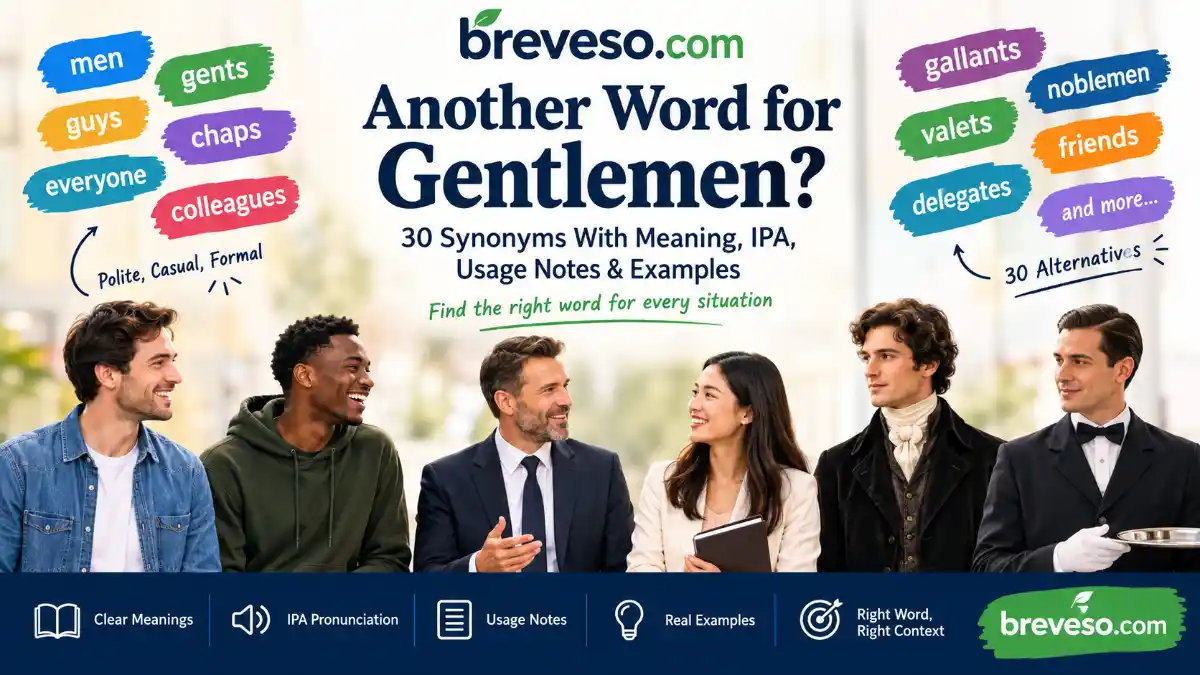
The simplest another word for “gentlemen” is men. In casual speech, gents, guys, and chaps work well. When you speak to a mixed group, everyone or friends is often a safer choice, because “gentlemen” leaves out women and people who are neither. If you mean well-mannered men, gallants is a literary option.
The best word depends on what “gentlemen” means in your sentence. It can be a polite word for men, a way to address a group, a label for men of good manners or high birth, or an old word for a male servant. This article covers each of those areas.
Quick list: men, gents, sirs, guys, chaps, everyone, colleagues, gallants, noblemen
Below are 30 alternatives with meanings, IPA, usage notes, examples, and context. Some are close synonyms, and others only fit one sense of “gentlemen.”
At a Glance: Gentlemen Synonyms and Related Alternatives
| Alternative | Part of Speech | Meaning | Register / Tone | Ideal Context |
| men | noun | adult male people | Neutral | Everyday speech and writing |
| gents | noun | short, friendly form of “gentlemen” | Informal | Talking to a group of men, especially in British English |
| sirs | noun | polite address for men | Formal, courteous | Service settings, formal speech |
| guys | noun | men, or a mixed group in US speech | Very informal | Talking with friends |
| chaps | noun | men, in a friendly way | Informal, British | Casual British speech and writing |
| everyone | pronoun | all the people present | Neutral | Addressing mixed or unknown groups |
| colleagues | noun | people you work with | Formal, professional | Meetings and workplace speeches |
| gallants | noun | brave, stylish, or very polite men | Literary, dated | Historical or romantic writing |
| noblemen | noun | men of high birth with a title | Formal, historical | History and fiction |
| valets | noun | male personal servants | Formal, dated | Describing household service |
Which Word Should You Use?
| If you want to… | Use | Why |
| Speak to a group of men in plain language | men | It is neutral and fits almost any setting. |
| Chat with male friends | guys, gents | Both sound relaxed and friendly. |
| Sound British and casual | chaps, blokes | These are common in British speech. |
| Address a mixed or unknown audience | everyone, friends | They include all listeners. |
| Address a professional group | colleagues, members, delegates | They name the group’s role. |
| Praise men for good manners in a literary way | gallants | It suggests courtesy and style. |
| Write about upper-class men in history | noblemen, gentry, squires | They show rank and status. |
| Write about a male household servant | valets, manservants | They match the old “gentleman’s gentleman” sense. |
Exploring the Multiple Meanings of “Gentlemen”
“Gentlemen” is the plural of “gentleman.” Here are its main senses.
1. A Polite Word for Men
- Meaning: Men, said in a courteous way.
- Explanation: In this sense, “gentleman” is a polite reference to a man of any social class. Dictionaries list it as a courteous way to refer to a man, and it says nothing about his manners or rank.
- Example: Please show these gentlemen to their seats.
2. A Form of Address
- Meaning: A word used to speak to a group of men.
- Explanation: The plural is often used to address an audience, traditionally alongside “ladies.” Today many speakers prefer words like “everyone” for mixed groups, since “gentlemen” names only men.
- Example: Gentlemen, please come this way.
3. Well-Mannered, Honorable Men
- Meaning: Men who are polite, fair, and respectful.
- Explanation: This is the “character” sense. A man is called a gentleman because of how he acts, whatever his background.
- Example: The two players shook hands like true gentlemen after the match.
4. Men of Good Birth or Social Position
- Meaning: Men from respected families or a high social class.
- Explanation: This is the older sense. In British history, it often meant men ranked above common farmers, sometimes including nobles. It could also mean men of independent means who did not work for pay.
- Example: In the 1700s, many gentlemen lived on income from their family land.
5. Male Personal Servants
- Meaning: Men who served another man of rank, also called valets.
- Explanation: This sense survives mainly in the phrase “gentleman’s gentleman.” It is rare in modern speech, but you may meet it in older books.
- Example: The lord’s gentleman laid out his evening clothes.
Sources: Merriam-Webster; Dictionary.com (Collins English Dictionary); Webster’s Revised Unabridged Dictionary (1913); Etymonline.
Analyzing 30 Gentlemen Alternatives in Detail
Some of these words are close synonyms, and others are related alternatives that fit only one sense of “gentlemen.” The Usage note for each word says which is which.
Everyday and Casual Alternatives
Plain and Polite Words
1. Men
IPA: /men/ (US and UK)
Definition: Adult male people.
- Usage: This is the closest plain synonym for the “polite word for men” sense. It is neutral, so it lacks the courtesy of “gentlemen” but is never rude.
- Example: The men at the front of the line moved aside to let the family pass.
2. Gents
IPA: /dʒents/ (US and UK)
Definition: An informal short form of “gentlemen.”
- Usage: This is a direct, informal synonym. It is friendly and common in British English. Avoid it in formal writing.
- Example: Evening, gents. What can I get you?
3. Sirs
IPA: US /sɝːz/ · UK /sɜːz/
Definition: A polite way to address more than one man.
- Usage: This is a related alternative for the “form of address” sense only. It sounds respectful and fits shops, restaurants, and formal speech. It does not describe a man’s manners.
- Example: Right this way, sirs. Your table is ready.
4. Fellows
IPA: US /ˈfeloʊz/ · UK /ˈfeləʊz/
Definition: Men, said in a friendly or slightly old-fashioned way.
- Usage: This is a loose synonym for “men.” The word has other meanings, such as members of a college or society, so context matters.
- Example: The fellows at the club welcomed the new member warmly.
Casual American Words
5. Guys
IPA: /ɡaɪz/ (US and UK)
Definition: Informal word for men; in American speech, sometimes for a mixed group.
- Usage: This is an informal, related alternative. It is not as polite as “gentlemen,” and in casual US English it can include women.
- Example: Hey, guys, dinner is ready.
6. Dudes
IPA: US /duːdz/ · UK /djuːdz/
Definition: Men, in American slang.
- Usage: This is a very casual, related alternative. Use it only with friends, never in polite or formal settings.
- Example: Dudes, you have to see this.
Casual British Words
7. Chaps
IPA: /tʃæps/ (US and UK)
Definition: Men, in a friendly, informal way.
- Usage: This is a British-flavored synonym for “men” with a warm tone. It sounds a little traditional.
- Example: The chaps at the office planned a surprise for the boss.
8. Blokes
IPA: US /bloʊks/ · UK /bləʊks/
Definition: Men, in informal British or Australian English.
- Usage: This is a casual synonym for “men.” Do not use it in formal speech.
- Example: A few blokes from work are coming to the match.
9. Lads
IPA: /lædz/ (US and UK)
Definition: Boys or young men, in informal British or Irish English.
- Usage: This is a related alternative, not an exact synonym, because it points to younger males. It is friendly and warm.
- Example: Come on, lads, one more game before dark.
Gender-Neutral and Formal Forms of Address
Warm and Friendly Words
10. Everyone
IPA: /ˈevriwʌn/ (US and UK)
Definition: Every person in a group.
- Usage: This is a related alternative for the “form of address” sense. It works for mixed audiences because it includes all listeners.
- Example: Good evening, everyone, and thank you for coming.
11. Folks
IPA: US /foʊks/ · UK /fəʊks/
Definition: People, in a warm, informal way.
- Usage: This is a related alternative. It is friendly and works for any audience, but it is too casual for very formal events.
- Example: Welcome back, folks. Let’s get started.
12. Friends
IPA: /frendz/ (US and UK)
Definition: People you know well, or a warm word for an audience.
- Usage: This is a related alternative used by speakers to address a group kindly. It suits speeches and community events.
- Example: Friends, thank you for being here tonight.
13. Guests
IPA: /ɡests/ (US and UK)
Definition: People invited to an event or staying as visitors.
- Usage: This is a related alternative. It works when you address people at a party, hotel, or ceremony.
- Example: Dear guests, dinner will be served at eight.
Professional and Formal Words
14. Colleagues
IPA: US /ˈkɑːliːɡz/ · UK /ˈkɒliːɡz/
Definition: People who work with you or in the same profession.
- Usage: This is a related alternative for professional settings. It names the group by role and not by gender.
- Example: Colleagues, let’s review this quarter’s numbers.
15. Members
IPA: US /ˈmembərz/ · UK /ˈmembəz/
Definition: People who belong to a group, club, or organization.
- Usage: This is a related alternative for formal addresses to a club, board, or society.
- Example: Members are asked to take their seats before the vote.
16. Delegates
IPA: /ˈdelɪɡəts/ (US and UK)
Definition: People chosen to speak or vote for a group at a meeting.
- Usage: This is a related alternative for conferences and councils. It tells the listener why the people are present.
- Example: Delegates will now vote on the first proposal.
Chivalrous and Literary Alternatives
17. Gallants
IPA: /ˈɡælənts/ (US and UK)
Definition: Brave, stylish men, or men who are very polite to women.
- Usage: This is a literary, dated alternative that matches the “well-mannered” sense. You will mostly find it in historical or romantic writing.
- Example: The young gallants bowed as the queen entered the hall.
18. Cavaliers
IPA: US /ˌkævəˈlɪrz/ · UK /ˌkævəˈlɪəz/
Definition: Gallant, courteous men, especially toward women; also, in history, horse soldiers.
- Usage: This is a related, literary alternative. Be careful: the adjective “cavalier” can mean careless or rude, which is the opposite of what you want.
- Example: In the old story, the cavaliers rode out to protect the village.
19. Knights
IPA: /naɪts/ (US and UK)
Definition: Men honored with a rank of knighthood; figuratively, brave and honorable men.
- Usage: This is a figurative, related alternative. It praises courage and good conduct. It is not a direct synonym.
- Example: The drivers who stopped to help in the rain were real knights.
Upper-Class and Noble Alternatives
Titled Ranks
20. Noblemen
IPA: US /ˈnoʊbəlmən/ · UK /ˈnəʊbəlmən/
Definition: Men of high birth who hold a noble title.
- Usage: This is a related alternative for the “good birth” sense. It is narrower than “gentlemen,” which can include men without titles.
- Example: Noblemen from across the country gathered at the king’s court.
21. Aristocrats
IPA: US /əˈrɪstəˌkræts/ · UK /ˈærɪstəkræts/
Definition: Members of the highest social class.
- Usage: This is a related alternative. It is not limited to men, and it often points to wealth and inherited rank.
- Example: The aristocrats of the region held their parties in grand country houses.
22. Lords
IPA: US /lɔːrdz/ · UK /lɔːdz/
Definition: Men of noble rank, especially in Britain.
- Usage: This is a related alternative tied to titles and rank. It is narrower than “gentlemen.”
- Example: The lords gathered in the great hall to hear the news.
23. Peers
IPA: US /pɪrz/ · UK /pɪəz/
Definition: Members of the British nobility who hold titles.
- Usage: This is a related alternative for the noble sense only. The word also means “people of equal standing,” which is a different meaning.
- Example: Peers of the realm were invited to the ceremony.
Social Class
24. Patricians
IPA: /pəˈtrɪʃənz/ (US and UK)
Definition: Members of the upper class, especially in ancient Rome.
- Usage: This is a formal, historical, related alternative. Use it in writing about the past or in a polished, literary style.
- Example: Roman patricians often lived in large, richly decorated homes.
25. Gentry
IPA: /ˈdʒentri/ (US and UK)
Definition: People of good social position, especially in British history, ranking just below the nobility.
- Usage: This is a collective noun, so it names a class and not individual men. It is closely tied to the old “good birth” sense of “gentleman.”
- Example: The local gentry hosted the autumn ball.
26. Gentlefolk
IPA: US /ˈdʒentlfoʊk/ · UK /ˈdʒentlfəʊk/
Definition: People of good birth and manners; a dated word.
- Usage: This is a related, old-fashioned alternative. It includes women as well as men.
- Example: The inn was a favorite stop for gentlefolk traveling to the city.
Landed and Courtesy Ranks
27. Squires
IPA: US /ˈskwaɪərz/ · UK /ˈskwaɪəz/
Definition: Landowners in the English countryside; also, young men who served knights.
- Usage: This is a related, historical alternative. It points to land and local standing, which many “gentlemen” had in the past.
- Example: The squires of the county met each month to discuss local matters.
28. Esquires
IPA: US /ˈeskwaɪərz/ · UK /ɪˈskwaɪəz/
Definition: Men ranked just below knights in older English society; also a courtesy title after a name.
- Usage: This is a related, formal, dated alternative. In the US, “Esq.” is also used after the names of lawyers.
- Example: The letter was addressed to two esquires of the county.
Servant Alternatives
29. Valets
IPA: /ˈvæleɪz/ (US and UK)
Definition: Male personal servants who care for a man’s clothes and daily needs.
- Usage: This is the closest match for the “gentleman’s gentleman” sense. It has nothing to do with manners or rank, so do not use it for the other senses.
- Example: Two valets carried the trunks up the stairs.
30. Manservants
IPA: US /ˈmænsɜːrvənts/ · UK /ˈmænsɜːvənts/
Definition: Male household servants.
- Usage: This is a dated, related alternative for the servant sense. You will mostly find it in older books and period stories.
- Example: The manor employed several manservants to run the household.
Sources: Merriam-Webster; Dictionary.com (Collins English Dictionary); Etymonline; Webster’s Revised Unabridged Dictionary (1913).
Gentleman, Gent, and Gentlemanly: What’s the Difference?
These words share a root, but they work differently.
| Word | Part of Speech | Meaning | Tone |
| gentleman | noun | a polite word for a man; a well-mannered man; a man of good birth | Polite to formal |
| gentlemen | noun (plural) | more than one gentleman; also used to address a group of men | Polite to formal |
| gent | noun | informal short form of “gentleman” | Casual, friendly |
| gentlemanly | adjective | acting the way a gentleman acts | Neutral to polite |
Dictionary.com records “gent” as a shortened form that first appeared in the 1500s. The adjective “gentlemanly” describes behavior, so “He was gentlemanly about losing” makes sense, while “the gentlemanly” does not stand alone as a noun.
Sources: Merriam-Webster; Dictionary.com (Collins English Dictionary).
Gentlemen and Opposite/Paired Word Pairs
| Word | Paired Word | Note |
| gentlemen | ladies | The traditional pair in older greetings. |
| gentleman | lady | The matching polite word for a woman. |
| gentleman | boor | A boor is a rude, badly mannered person. |
| gentleman | cad | A dated word for a man who treats others, especially women, badly. |
| gentleman | yeoman | In older English society, a gentleman ranked above a yeoman. |
| gentleman | commoner | In the social-rank sense, a gentleman is not a common man. |
“Gentleman” has no single perfect opposite, because its meanings are so different. For manners, “boor” and “cad” work best. For rank, the contrast is with common people. In modern speech, the most common pair is “ladies” and “gentlemen,” though many speakers now choose neutral words for mixed groups.
Sources: Merriam-Webster; Dictionary.com (Collins English Dictionary); Webster’s Revised Unabridged Dictionary (1913).
Common Word Partners of “Gentlemen”
| Pattern | Common Partners | Example |
| adjective + gentleman | perfect, true, young, older, fine | He was a perfect gentleman all evening. |
| gentleman + noun | farmer, caller, usher | A gentleman farmer rarely does the hard work himself. |
| possessive + noun | gentleman’s agreement, gentleman’s club, gentleman’s gentleman | They sealed the deal with a gentleman’s agreement. |
| verb + like a gentleman | act, behave | Please behave like a gentleman. |
| address pattern | gentlemen of the jury, gentlemen, please | Gentlemen of the jury, you have heard the facts. |
| the gentleman from + place | the gentleman from Ohio | The chair recognizes the gentleman from Ohio. |
The last pattern comes from formal debate, where speakers refer to each other politely by place.
Sources: Merriam-Webster; Dictionary.com (Collins English Dictionary); Webster’s Revised Unabridged Dictionary (1913); Etymonline.
Idiomatic Phrases Featuring “Gentlemen”
Most of these are established expressions rather than true idioms, because their meanings are fairly clear from the words.
1. Gentlemen’s agreement
- Meaning: A deal based on trust and honor and not on a written contract.
- Example: The two owners made a gentlemen’s agreement to share the land.
2. Gentlemen of leisure
- Meaning: Men who do not need to work for a living, sometimes said with humor for men who are not working.
- Example: Now that they’ve retired, the brothers call themselves gentlemen of leisure.
3. Gentlemen farmers
- Meaning: Wealthy men who run farms but do little of the labor themselves.
- Example: The hills around the town were dotted with gentlemen farmers and their horses.
4. Gentleman’s gentleman
- Meaning: A male personal servant, or valet, who serves a man of rank.
- Example: In the old novel, the lord’s gentleman’s gentleman role was played by a quiet, careful man named Barnes.
Sources: Merriam-Webster; Etymonline.
Word Formation of “Gentlemen”
Etymology & Structure
“Gentleman” is a compound of “gentle” and “man.” Here, “gentle” carries its old sense of “well-born.” It comes from Old French, and behind that from Latin words linked to clan and family birth. English likely modeled the word on the Old French “gentilhomme.” The plural, “gentlemen,” follows the irregular plural of “man.”
Date and History
Etymonline dates the word to about 1200, possibly the mid-1100s, and Merriam-Webster places its first known use in the 12th century. At first it meant a man of good birth. Over time it grew to describe any man with good manners, honor, and kindness. In courteous speech it came to refer to any man, whatever his class. The phrase “gentleman farmer” is recorded from 1749, and “gentleman’s agreement” from 1929.
Word Class Variations
- Noun: gentleman (singular), gentlemen (plural)
- Informal noun: gent, gents
- Adjective: gentlemanly, gentlemanlike
- Noun (related): gentlemanliness
- Possessive: gentleman’s, gentlemen’s
Sources: Etymonline; Merriam-Webster; Dictionary.com (Collins English Dictionary).
Common Word-Choice Mistakes
- “This gentlemen is waiting”: use “this gentleman” for one man.
- “The two gentlemans arrived”: the plural is “gentlemen.”
- “The gentlemens’ agreement”: write “gentlemen’s agreement,” because the plural already ends without “s.”
- “Gentlemen, welcome” to a mixed audience: use “everyone” or “friends” so no one is left out.
- “Gents, please welcome our speaker” at a formal event: use “Gentlemen” or “Everyone.”
- “Dear Sirs” in a letter to an unknown audience: many writers now choose a more inclusive greeting.
- “He acted like a gentleman when he shouted at the staff”: use “bully” or “boor,” because “gentleman” points to good manners.
Frequently Asked Questions
What is the closest synonym for gentlemen?
For the plain meaning, “men” is closest. For an informal tone, “gents” is the nearest match.
What can I say for a mixed audience instead of “gentlemen”?
“Everyone,” “friends,” “honored guests,” and “colleagues” work well. They include all listeners and still sound polite.
Is “gents” rude?
No. It is a friendly, informal form of “gentlemen,” and it is common in British speech.
What is the difference between gentleman and gent?
“Gentleman” is the standard, polite word. “Gent” is its informal short form and is best kept for casual speech.
What is a formal alternative to gentlemen?
“Colleagues,” “members,” and “delegates” are formal ways to address a professional group.
What is a literary alternative?
“Gallants” and “cavaliers” suit historical or romantic writing. Both feel dated in everyday speech.
What is the opposite of a gentleman?
There is no single opposite. For manners, “boor” and “cad” are common contrasts.
Can “gentleman” mean a servant?
Yes, in the phrase “gentleman’s gentleman.” It means a male personal servant, or valet.
Does “gentleman” only mean a rich or high-born man?
Not anymore. The older sense did, but today it usually describes a polite man of any background.
Is “gentlemen” singular or plural?
It is plural. The singular is “gentleman.”
Conclusion
The closest everyday alternatives to “gentlemen” are “men,” “gents,” and “sirs.” For a mixed audience, “everyone” and “friends” are often better. For a professional group, “colleagues” is a strong choice.
Context matters because “gentlemen” has several senses. It can be a polite word for men, a form of address, a description of good manners, a sign of rank, or an old word for a servant. A word that fits one sense may sound wrong in another.
To choose well, first decide which sense you mean. Then think about tone: formal, friendly, or literary. If you are unsure, “men” is the safest plain choice.

Ali Bismal is the founder and writer behind Breveso.com, where he helps readers find the perfect synonym for every word. What started as a simple love for words turned into a growing library of “another word for ___” guides covering emotions, actions, slang, and everyday language.
Ali believes the right word can sharpen a sentence, and the wrong one can blur it. That is why every Breveso guide is written in plain, simple English, grouped in a way that actually makes sense, and checked for real-world use.
He writes for students, writers, and anyone who has ever stared at a sentence thinking there must be a better word for this. Clean, useful content that answers the question fast, that is the whole mission.