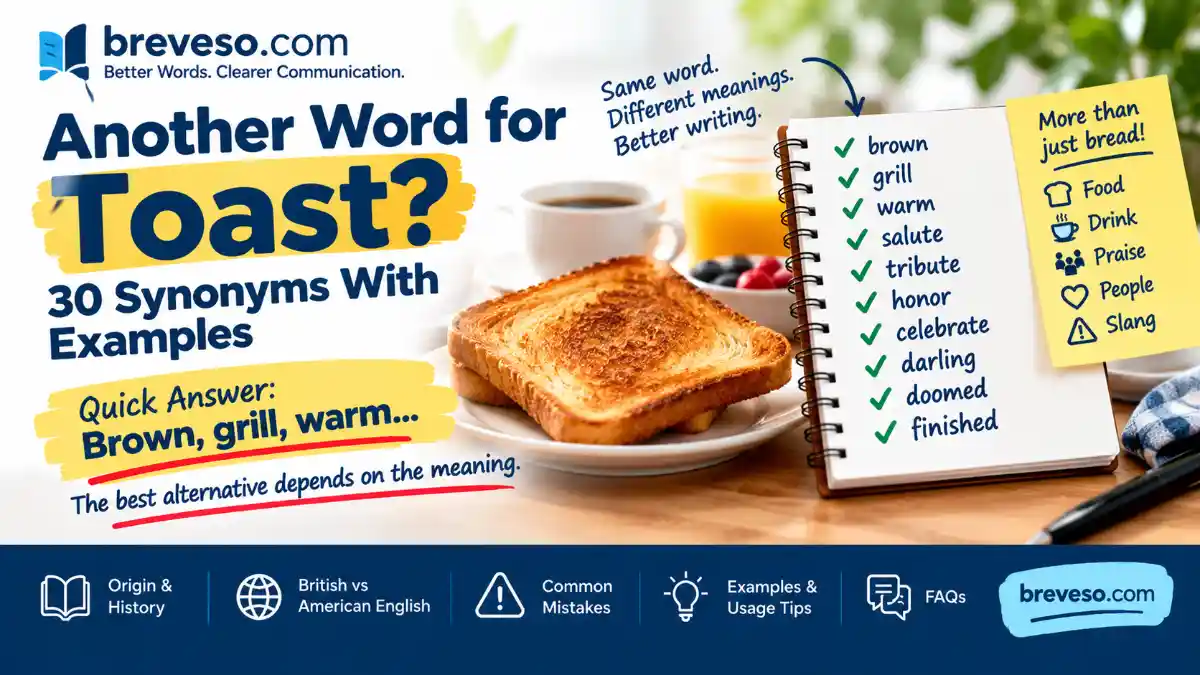
“Toast” has several unrelated meanings, so the best alternative depends on the sense. Browned bread or browning food calls for brown, grill, or crisp. If you mean warming yourself, warm works. A drink or speech honoring someone fits salute, tribute, or honor, and a much-admired person can be a darling or a favorite. In slang (“we’re toast”), doomed or finished does the job.
Quick list: brown, grill, broil, warm, salute, tribute, honor, celebrate, darling, doomed
This article looks at 30 alternatives, each with a meaning, IPA, usage note, and example. Some are direct synonyms, while others are related words that fit only certain contexts.
At a Glance: Toast Synonyms and Related Alternatives
| Alternative | Part of Speech | Meaning | Register / Tone | Ideal Context |
| Brown | verb | to make food brown with heat | Neutral | Cooking |
| Grill | verb | to cook or brown over or under direct heat | Neutral | Bread, sandwiches, meat |
| Warm | verb | to make or become warm | Neutral | Warming hands, feet, or a room |
| Rusk | noun | hard, dry, twice-baked bread | Neutral | Baked goods, baby food |
| Salute | verb | to honor with a gesture or drink | Formal to neutral | Ceremonies, tributes |
| Cheers | interjection | a word said when drinking together | Informal | Drinks with others |
| Tribute | noun | something said or done to show respect | Formal to neutral | Speeches, events |
| Darling | noun | a much-loved or admired person | Warm, slightly dated | “Toast of the town” |
| Doomed | adjective | certain to fail or suffer | Neutral to dramatic | Serious trouble |
| Finished | adjective | ruined or no longer able to succeed | Informal | Careers, plans |
Which Word Should You Use?
| If you want to… | Use | Why |
| Describe browning bread in a general way | brown | Simple and widely understood |
| Cook bread or a sandwich under strong heat | grill | Common in British English for toasting bread |
| Say you are getting comfortably hot | warm | Plain and natural |
| Honor someone formally at an event | salute or tribute | Both sound respectful |
| Name the word that goes with raising a glass | cheers | It is the spoken phrase, not the act |
| Describe a person everyone admires | darling | Close to “toast of the town” |
| Say someone is in serious trouble | doomed | Clear, with no slang |
| Say it casually | finished or cooked | Informal, like “we’re toast” |
Exploring the Multiple Meanings of “Toast”
1. Browned Bread
- Meaning: Sliced bread that has been browned and crisped by heat.
- Explanation: This is the most common noun sense, and it also covers “French toast” and “cheese on toast.”
- Example: I had toast and jam for breakfast.
2. To Brown With Heat
- Meaning: To make food brown and crisp by heat.
- Explanation: Bread, nuts, seeds, spices, and marshmallows are the usual objects. Meat is more naturally roasted or grilled.
- Example: She toasted the almonds in a dry pan.
3. To Warm Thoroughly
- Meaning: To warm someone or something, especially in front of a fire.
- Explanation: This older sense is less common today and often appears with feet, hands, or toes.
- Example: We toasted our feet by the fire after the long walk.
4. A Drink or Speech in Someone’s Honor
- Meaning: A call to drink together as a way of honoring a person, or to do so.
- Explanation: As a noun, it is the act or the short speech. As a verb, it means to drink to someone’s health or success.
- Example: He raised his glass and proposed a toast to the bride and groom.
5. A Much-Admired Person
- Meaning: A person who is greatly praised or celebrated.
- Explanation: The phrase “toast of the town” is the usual home of this sense.
- Example: After the film came out, she was the toast of Hollywood.
6. Doomed or Finished (Informal)
- Meaning: In serious trouble, beaten, or ruined.
- Explanation: This casual slang use usually follows “be” (“You’re toast”).
- Example: If the boss finds out, we’re toast.
Sources: Merriam-Webster; Collins English Dictionary; Dictionary.com
Analyzing 30 Toast Alternatives in Detail
Some of these are direct synonyms for one sense of “toast.” Others are related words that fit only certain contexts, and each usage note says which is which.
Direct Cooking Synonyms
1. Brown
IPA: /braʊn/ (US and UK)
Definition: To make something brown, especially by cooking.
- Usage: The closest general synonym for the verb “toast” in cooking. Its range is broader, since meat and onions can also be browned.
- Example: Brown the bread lightly on both sides.
2. Grill
IPA: /ɡrɪl/ (US and UK)
Definition: To cook food over or under direct heat.
- Usage: In British English, bread is often grilled under a heat source, so it is a direct synonym there. American English usually reserves “grill” for outdoor cooking or a grill pan.
- Example: She grilled the cheese sandwich until it was golden.
3. Broil
IPA: /brɔɪl/ (US and UK)
Definition: To cook food with heat from above.
- Usage: Mostly American English. A related alternative for bread or open-faced sandwiches, not a general synonym.
- Example: Broil the bread for two minutes.
4. Roast
IPA: US /roʊst/ · UK /rəʊst/
Definition: To cook with dry heat, usually in an oven or over a fire.
- Usage: Related, not exact. Nuts, coffee beans, meat, and vegetables are normally roasted, though “toast” is sometimes used for some of them.
- Example: He roasted the chestnuts over the fire.
Related Cooking Methods
5. Bake
IPA: /beɪk/ (US and UK)
Definition: To cook food with dry heat in an oven.
- Usage: Related, not exact. Bread and pastries are baked, but the word does not mean browning a slice.
- Example: The crackers were baked until crisp.
6. Sear
IPA: US /sɪr/ · UK /sɪə/
Definition: To brown the surface of food quickly with high heat.
- Usage: Related, not exact. Meat and fish are seared, not bread.
- Example: Sear the steak for one minute on each side.
7. Char
IPA: US /tʃɑːr/ · UK /tʃɑː/
Definition: To burn the surface of something so that it turns black.
- Usage: Related, not exact. Browning that goes too far, or a deliberate smoky effect, is called charring.
- Example: The peppers were charred over the open flame.
8. Crisp
IPA: /krɪsp/ (US and UK)
Definition: To make something firm and crunchy.
- Usage: Close in result to toasting bread, but it names the texture, not the browning.
- Example: Crisp the tortillas in the oven.
Warming Words
9. Warm
IPA: US /wɔːrm/ · UK /wɔːm/
Definition: To make something or someone warmer.
- Usage: The usual modern alternative for the older sense “to warm by a fire.”
- Example: We warmed our hands by the stove.
10. Heat
IPA: /hiːt/ (US and UK)
Definition: To make something hot or warm.
- Usage: Related, not exact. This word is more general and does not suggest comfort.
- Example: Heat the room before the guests arrive.
11. Bask
IPA: US /bæsk/ · UK /bɑːsk/
Definition: To lie or sit in warmth or sunlight and enjoy it.
- Usage: Related, not exact. The word describes the relaxed feeling of being warm and has no cooking meaning. It does not take an object.
- Example: The cats basked in the sun.
Dry Bread Products
12. Rusk
IPA: /rʌsk/ (US and UK)
Definition: A hard, dry biscuit or bread that has been baked twice.
- Usage: Related to toast as a dry, crisp bread product, but not a general synonym.
- Example: The baby chewed on a rusk.
13. Crouton
IPA: US /ˈkruːtɑːn/ · UK /ˈkruːtɒn/
Definition: A small piece of toasted or fried bread served with salad or soup.
- Usage: Related, not exact. A crouton is a small cube, while toast is usually a slice.
- Example: She added croutons to the soup.
14. Melba toast
IPA: US /ˌmelbə ˈtoʊst/ · UK /ˌmelbə ˈtəʊst/
Definition: Very thin, crisp toast.
- Usage: A type of toast, not a synonym. Soft cheese or pâté often comes with it.
- Example: The pâté came with melba toast.
Toasted Bread With Toppings
15. Crostini
IPA: US /kroʊˈstiːni/ · UK /krɒˈstiːni/
Definition: Small slices of toasted bread, usually with a topping.
- Usage: Related, not exact. This Italian-style appetizer is more specific than “toast.”
- Example: We ordered crostini with tomato and basil.
16. Bruschetta
IPA: US /bruːˈsketə/ · UK /brʊˈsketə/
Definition: Grilled bread rubbed with garlic and topped with olive oil, tomatoes, or other foods.
- Usage: Related, not exact. The word names a dish made from toasted bread.
- Example: The restaurant serves bruschetta as a starter.
Honoring Someone
17. Salute
IPA: /səˈluːt/ (US and UK)
Definition: To show respect or honor to someone.
- Usage: A direct synonym for the verb “toast” when honoring someone, though more formal. Drinking is not always involved.
- Example: We salute the nurses for their courage.
18. Tribute
IPA: /ˈtrɪbjuːt/ (US and UK)
Definition: Something said, done, or given to show respect or praise.
- Usage: A close alternative for the noun “toast” when it means a short speech or gesture of honor.
- Example: Her friends paid tribute to her in short speeches.
19. Honor
IPA: US /ˈɑːnər/ · UK /ˈɒnə/
Definition: To show great respect or admiration for someone.
- Usage: A close alternative for the verb “toast” in the sense of giving public respect.
- Example: The team honored its coach at the dinner.
20. Pledge
IPA: /pledʒ/ (US and UK)
Definition: To drink to someone’s health, or to make a solemn promise.
- Usage: In the “drink to” sense, the word is old-fashioned and uncommon. Today it mostly means a promise.
- Example: The guests pledged the king’s health.
Drinking and Celebrating
21. Cheers
IPA: US /tʃɪrz/ · UK /tʃɪəz/
Definition: A word said before drinking, especially with others.
- Usage: Related, not exact. People say it during a toast, so it is not the toast itself. Informal.
- Example: Everyone said “Cheers!” and clinked glasses.
22. Celebrate
IPA: /ˈseləbreɪt/ (US and UK)
Definition: To mark a happy event or praise someone publicly.
- Usage: Related, not exact. Its range is broader than “toast,” which is only one way of celebrating.
- Example: They celebrated her promotion with dinner.
Admired Persons
23. Darling
IPA: US /ˈdɑːrlɪŋ/ · UK /ˈdɑːlɪŋ/
Definition: A person who is greatly loved or admired by a group.
- Usage: Close to “toast of the town” in meaning, as in “the darling of the critics.”
- Example: The young singer became the darling of the press.
24. Favorite
IPA: /ˈfeɪvərɪt/ (US and UK; spelled “favourite” in British English)
Definition: A person or thing preferred above others.
- Usage: Related, not exact. Plainer than “toast,” and without any suggestion of fame.
- Example: She was the favorite of the whole village.
25. Idol
IPA: /ˈaɪdl/ (US and UK)
Definition: A person who is admired or loved very much.
- Usage: Related, not exact. Strong fan worship is implied, which goes beyond “toast.”
- Example: The player was the idol of the city.
26. Celebrity
IPA: /səˈlebrəti/ (US and UK)
Definition: A famous person.
- Usage: Related, not exact. The person is famous, but not necessarily admired right now.
- Example: The new chef became a local celebrity.
Doomed or Ruined (Informal)
27. Doomed
IPA: /duːmd/ (US and UK)
Definition: Certain to fail, suffer, or be destroyed.
- Usage: A plain, clear equivalent of “toast” in slang, with a more serious tone.
- Example: Without a plan, the project is doomed.
28. Finished
IPA: /ˈfɪnɪʃt/ (US and UK)
Definition: Ruined or no longer able to succeed.
- Usage: A good informal match for “toast” in the sense of “done for.”
- Example: If he loses this case, he’s finished.
29. Ruined
IPA: /ˈruːɪnd/ (US and UK)
Definition: Badly damaged or destroyed.
- Usage: Related, not exact. Ruined describes the damage, while “toast” focuses on a person facing bad consequences.
- Example: Our plans were ruined by the rain.
30. Cooked
IPA: /kʊkt/ (US and UK)
Definition: In slang, defeated or in serious trouble.
- Usage: Very informal slang. Both this word and “toast” borrow from cooking, which makes them close parallels.
- Example: If we miss the deadline, we’re cooked.
Sources: Merriam-Webster; Collins English Dictionary; Collins Thesaurus; Dictionary.com
Toast vs. Roast vs. Tribute vs. Eulogy
These words name different kinds of speech at an event, and they are easy to mix up.
| Word | What it is | Tone | When it is used |
| Toast | A short speech or glass-raising to wish someone well | Warm, positive | Weddings, birthdays, dinners |
| Roast | A funny event or speech that teases someone | Humorous, mocking | Retirement parties, comedy events |
| Tribute | A speech or gesture of praise | Respectful | Awards, memorials, ceremonies |
| Eulogy | A speech praising someone who has died | Serious | Funerals |
Sources: Merriam-Webster; Collins English Dictionary
Toast and Opposite/Paired Word Pairs
| Word | Paired Word | Note |
| toast (bread) | untoasted bread | The simple contrast |
| toast (to heat) | chill / cool | Warming against cooling |
| toast (tribute) | roast | A toast praises, a roast teases |
| toast (admired person) | pariah / outcast | “Toast of the town” against someone shunned |
| toast (doomed) | safe | Slang against a plain opposite |
| toast | butter / jam | A common food pairing |
“Toast” has no single opposite because its senses differ so much. Sense-by-sense pairs work better. The contrast with “roast” is the most useful for learners, since the two words sound alike but mean different things at an event.
Sources: Merriam-Webster; Collins English Dictionary
Common Word Partners of “Toast”
| Pattern | Common Partners | Example |
| verb + toast | make, propose, raise, drink | She raised a toast to her parents. |
| adjective + toast | buttered, dry, burnt, wholemeal | He likes dry toast with tea. |
| toast + noun | rack, topping | A toast rack held the slices. |
| toast + with | butter, jam, cheese, eggs | We had toast with honey. |
| toast + to | someone, success, the future | They toasted to a new beginning. |
| types of toast | French toast, avocado toast, cheese on toast | I ordered avocado toast for brunch. |
| toasted + noun | sandwich, nuts, seeds | The salad had toasted seeds. |
Sources: Collins English Dictionary; Merriam-Webster; Oxford Learner’s Dictionaries
Idiomatic Phrases Featuring “Toast”
1. Toast of the town
- Meaning: A person who is greatly admired in a place or community.
- Example: After her first novel, she became the toast of the town.
2. Be toast
- Meaning: To be in serious trouble or about to fail (informal).
- Example: If the printer breaks now, we’re toast.
3. Warm as toast
- Meaning: Very warm and comfortable. This is an established expression, closer to a simile than an idiom.
- Example: The kids were warm as toast under the blanket.
4. Have someone on toast
- Meaning: To defeat someone easily (informal, mainly British).
- Example: Our team had them on toast in the first half.
Sources: Merriam-Webster; Collins English Dictionary; Cambridge Dictionary
Word Formation of “Toast”
Etymology & Structure
“Toast” came into English from Old French toster, “to grill or roast,” which goes back to Latin tostus, the past participle of torrere, “to dry or parch.” The word is a single base with no prefix or suffix.
Date and History
The cooking sense appears in Middle English, around the 14th century. Later, in the 17th century, the drinking sense arrived. Dictionaries link it to the old custom of putting spiced toast in a drink, so the person honored was said to be “the toast.” The slang sense “doomed” is a modern informal use.
Word Class Variations
- Verb: toast, toasts, toasted, toasting
- Noun: toast, toasts
- Adjective: toasted, toasty
- Related words: toaster, toastmaster, toastie (British informal for a toasted sandwich)
Sources: Etymonline; Merriam-Webster; Collins English Dictionary
Common Word-Choice Mistakes
- Wrong: “Please toast the chicken in the oven.” Correct: “Please roast the chicken in the oven.”
- Wrong: “He raised a roast to the bride.” Correct: “He raised a toast to the bride.”
- Wrong: “The room was toast after the heater came on.” Correct: “The room was toasty.”
- Wrong: “I failed the test, so I’m toasty.” Correct: “I failed the test, so I’m toast.”
- Wrong: “Everyone shouted ‘Toasts!’ and drank.” Correct: “Everyone shouted ‘Cheers!’ and drank.”
- Wrong: “She is the toasted of the town.” Correct: “She is the toast of the town.”
- Wrong: “Bruschetta and croutons are the same.” Correct: “Bruschetta is a slice of grilled bread with a topping, while croutons are small cubes.”
Frequently Asked Questions
1. What is the closest synonym for “toast”?
It depends on the sense. For cooking, brown is the closest. For honoring someone, salute is closest.
2. What is another word for toast bread?
You can say “browned bread,” “grilled bread,” or name a type like melba toast or crostini.
3. What is a formal alternative for “toast” (the drink)?
Tribute and salute sound formal. Honor works as a verb.
4. What is the difference between a toast and a roast?
A toast praises someone, usually in a short speech. A roast teases someone in a humorous way.
5. What does “toast” mean in slang?
It means in serious trouble or doomed, as in “We’re toast.”
6. Can “toast” be used for a person?
Yes. In “toast of the town,” it describes a person who is widely admired.
7. Is “cheers” the same as “toast”?
Not quite. “Cheers” is what people say, while a toast is the act or speech.
8. What is the difference between toast and toasty?
“Toast” is bread, a tribute, or slang for doomed. “Toasty” means comfortably warm.
9. What is a casual alternative to “we’re toast”?
Try “we’re finished,” “we’re done for,” or “we’re cooked.”
10. What is the difference between toast and rusk?
Toast is bread browned in one step. A rusk is baked twice and is much harder and drier.
Conclusion
The closest everyday alternatives for “toast” are brown and grill for cooking, warm for heating, salute and tribute for honoring someone, darling for a well-loved person, and doomed or finished for slang.
Context matters because “toast” has unrelated meanings. A word that fits browned bread, like crisp, makes no sense for a wedding speech, and a word for a speech, like tribute, makes no sense for a slice of bread.
To choose the right word, first decide which sense you mean: food, warmth, an honor, an admired person, or trouble. Then pick the alternative from that group that matches your tone.

Ali Sultan is a writer and editor at Breveso.com, where he covers synonyms for emotions, everyday speech, and modern slang. He has spent years playing with words, first as an English literature student and later as a content editor. Ali believes no one should get stuck on a single word. His guides break synonyms down by tone and situation, so readers can pick the word that fits, not just the first one they find. He is currently building out Breveso’s collections on feelings, actions, and casual speech. His rule is simple: if a guide does not help a real person write a better sentence, it does not get published.