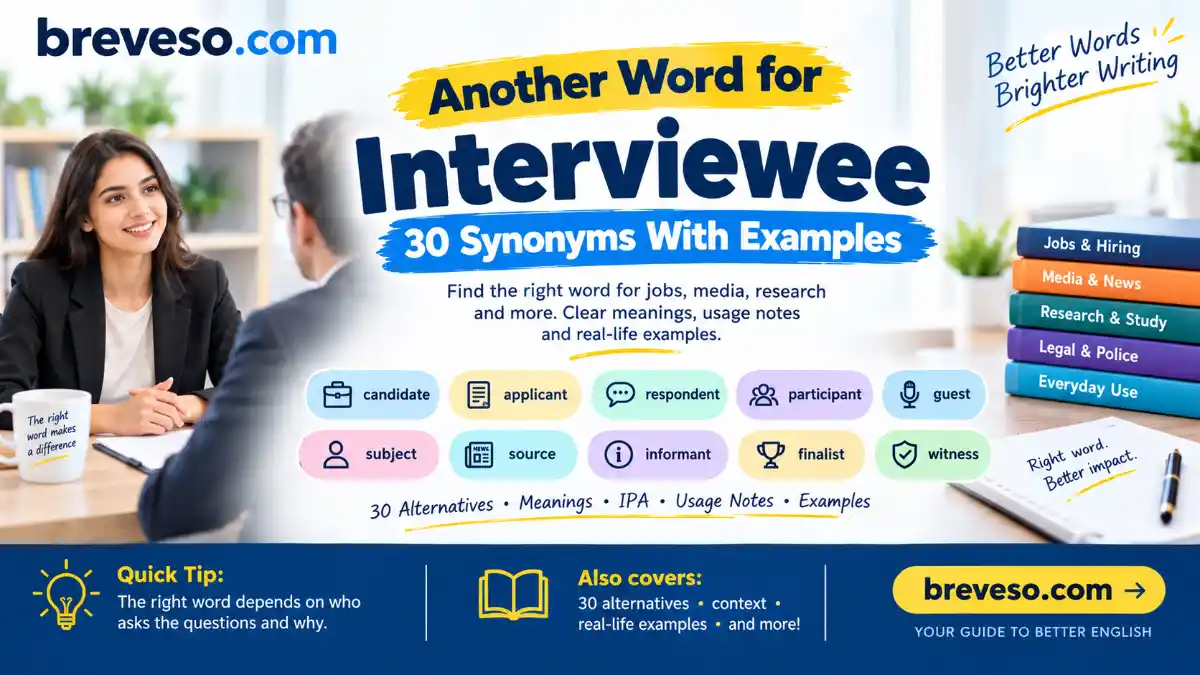
The closest everyday alternatives to “interviewee” are candidate, applicant, respondent, participant, guest, and source. For a job interview, “candidate” or “applicant” usually fits best. For a survey or study, “respondent” or “participant” is better.
The right word depends on who asks the questions and why. A job interview, a news interview, a research study, and a police interview each use a different label. Some words below are close synonyms. Others fit only one setting.
Quick list: candidate, applicant, respondent, participant, guest, subject, source, job seeker, informant, finalist
This article covers 30 alternatives with meanings, IPA, usage notes, examples, and context.
At a Glance: Interviewee Synonyms and Related Alternatives
| Alternative | Part of Speech | Meaning | Register / Tone | Ideal Context |
| Candidate | noun | A person being considered for a job or role | Neutral, professional | Hiring |
| Applicant | noun | A person who has applied for something | Neutral, formal | Jobs, schools, loans |
| Respondent | noun | A person who answers questions | Formal, technical | Surveys, research |
| Participant | noun | A person who takes part in a study or event | Neutral, formal | Research |
| Guest | noun | A person invited to appear on a show | Neutral, friendly | Radio, TV, podcasts |
| Subject | noun | A person who is the focus of a study or article | Neutral, clinical | Journalism, research |
| Source | noun | A person who gives information | Neutral, professional | News reporting |
| Informant | noun | A person who gives information to a researcher or authority | Formal, technical | Research, police work |
| Finalist | noun | A person in the last round of selection | Neutral | Hiring, contests |
| Witness | noun | A person who saw or knows about an event | Formal, legal | Police and court settings |
Which Word Should You Use?
| If you want to… | Use | Why |
| Describe someone in a job interview | candidate | It is the standard hiring term. |
| Describe someone who sent in a job application | applicant | It focuses on the act of applying. |
| Describe someone answering survey questions | respondent | It is the usual word for surveys. |
| Describe someone in a research study | participant | It is neutral and respectful. |
| Describe someone on a podcast or talk show | guest | It sounds natural and friendly. |
| Describe someone a reporter quotes | source | It focuses on the information given. |
| Describe someone telling their life story for an archive | narrator | Oral history projects commonly use it. |
| Describe someone questioned by police | witness or suspect | It names the person’s role in the case. |
Exploring the Multiple Meanings of “Interviewee”
1. A Person Interviewed for a Job
- Meaning: A person questioned by an employer to see if they suit a job.
- Explanation: This is the most common sense. “Candidate” and “applicant” are often more natural in hiring. “Interviewee” is useful when you want to stress the interview itself.
- Example: The interviewee arrived ten minutes early and brought extra copies of her résumé.
2. A Person Interviewed by the Media
- Meaning: A person questioned by a journalist or broadcaster for a story or show.
- Explanation: The interviewee is often an expert, a public figure, or a witness to news. In broadcasting, “guest” is common.
- Example: The interviewee told the reporter that the new bridge would open in spring.
3. A Person Questioned in Research
- Meaning: A person who answers questions as part of a study.
- Explanation: The word is used for one-to-one interviews. In formal writing, “respondent” or “participant” may be preferred.
- Example: Each interviewee spent an hour describing life as a caregiver.
4. A Person Questioned by Officials
- Meaning: A person asked questions by police, lawyers, or other officials.
- Explanation: “Interviewee” is a neutral label here. “Witness” and “suspect” are more specific.
- Example: The interviewee was asked to explain where she was that evening.
5. A Person Sharing Memories for a Record
- Meaning: A person who tells their story so it can be saved for later study.
- Explanation: In oral history, “narrator” is also used for this person.
- Example: The museum recorded an interviewee who remembered the town before the factory opened.
Sources: Merriam-Webster; Collins Dictionary; Cambridge Dictionary
Analyzing 30 Interviewee Alternatives in Detail
Some alternatives below are close synonyms. Others are related words that fit only one kind of interview.
Everyday Core Alternatives
1. Respondent
IPA: US /rɪˈspɑːndənt/ · UK /rɪˈspɒndənt/
Definition: A person who answers questions, especially in a survey or study.
- Usage: A close synonym in research and surveys. It sounds more formal and less personal than “interviewee.”
- Example: Most respondents said they preferred morning classes.
2. Participant
IPA: US /pɑːrˈtɪsɪpənt/ · UK /pɑːˈtɪsɪpənt/
Definition: A person who takes part in an activity or study.
- Usage: A close synonym in research. It is broader than “interviewee” because participants may do more than answer questions.
- Example: Each participant signed a consent form before the interview began.
3. Guest
IPA: /ɡɛst/ (US and UK)
Definition: A person invited to appear on a show or program.
- Usage: A close synonym in radio, TV, and podcasts. It is friendly and does not fit job or police interviews.
- Example: Our guest this week is a marine biologist.
4. Subject
IPA: /ˈsʌbdʒɪkt/ (US and UK)
Definition: A person who is the focus of a study, article, or investigation.
- Usage: A related alternative. It can sound cold or clinical. Sometimes it means the person is the topic, not the one answering.
- Example: The subject of the profile agreed to three long interviews.
5. Source
IPA: US /sɔːrs/ · UK /sɔːs/
Definition: A person or thing that provides information.
- Usage: A related alternative in journalism. It stresses the information given, not the interview itself.
- Example: The reporter’s source asked not to be named.
Job Interview Alternatives
6. Candidate
IPA: US /ˈkændɪdeɪt/ · UK /ˈkændɪdət/
Definition: A person who is being considered for a job, position, or prize.
- Usage: The closest everyday synonym in hiring. It is neutral and professional.
- Example: The strongest candidate had worked in sales for six years.
7. Applicant
IPA: /ˈæplɪkənt/ (US and UK)
Definition: A person who formally asks for a job, place, or benefit.
- Usage: A close synonym in hiring. It also covers people who have not been interviewed yet.
- Example: The company received over two hundred applicants for the role.
8. Job seeker
IPA: US /ˈdʒɑːb ˌsiːkər/ · UK /ˈdʒɒb ˌsiːkə/
Definition: A person who is looking for work.
- Usage: A related alternative. It describes a stage of life, not a specific interview.
- Example: The workshop helps job seekers prepare for interviews.
9. Hopeful
IPA: US /ˈhoʊpfəl/ · UK /ˈhəʊpfəl/
Definition: A person who hopes to succeed, often in a contest or for a job.
- Usage: A related, informal alternative. It is common in news writing, often as “job hopeful.”
- Example: A dozen hopefuls waited outside the office.
10. Finalist
IPA: /ˈfaɪnəlɪst/ (US and UK)
Definition: A person who reaches the last round of a selection process.
- Usage: A related alternative. It applies only after earlier rounds of selection.
- Example: The three finalists will meet the full hiring panel on Friday.
11. Prospect
IPA: US /ˈprɑːspɛkt/ · UK /ˈprɒspɛkt/
Definition: A person who might become a customer, client, or team member.
- Usage: A related alternative used in sales and sports recruiting. It rarely refers to an ordinary job interview.
- Example: The coach met each prospect before the season began.
12. Prospective hire
IPA: US /prəˈspɛktɪv ˈhaɪər/ · UK /prəˈspɛktɪv ˈhaɪə/
Definition: A person who may be hired.
- Usage: A related alternative that sounds like business writing. It looks ahead to a possible hire, not the interview itself.
- Example: Managers should make each prospective hire feel welcome.
13. Contender
IPA: US /kənˈtɛndər/ · UK /kənˈtɛndə/
Definition: A person who competes for a position, title, or prize.
- Usage: A related alternative. It stresses competition and suits cases where several people want one role.
- Example: She was a serious contender for the director position.
14. Aspirant
IPA: US /ˈæspərənt/ · UK /ˈæspɪrənt/
Definition: A person who strongly hopes to reach a position or goal.
- Usage: A related, formal alternative. It is less common in everyday English.
- Example: Every aspirant for the post had to submit a written plan.
Media and Public Alternatives
15. Newsmaker
IPA: US /ˈnuːzˌmeɪkər/ · UK /ˈnjuːzˌmeɪkə/
Definition: A person who is currently in the news.
- Usage: A related alternative. It describes news value and does not always mean the person is being interviewed.
- Example: The mayor was the day’s top newsmaker.
16. Spokesperson
IPA: US /ˈspoʊksˌpɜːrsən/ · UK /ˈspəʊksˌpɜːsən/
Definition: A person who speaks on behalf of a group or organization.
- Usage: A related alternative. Use it only when the person officially represents someone else.
- Example: A hospital spokesperson answered the reporter’s questions.
17. Expert
IPA: US /ˈɛkspɜːrt/ · UK /ˈɛkspɜːt/
Definition: A person with special knowledge or skill.
- Usage: A related alternative. It explains why the person was chosen, not that they were interviewed.
- Example: The show invited an expert on climate science.
18. Contributor
IPA: US /kənˈtrɪbjətər/ · UK /kənˈtrɪbjʊtə/
Definition: A person who gives something, such as ideas, money, or articles.
- Usage: A related alternative. Broadcasters sometimes use it for regular guests, but it is looser than “interviewee.”
- Example: The magazine thanked each contributor who spoke to its writers.
19. Panelist
IPA: /ˈpænəlɪst/ (US and UK)
Definition: A member of a panel who takes part in a discussion.
- Usage: A related alternative. Panelists answer questions in a group, so it does not suit a one-to-one interview.
- Example: The panelist answered questions from the audience.
Research and Oral History Alternatives
20. Informant
IPA: US /ɪnˈfɔːrmənt/ · UK /ɪnˈfɔːmənt/
Definition: A person who gives information, especially to a researcher or an authority.
- Usage: A related alternative. It is neutral in research, but outside academic writing it can sound like a secret informer.
- Example: The linguist recorded her informant speaking in the local dialect.
21. Narrator
IPA: US /ˈnɛreɪtər/ · UK /nəˈreɪtə/
Definition: A person who tells a story or account.
- Usage: A related alternative. It is common in oral history, where the person tells their own story.
- Example: The narrator described life in the village in the 1950s.
22. Interlocutor
IPA: US /ˌɪntərˈlɑːkjətər/ · UK /ˌɪntəˈlɒkjʊtə/
Definition: A person who takes part in a conversation.
- Usage: A related, formal alternative. It can mean either side of a conversation, so the context must show who is being questioned.
- Example: The professor was a patient interlocutor during the long discussion.
23. Focus group member
IPA: US /ˈfoʊkəs ɡruːp ˈmɛmbər/ · UK /ˈfəʊkəs ɡruːp ˈmɛmbə/
Definition: A person who joins a small group discussion to share opinions.
- Usage: A related alternative. It describes a group discussion, not a one-to-one interview.
- Example: Each focus group member was asked about the new packaging.
Legal and Investigative Alternatives
24. Witness
IPA: /ˈwɪtnəs/ (US and UK)
Definition: A person who sees an event or has direct knowledge about it.
- Usage: A related alternative in legal and police settings. It says why the person is being questioned.
- Example: The witness told officers what she saw from her window.
25. Suspect
IPA: /ˈsʌspɛkt/ (US and UK)
Definition: A person thought to have committed a crime.
- Usage: A related alternative with a serious meaning. Use it only when police treat the person as a suspect.
- Example: Officers questioned the suspect for several hours.
26. Person of interest
IPA: US /ˈpɜːrsən əv ˈɪntrəst/ · UK /ˈpɜːsən əv ˈɪntrəst/
Definition: A person police want to question in an investigation, without calling them a suspect.
- Usage: A related alternative common in crime news. It is not a formal charge.
- Example: Police named him a person of interest and asked him to come in.
27. Deponent
IPA: US /dɪˈpoʊnənt/ · UK /dɪˈpəʊnənt/
Definition: A person who gives sworn evidence in writing or in a legal setting.
- Usage: A related, formal alternative. It fits only legal depositions.
- Example: The deponent answered each question under oath.
Specialized Alternatives
28. Examinee
IPA: /ɪɡˌzæmɪˈniː/ (US and UK)
Definition: A person who takes an examination.
- Usage: A related alternative. It fits oral exams and tests, not ordinary interviews.
- Example: The examinee had twenty minutes to answer the questions aloud.
29. Client
IPA: /ˈklaɪənt/ (US and UK)
Definition: A person who uses the services of a professional.
- Usage: A related alternative for intake interviews with lawyers, counselors, and advisers. It does not fit a job interview.
- Example: The adviser asked each new client about their goals.
30. Nominee
IPA: US /ˌnɑːmɪˈniː/ · UK /ˌnɒmɪˈniː/
Definition: A person who has been proposed for a position or award.
- Usage: A related alternative. A nominee may face questions at a formal hearing, but the word describes the nomination, not the questioning.
- Example: The nominee answered questions from the committee for two hours.
Sources: Merriam-Webster; Collins Dictionary; Cambridge Dictionary; Dictionary.com
Interviewee vs. Candidate vs. Respondent vs. Subject
These four words are often swapped, but each points to something different.
| Word | What it focuses on | Typical setting |
| Interviewee | The person being questioned | Any interview |
| Candidate | The person’s chance of being chosen | Hiring, elections |
| Respondent | The person’s answers to set questions | Surveys, studies |
| Subject | The person as the topic of study or writing | Research, profiles |
“Interviewee” is the broadest word. It only says that someone is being interviewed. The other three add meaning about the purpose.
Sources: Merriam-Webster; Collins Dictionary; Cambridge Dictionary
Interviewee and Opposite/Paired Word Pairs
| Word | Paired Word | Note |
| Interviewee | Interviewer | The natural opposite. One asks, the other answers. |
| Candidate | Recruiter | The person seeking a role and the person filling it. |
| Applicant | Hiring manager | Used in hiring. |
| Respondent | Researcher | Used in surveys and studies. |
| Guest | Host | Used in broadcasting. |
| Source | Reporter | Used in journalism. |
“Interviewer” is the true opposite of “interviewee.” Both come from “interview” and differ only in their endings. The other pairs are paired roles, not exact antonyms.
Sources: Merriam-Webster; Collins Dictionary
Common Word Partners of “Interviewee”
| Pattern | Common Partners | Example |
| adjective + interviewee | nervous, prepared, confident, reluctant | The nervous interviewee took a deep breath. |
| verb + interviewee | ask, thank, quote, introduce | The host will introduce each interviewee. |
| interviewee + verb | answer, reply, describe, decline | The interviewee declined to comment. |
| interviewee + noun | responses, consent, feedback | Researchers must get interviewee consent. |
Sources: Collins Dictionary; Cambridge Dictionary
Idiomatic Phrases Featuring “Interviewee”
“Interviewee” does not appear in any true idiom. The expressions below are established phrases from the world of interviews. They describe how interviewees speak or are treated.
1. On the record
- Meaning: Said in a way that can be quoted and shared publicly.
- Example: The interviewee agreed to go on the record about the changes.
2. Off the record
- Meaning: Said privately, with the understanding that it will not be quoted or published.
- Example: The interviewee shared the details off the record.
3. In the hot seat
- Meaning: In a position where one must answer hard questions.
- Example: The interviewee was in the hot seat for the whole hour.
4. To grill someone
- Meaning: To question someone closely and for a long time.
- Example: The panel grilled the interviewee about her past work.
Sources: Merriam-Webster; Cambridge Dictionary
Word Formation of “Interviewee”
Etymology & Structure
“Interviewee” is made from interview + -ee. The suffix “-ee” marks a person who receives an action, as in “employee” and “addressee.” “Interview” comes from the French entrevue, which comes from s’entrevoir, “to see each other.”
Date and History
“Interview” entered English in the 1500s with the meaning of a face-to-face meeting. The news sense of questioning someone for publication came later, in the 1800s. “Interviewee” appeared in the late 1800s. Check Merriam-Webster or the OED for the exact first-use date before citing one.
Word Class Variations
- Noun: interviewee, interviewees
- Related nouns: interviewer, interview
- Related verb: interview, interviewed, interviewing
“Interviewee” has no adjective or adverb form of its own.
Sources: Etymonline; Merriam-Webster
Common Word-Choice Mistakes
- The interviewee asked me three questions: The interviewer asked me three questions.
- Interviewe: Interviewee, with two e’s at the end.
- Thirty interviewees completed the online form: Thirty respondents completed the online form, because a form is not an interview.
- The interviewed was nervous: The interviewee was nervous.
- The interviewee was hired on Monday: The candidate was hired on Monday, because after the interview the person is no longer just an interviewee.
- The informant at the job interview: The candidate at the job interview, because “informant” sounds like a secret informer outside research.
- The reporter’s interviewee leaked the files: The reporter’s source leaked the files, because “source” fits when a person gives information.
Frequently Asked Questions
What is the closest synonym for interviewee?
“Candidate” is the closest in hiring. “Respondent” is the closest in research.
What is the opposite of interviewee?
The opposite is “interviewer,” the person who asks the questions.
Is interviewee the same as candidate?
No. A candidate is someone being considered for a role. An interviewee is anyone being interviewed.
Is interviewee the same as applicant?
Not always. An applicant has applied, but may not have been interviewed yet.
What is a formal word for interviewee?
“Respondent” is formal. “Interlocutor” is also formal, but it can mean the interviewer too.
What do you call an interviewee on a podcast?
Use “guest.”
What do you call a person who gives information to a reporter?
That person is a “source.”
Can interviewee be used for police questioning?
Yes, as a neutral label. “Witness” and “suspect” are more specific.
What do oral historians call an interviewee?
Many call the person a “narrator.”
Can interviewee be used for people in a survey?
Only if they were interviewed. For a written survey, “respondent” is correct.
Conclusion
The closest alternatives to “interviewee” are “candidate” and “applicant” for jobs, “respondent” and “participant” for research, and “guest” and “source” for media. Words like “witness,” “narrator,” and “examinee” fit only specific settings.
Context matters because each word adds meaning. “Candidate” suggests a chance of being chosen. “Respondent” suggests answers to set questions. “Source” suggests information given to a reporter.
To choose the right word, first decide who is asking and why. Then pick the label that matches the person’s role in that setting.

Ali Bismal is the founder and writer behind Breveso.com, where he helps readers find the perfect synonym for every word. What started as a simple love for words turned into a growing library of “another word for ___” guides covering emotions, actions, slang, and everyday language.
Ali believes the right word can sharpen a sentence, and the wrong one can blur it. That is why every Breveso guide is written in plain, simple English, grouped in a way that actually makes sense, and checked for real-world use.
He writes for students, writers, and anyone who has ever stared at a sentence thinking there must be a better word for this. Clean, useful content that answers the question fast, that is the whole mission.