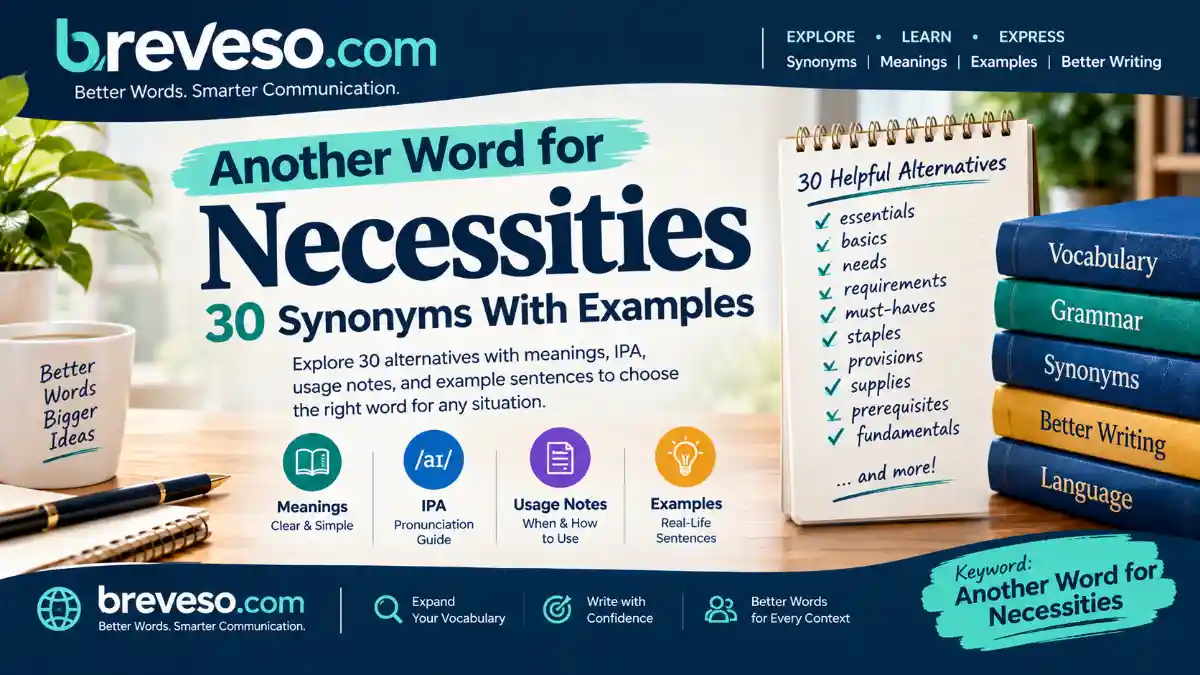
The closest everyday alternatives to “necessities” are essentials, basics, and needs. All three name the things people must have to live, work, or reach a goal. Other words fit narrower jobs, such as staples for food, supplies for gear, or requirements for rules and conditions.
The best choice depends on what you mean. Food, water, and shelter point to basic needs. A school or job usually calls for requirements or prerequisites. Trips and emergencies often call for provisions or supplies.
Quick list: essentials, basics, needs, requirements, must-haves, staples, provisions, supplies, prerequisites, fundamentals
This article explains 30 alternatives with meanings, IPA, usage notes, examples, and context. Some are direct synonyms. Others only work in certain situations, and the usage notes say which is which.
Table of Contents
- At a Glance: Necessities Synonyms and Related Alternatives
- Which Word Should You Use?
- Exploring the Multiple Meanings of “Necessities”
- Analyzing 30 Necessities Alternatives in Detail
- Necessities vs. Essentials vs. Needs vs. Basics
- Necessities and Opposite/Paired Word Pairs
- Common Word Partners of “Necessities”
- Idiomatic Phrases Featuring “Necessities”
- Word Formation of “Necessities”
- Common Word-Choice Mistakes
- Frequently Asked Questions
- Conclusion
At a Glance: Necessities Synonyms and Related Alternatives
| Alternative | Part of Speech | Meaning | Register / Tone | Ideal Context |
| Essentials | noun (plural) | Things that cannot be left out | Neutral | Daily life, travel, shopping |
| Basics | noun (plural) | The simplest and most important things | Casual | Living costs, learning |
| Needs | noun (plural) | Things a person must have | Neutral | Care, aid, planning |
| Requirements | noun (plural) | Things that must be done or had | Neutral to formal | Jobs, rules, projects |
| Must-haves | noun (plural) | Items someone treats as vital | Informal | Shopping, packing |
| Staples | noun (plural) | Basic goods bought again and again | Neutral | Food, household goods |
| Provisions | noun (plural) | Food and goods stored for use | Neutral to formal | Trips, emergencies |
| Supplies | noun (plural) | Items kept for a purpose | Neutral | Schools, clinics, offices |
| Prerequisites | noun (plural) | Things needed before something else | Formal | Courses, careers |
| Fundamentals | noun (plural) | Core principles or parts | Neutral to formal | Skills, subjects |
Which Word Should You Use?
| If you want to… | Use | Why |
| Describe what people need to live | Basic needs | It names food, water, shelter, and clothing clearly. |
| Name items to pack for a trip | Essentials | It sounds natural and covers anything you cannot skip. |
| List conditions in a job ad or rulebook | Requirements | It points to rules, not physical items. |
| Talk about food people buy every week | Staples | It means basic foods such as rice, flour, and salt. |
| Describe goods stored for a trip or crisis | Provisions | It suggests food and gear set aside in advance. |
| Name what you must finish before a course | Prerequisites | It stresses things that come first. |
| Say someone has little more than the minimum | Bare essentials | “Bare” signals the smallest possible amount. |
| Discuss the money needed to do something | Wherewithal | It centers on the means, not the items. |
Exploring the Multiple Meanings of “Necessities”
The plural form “necessities” mostly carries the first two senses below. The singular “necessity” covers all five.
1. Things needed for daily life
- Meaning: Items a person must have to live safely and comfortably, such as food, water, clothing, and shelter.
- Explanation: This is the most common sense. It often appears in the phrase “necessities of life” and in talk about charity, prices, and budgets.
- Example: The charity gives food, soap, and other necessities to families in need.
2. Things required for a purpose
- Meaning: Items or conditions that something cannot work or succeed without.
- Explanation: Here the word goes beyond survival. It describes what a task, job, or hobby demands.
- Example: Good boots and a map are necessities for any long hike.
3. Unavoidable force or circumstance
- Meaning: A situation that leaves no real choice.
- Explanation: This sense usually appears in the singular, as in “out of necessity.” It stresses pressure from events rather than a list of objects.
- Example: He sold the car out of necessity, not choice.
4. Poverty or great need
- Meaning: A state of hardship or lack.
- Explanation: This sense sounds formal or old-fashioned. Modern writers usually choose “poverty” or “hardship” instead.
- Example: Many families lived in great necessity during the war.
5. Logical or natural certainty
- Meaning: The quality of being impossible to avoid or to be otherwise.
- Explanation: Philosophy and science use this sense. It describes facts that must be true, not things people need to own.
- Example: Philosophers argue about whether the laws of nature exist by necessity.
Sources: Merriam-Webster, Collins Dictionary, Dictionary.com
Analyzing 30 Necessities Alternatives in Detail
Some alternatives below are direct synonyms, while others only fit certain contexts. The usage notes mark each one.
Everyday Core Synonyms
1. Essentials
IPA: /ɪˈsɛnʃəlz/ (US and UK)
Definition: Things that are absolutely necessary or basic to something.
- Usage: The closest everyday match to “necessities.” It works for daily life, travel, and shopping, and the tone stays neutral.
- Example: Pack the essentials first: passport, phone charger, and medicine.
2. Basics
IPA: /ˈbeɪsɪks/ (US and UK)
Definition: The simplest and most important things needed for something, or the main facts of a subject.
- Usage: Casual and flexible. It can mean living items or beginner knowledge, so context decides. As a synonym it is slightly softer than “necessities.”
- Example: Rent, food, and other basics take most of her pay.
3. Needs
IPA: /niːdz/ (US and UK)
Definition: Things a person must have; requirements.
- Usage: A close synonym. The word can also mean a state of lacking something, so check the sentence for the intended sense.
- Example: The shelter meets the daily needs of every guest.
Requirement-Based Alternatives
4. Requirements
IPA: US /rɪˈkwaɪərmənts/ · UK /rɪˈkwaɪəmənts/
Definition: Things that must be done, met, or had.
- Usage: A related alternative. It fits rules, conditions, and standards better than physical items. The tone runs neutral to formal.
- Example: The main requirements for the job are a license and two years of experience.
5. Must-haves
IPA: /ˈmʌst hævz/ (US and UK)
Definition: Items or features that someone treats as absolutely necessary.
- Usage: Informal and common in shopping, fashion, and travel. A must-have can be a strong want, so it is a related alternative rather than an exact synonym.
- Example: A warm coat and good boots top my list of winter must-haves.
6. Fundamentals
IPA: /ˌfʌndəˈmɛntlz/ (US and UK)
Definition: The basic principles or core parts of something.
- Usage: A related alternative. It describes ideas and skills, not goods. The tone is neutral to formal.
- Example: Learn the fundamentals before you try advanced moves.
Formal and Written Alternatives
7. Requisites
IPA: US /ˈrɛkwəzɪts/ · UK /ˈrɛkwɪzɪts/
Definition: Things that are necessary for a particular purpose.
- Usage: Formal and a little old-fashioned. It often appears in the pattern “requisites for.”
- Example: Honesty and patience are requisites for a good teacher.
8. Prerequisites
IPA: US /priːˈrɛkwəzɪts/ · UK /priːˈrɛkwɪzɪts/
Definition: Things that must exist or happen first before something else can.
- Usage: A related alternative. It stresses order, meaning what comes before a goal. Schools and businesses use it often.
- Example: Basic math is one of the prerequisites for this course.
9. Imperatives
IPA: /ɪmˈpɛrətɪvz/ (US and UK)
Definition: Things that are absolutely necessary or urgent.
- Usage: Formal. It suits urgent duties or goals, such as safety or health, rather than everyday goods. It is a related alternative.
- Example: Clean water and safe housing became urgent imperatives after the flood.
10. Exigencies
IPA: /ˈɛksɪdʒənsiz/ (US and UK)
Definition: Urgent needs or demands created by a situation.
- Usage: Formal and fairly rare. It highlights pressure from circumstances, not a list of items, so it is only a related alternative.
- Example: The exigencies of war left little room for comfort.
11. Sine qua non
IPA: US /ˌsɪneɪ kwɑː ˈnoʊn/ · UK /ˌsɪneɪ kwɑː ˈnɒn/
Definition: Something absolutely essential. The Latin phrase means “without which not.”
- Usage: Formal, and used for one key condition rather than a group of items. It is a related alternative with a scholarly feel.
- Example: Trust is the sine qua non of any good partnership.
Supplies and Daily Life
12. Provisions
IPA: /prəˈvɪʒənz/ (US and UK)
Definition: Supplies of food, drink, and other things needed.
- Usage: A related alternative. It points to goods gathered ahead of time, such as for a trip, a storm, or a long stay.
- Example: The hikers bought provisions for five days.
13. Supplies
IPA: /səˈplaɪz/ (US and UK)
Definition: Amounts of things kept and used for a purpose or period.
- Usage: Everyday and flexible. It works with a type of item, as in school, medical, or office supplies. It fits “necessities” when the focus is on goods.
- Example: The clinic ran low on basic supplies.
14. Rations
IPA: /ˈræʃənz/ (US and UK)
Definition: Fixed amounts of food or other goods given to a person or group.
- Usage: Narrow. It suits soldiers, hikers, and shortages. It is a related alternative, not a general synonym.
- Example: The soldiers received rations for three days.
15. Staples
IPA: /ˈsteɪpəlz/ (US and UK)
Definition: Basic foods or goods that people buy regularly.
- Usage: Food-focused. Rice, flour, salt, and oil are typical staples. It covers only part of what “necessities” can mean.
- Example: Rice and beans are staples in many homes.
16. Sustenance
IPA: /ˈsʌstənəns/ (US and UK)
Definition: Food and drink that keep a person alive and strong.
- Usage: Formal and sometimes literary. It covers nourishment only, so it is a related alternative. Writers also use it in a figurative way.
- Example: The village had little sustenance left after the drought.
Survival and Basic Living
17. Basic needs
IPA: /ˈbeɪsɪk niːdz/ (US and UK)
Definition: The most important things people need to live, such as food, water, shelter, and clothing.
- Usage: A direct match in aid work, health, and social policy. The tone is neutral and clear.
- Example: Families get help with basic needs through the program.
18. Bare essentials
IPA: US /ˈbɛr ɪˈsɛnʃəlz/ · UK /ˈbeə ɪˈsenʃəlz/
Definition: Only the minimum amount of things needed.
- Usage: “Bare” stresses the minimum. It is nearly the same as “bare necessities” and suits both casual and careful writing.
- Example: She traveled light with only the bare essentials.
19. Necessaries
IPA: US /ˈnɛsəˌsɛriz/ · UK /ˈnesəsriz/
Definition: Things needed for life. In law, it means goods and services that a person needs, such as food and clothing.
- Usage: Old-fashioned and mostly legal. Modern writers rarely use it outside that field.
- Example: The law required him to provide food, clothing, and other necessaries for his child.
20. Subsistence
IPA: /səbˈsɪstəns/ (US and UK)
Definition: The minimum needed to stay alive, or the state of barely staying alive.
- Usage: It names a level of living, not a list of items, so it is a related alternative. Look for it in phrases such as “subsistence farming.”
- Example: Many families in the region live at subsistence level.
Resources and Means (Related Alternatives)
21. Resources
IPA: US /ˈriːsɔːrsɪz/ · UK /rɪˈzɔːsɪz/
Definition: Things such as money, materials, or skills that someone can use.
- Usage: Broader than “necessities.” It fits when you mean what a person or group needs to get a job done.
- Example: The small team lacked the resources to finish on time.
22. Means
IPA: /miːnz/ (US and UK)
Definition: Money or other resources that allow someone to do something.
- Usage: In the plural it often refers to money. It is a related alternative and carries a slightly formal tone.
- Example: He had neither the means nor the time to travel.
23. Wherewithal
IPA: US /ˈwɛrwɪðɔːl/ · UK /ˈweəwɪðɔːl/
Definition: The money or other things needed to do something.
- Usage: Usually singular and preceded by “the.” It centers on the ability to pay or act, so it is a related alternative.
- Example: She had the wherewithal to start her own business.
24. Gear
IPA: US /ɡɪr/ · UK /ɡɪə/
Definition: Tools, clothing, and equipment used for a particular activity.
- Usage: Informal and tied to one activity, such as camping, fishing, or sports. It is a related alternative.
- Example: Check your camping gear before the trip.
25. Kit
IPA: /kɪt/ (US and UK)
Definition: A set of tools, clothing, or items kept together for a specific purpose.
- Usage: Common in everyday speech, and especially in British English for sports clothing. It names a bundle, not a general idea of need.
- Example: Keep a first-aid kit in the car.
Core Parts and Key Priorities (Related Alternatives)
26. Rudiments
IPA: /ˈruːdɪmənts/ (US and UK)
Definition: The most basic parts or ideas of a subject.
- Usage: Formal. It describes beginner knowledge or skills, not physical goods, so it works only in learning contexts.
- Example: He learned the rudiments of Spanish in a month.
27. Indispensables
IPA: /ˌɪndɪˈspɛnsəbəlz/ (US and UK)
Definition: Things that nobody can do without.
- Usage: A plural noun that is less common than the adjective “indispensable.” It carries a strong, slightly formal tone.
- Example: A sharp knife is one of the indispensables of any kitchen.
28. Priorities
IPA: US /praɪˈɔːrətiz/ · UK /praɪˈɒrətiz/
Definition: Things that matter more than others and need attention first.
- Usage: It describes order of importance, not physical needs. Choose it when the point is what comes first.
- Example: Rent and food come first among her priorities.
29. Mainstays
IPA: /ˈmeɪnsteɪz/ (US and UK)
Definition: The chief supports or most important parts of something.
- Usage: A related alternative. It names items or people that others depend on, such as foods in a diet.
- Example: Bread and soup were the mainstays of the winter diet.
30. Necessity goods
IPA: US /nəˈsɛsəti ɡʊdz/ · UK /nɪˈsesɪti ɡʊdz/
Definition: In economics, goods that people need and keep buying even when money is tight.
- Usage: A technical term. It sits opposite “luxury goods” in business and economics writing.
- Example: Food and medicine count as necessity goods.
Sources: Merriam-Webster, Collins Dictionary and Thesaurus, Dictionary.com, Investopedia (for “necessity goods”)
Necessities vs. Essentials vs. Needs vs. Basics
These four words overlap a lot. Small differences in focus help you pick the right one.
| Word | Core Idea | Typical Use |
| Necessities | Things you cannot live or work without | Life, budgets, charity |
| Essentials | Things you cannot leave out | Packing, shopping, lists |
| Needs | Things required, or the state of lacking | Care, aid, planning |
| Basics | The simplest, most important things | Casual talk, learning |
In everyday speech, “necessities” and “essentials” can swap places. “Needs” can describe feelings and goals too, such as “emotional needs.” “Basics” often hints at a simple or starting level.
Sources: Merriam-Webster, Collins Dictionary
Necessities and Opposite/Paired Word Pairs
| Word | Paired Word | Note |
| Necessities | Luxuries | The most common opposite. Luxuries are things that add comfort but are not needed. |
| Necessities | Extras | A casual contrast for anything beyond the basics. |
| Needs | Wants | A popular pair in money advice. |
| Essentials | Non-essentials | A direct negative form used in budgets and rules. |
| Basics | Frills | Frills are decorations or extras that add nothing vital. |
| Staples | Treats | A common food contrast. |
| Must-haves | Nice-to-haves | Common in shopping and business planning. |
“Necessities and luxuries” often appear together to show the range of what people buy. The line between the two can move. A phone may be a luxury in one setting and a necessity in another, so context shapes the contrast.
Sources: Merriam-Webster, Collins Dictionary, Cambridge Dictionary
Common Word Partners of “Necessities”
| Pattern | Common Partners | Example |
| adjective + necessities | basic, daily, everyday, bare, household | Soap and towels are everyday necessities. |
| verb + necessities | buy, afford, provide, lack, stock up on | Many families struggle to afford basic necessities. |
| noun + necessities | household, baby, travel, school | We packed baby necessities in a small bag. |
| necessities + of + noun | necessities of life, necessities of daily living | The fund covers the necessities of life. |
| necessities + for + noun | necessities for a trip, necessities for school | List the necessities for the trip. |
| necessities and luxuries | necessities and luxuries, luxuries and necessities | Prices rose for both necessities and luxuries. |
Sources: Collins Dictionary, Oxford Collocations Dictionary, Merriam-Webster
Idiomatic Phrases Featuring “Necessities”
Most idioms use the singular “necessity.” Below are the strongest established expressions. The first is a fixed expression, the second a proverb, and the last two idioms or set phrases.
1. Bare necessities
- Meaning: The smallest set of things needed to live. It is a well-known expression rather than a true idiom.
- Example: After the move, we had only the bare necessities in the new flat.
2. Necessity is the mother of invention
- Meaning: A proverb saying that people create new ideas when they face a real need.
- Example: With no shop nearby, she built her own shelves. Necessity is the mother of invention.
3. Make a virtue of necessity
- Meaning: To act as if you chose something that you actually had to do.
- Example: He lost his job, so he made a virtue of necessity and started his own company.
4. Of necessity
- Meaning: Because there is no other choice.
- Example: The team worked from home of necessity during the storm.
Sources: Merriam-Webster, Cambridge Dictionary, Collins Dictionary
Word Formation of “Necessities”
Etymology & Structure
“Necessities” is the plural of “necessity.” The word came into English through Old French from Latin necessitas, which links to necesse, meaning “unavoidable.” Some references suggest an older root linked to the idea of “not yielding,” though the earliest origin remains uncertain. The structure is simple: the base necess- plus the noun suffix -ity. The plural changes y to ies.
IPA: US /nəˈsɛsətiz/ · UK /nɪˈsesɪtiz/
Date and History
“Necessity” entered English in the 14th century. The plural form grew common as writers needed a word for the goods people must have.
Word Class Variations
- Noun: necessity, necessities
- Noun and adjective: necessary (the plural noun is “necessaries”)
- Adjective: necessary, unnecessary, necessitous (formal, meaning very poor)
- Verb: necessitate (to make something necessary)
- Adverb: necessarily
Sources: Etymonline, Merriam-Webster, Collins Dictionary
Common Word-Choice Mistakes
- A necessities: use “a necessity” or just “necessities.”
- Necessitys: use “necessities.”
- Necessary of life: use “necessities of life,” because the noun form is needed here.
- He packed provisions of clothes: use “he packed clothes and other necessities,” because provisions usually means food and basic goods.
- Pre-requisites: write “prerequisites” without a hyphen.
- She bought many necessities for fun: use “extras” or “luxuries” for items that are not needed.
- The rations of the course: use “requirements” or “prerequisites,” because rations means fixed amounts of food.
Frequently Asked Questions
What is the closest synonym for necessities?
“Essentials” is the closest everyday match. “Basic needs” works well when you mean food, water, and shelter.
What is a formal alternative to necessities?
“Requisites” and “prerequisites” suit formal writing. “Requirements” works in business and official texts.
What is the difference between necessities and needs?
“Necessities” names the things themselves. “Needs” can name things or describe a state of lacking, such as “emotional needs.”
What is the opposite of necessities?
“Luxuries” is the most common opposite. “Extras” and “frills” also work in casual speech.
Can necessities be used for a single item?
Use the singular “necessity” for one item. For example, “A warm coat is a necessity in winter.”
What is a good word for necessities of food?
“Staples,” “provisions,” and “rations” each fit. “Sustenance” suits formal or literary writing.
Is “necessaries” still used?
It is rare today and mostly appears in legal or old texts. Choose “necessities” in modern writing.
What is the difference between essentials and basics?
“Essentials” stresses what you cannot leave out. “Basics” often points to the simplest items or beginner knowledge.
Can necessities refer to money?
Not directly. Words such as “means” and “wherewithal” cover the money needed to do something.
Can I use “bare necessities” in formal writing?
Yes. It is common and clear, and “minimum requirements” is a stricter alternative.
Conclusion
The closest alternatives to “necessities” are “essentials,” “basics,” and “needs.” Phrases such as “basic needs” and “bare essentials” match the meaning even more closely. “Staples” and “provisions” fit food and stored goods.
Context decides which word works best. Some words name items, such as supplies and gear. Others name conditions or ideas, such as requirements, prerequisites, and fundamentals. A few, such as “means” and “wherewithal,” point to the money needed.
To choose the right word, ask what you want to describe: goods, rules, skills, or money. Then check the tone, whether casual, neutral, or formal. A clear match makes your sentence easier to read and more accurate.
Related synonym guides
- Another word for reliant: 30 synonyms with examples
- Another word for deserving: 30 synonyms with examples
- Another word for guidance: 30 synonyms with examples
- Another word for something: 30 synonyms with examples

Ali Bismal is the founder and writer behind Breveso.com, where he helps readers find the perfect synonym for every word. What started as a simple love for words turned into a growing library of “another word for ___” guides covering emotions, actions, slang, and everyday language.
Ali believes the right word can sharpen a sentence, and the wrong one can blur it. That is why every Breveso guide is written in plain, simple English, grouped in a way that actually makes sense, and checked for real-world use.
He writes for students, writers, and anyone who has ever stared at a sentence thinking there must be a better word for this. Clean, useful content that answers the question fast, that is the whole mission.