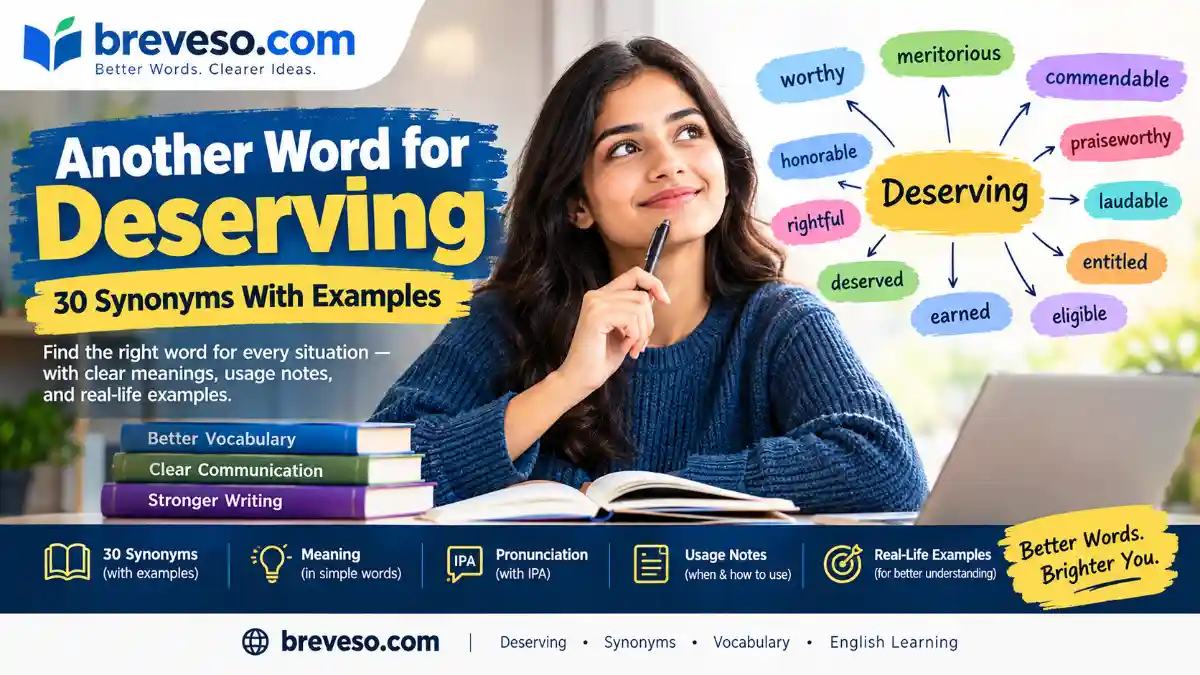
The closest everyday alternative for “deserving” is worthy. Both describe a person or cause that merits help, praise, or a reward. For a more formal tone, use meritorious. To praise someone’s effort, commendable and praiseworthy work well.
The best word depends on what you mean. “Deserving” can mean worthy of support, as in a deserving student. It can mean having earned something, as in deserving of respect. It can also describe a good cause, such as a deserving charity. Some alternatives focus on praise, some on rights or eligibility, and some on moral character.
Quick list: worthy, meritorious, commendable, praiseworthy, laudable, deserved, earned, entitled, eligible
This article looks at 30 alternatives to “deserving.” Each one comes with a meaning, IPA, usage note, and example sentence, so you can see how it differs from “deserving” and when to use it.
At a Glance: Deserving Synonyms and Related Alternatives
| Alternative | Part of Speech | Meaning | Register / Tone | Ideal Context |
| Worthy | Adjective | Having enough value or merit | Neutral | Causes, recipients, winners |
| Meritorious | Adjective | Deserving praise or reward | Formal | Awards, legal and academic writing |
| Commendable | Adjective | Worth praising | Neutral to formal | Effort, behavior, results |
| Praiseworthy | Adjective | Deserving praise | Neutral | Actions and attitudes |
| Laudable | Adjective | Deserving admiration | Formal | Goals, aims, efforts |
| Deserved | Adjective | Earned or fairly received | Neutral | Wins, rewards, results |
| Earned | Adjective | Gained through effort | Neutral | Breaks, titles, success |
| Rightful | Adjective | Having a fair or legal claim | Neutral to formal | Ownership, titles, places |
| Entitled | Adjective | Having a right to something | Neutral | Benefits, rules, rights |
| Eligible | Adjective | Meeting the conditions for something | Neutral | Programs, jobs, prizes |
Which Word Should You Use?
| If you want to… | Use | Why |
| Say a person or cause should receive help | worthy | It is the closest everyday match for “deserving.” |
| Praise someone’s effort | commendable | It focuses on praise for what someone did. |
| Write in a formal, legal, or academic style | meritorious | It sounds official and refers to real merit. |
| Describe a result that was fairly earned | deserved | It describes the outcome, not the person. |
| Say someone has a right to something | entitled | It points to a right, not merit. |
| Say someone meets the requirements | eligible | It is about conditions, not worth. |
| Say something calls for a response | warranting | It works for situations, not people. |
| Describe a person of good character | honorable | It focuses on moral quality. |
Exploring the Multiple Meanings of “Deserving”
1. Worthy of Reward, Help, or Support
- Meaning: Having qualities or needs that make someone fit to receive something good.
- Explanation: This is the most common sense. It describes people who should receive help, a prize, or an opportunity, and it appears often in phrases like “deserving students.”
- Example: The scholarship fund supports deserving students from low-income families.
2. Deserving of Something Specific
- Meaning: Having earned a particular response or treatment, good or bad.
- Explanation: Used with “of,” the word is not limited to good outcomes. People can be deserving of praise or deserving of blame.
- Example: Her patience with the children was deserving of praise.
3. Describing a Cause or Charity
- Meaning: Considered a good or valuable cause for support.
- Explanation: In fundraising and giving, “deserving” describes causes thought to merit donations.
- Example: The shop donates part of its profit to deserving causes.
4. “The Deserving” as a Group
- Meaning: People who are considered worthy of help.
- Explanation: Here “deserving” works like a noun and refers to a whole group. It can sound judgmental, because it implies that others are not deserving. Many writers avoid it and name the group directly, such as “students in need.”
- Example: The fund was created to support the deserving.
5. The Verb Form of “Deserve”
- Meaning: Being worthy of something, in an ongoing action.
- Explanation: “Deserving” is also the -ing form of the verb “deserve.” In this use it often begins a phrase explaining a reason.
- Example: Deserving a rest after the long trip, he slept until noon.
Sources: Merriam-Webster, Collins English Dictionary, Dictionary.com, Cambridge Dictionary
Analyzing 30 Deserving Alternatives in Detail
Some of these words are close synonyms of “deserving,” while others are related alternatives that fit only certain contexts. Each usage note says which is which.
Core Synonyms
1. Worthy
IPA: US /ˈwɝði/ · UK /ˈwɜːði/
Definition: Having value, merit, or importance that earns respect or support.
- Usage: The closest everyday synonym. It works for people, causes, and goals, and it is often followed by “of.”
- Example: The shelter is a worthy cause that needs more volunteers.
2. Meritorious
IPA: US /ˌmɛrəˈtɔriəs/ · UK /ˌmerɪˈtɔːriəs/
Definition: Deserving reward or praise because of high quality or effort.
- Usage: A direct but formal synonym. It is common in awards, law, and academic writing and sounds stiff in casual speech.
- Example: The committee gave her a medal for meritorious service.
3. Commendable
IPA: US /kəˈmɛndəbəl/ · UK /kəˈmendəbl/
Definition: Worthy of praise.
- Usage: A close synonym that focuses on praise for an action or quality, more than on a reward.
- Example: The team showed commendable honesty in admitting its mistake.
4. Praiseworthy
IPA: US /ˈpreɪzˌwɝði/ · UK /ˈpreɪzˌwɜːði/
Definition: Deserving praise or approval.
- Usage: A direct synonym for the “worthy of praise” sense. It is plain and easy to understand.
- Example: Her praiseworthy effort helped the class finish on time.
5. Laudable
IPA: US /ˈlɔdəbəl/ · UK /ˈlɔːdəbl/
Definition: Deserving praise, even if the result is not perfect.
- Usage: A formal synonym. It is often used for goals and efforts, as in “a laudable aim.”
- Example: Reducing waste is a laudable goal for any business.
Earned and Justified
6. Deserved
IPA: US /dɪˈzɝvd/ · UK /dɪˈzɜːvd/
Definition: Rightly earned or fairly received.
- Usage: A related form of “deserving.” It describes the result, such as a win or rest, not the person.
- Example: After months of training, it was a deserved victory.
7. Earned
IPA: US /ɝnd/ · UK /ɜːnd/
Definition: Gained through effort, work, or good conduct.
- Usage: A related alternative that stresses effort. It fits things like rest, respect, and success.
- Example: The players enjoyed an earned day off.
8. Rightful
IPA: /ˈraɪtfəl/ (US and UK)
Definition: Having a fair or legal claim to something.
- Usage: A related alternative that focuses on a fair claim. It does not mean the person has shown merit.
- Example: The court returned the painting to its rightful owner.
9. Justified
IPA: US /ˈdʒʌstəˌfaɪd/ · UK /ˈdʒʌstɪfaɪd/
Definition: Having a good or fair reason.
- Usage: A related alternative for actions and feelings that are fair. It does not describe worth.
- Example: Her anger was justified after the unfair decision.
10. Due
IPA: US /du/ · UK /djuː/
Definition: Owed or expected as a fair right.
- Usage: A related alternative used before nouns like “credit” or “respect,” often in the phrase “due credit.” It is not used for people as “deserving” is.
- Example: He gave his coach the credit that was due.
Entitled and Eligible
11. Entitled
IPA: /ɪnˈtaɪtəld/ (US and UK)
Definition: Having a right to something by rule, law, or agreement.
- Usage: A related alternative. It points to a right, not to worth or merit. Used negatively, it can describe someone who expects too much.
- Example: Workers are entitled to a day of rest each week.
12. Eligible
IPA: US /ˈɛlɪdʒəbəl/ · UK /ˈelɪdʒəbl/
Definition: Meeting the conditions needed to receive or take part in something.
- Usage: A related alternative about rules and requirements. A person can be eligible without being deserving.
- Example: Students with high grades are eligible for the prize.
13. Qualified
IPA: US /ˈkwɑləˌfaɪd/ · UK /ˈkwɒlɪfaɪd/
Definition: Having the skills, training, or conditions required.
- Usage: A related alternative for skills or conditions. It does not say the person has earned something.
- Example: She is qualified for the promotion.
14. Fit
IPA: /fɪt/ (US and UK)
Definition: Suitable or good enough for a purpose.
- Usage: A related alternative, common in “fit for” phrases. It points to suitability, not reward.
- Example: He was fit for the role after two years of training.
Alternatives for “Deserving of”
15. Meriting
IPA: US /ˈmɛrɪtɪŋ/ · UK /ˈmerɪtɪŋ/
Definition: Being worthy of or earning something.
- Usage: A formal synonym for “deserving of.” It suits writing about attention, praise, or review.
- Example: Any claim meriting a closer look will go to the review board.
16. Warranting
IPA: US /ˈwɔrəntɪŋ/ · UK /ˈwɒrəntɪŋ/
Definition: Making a certain response necessary or reasonable.
- Usage: A related alternative for situations. It means a situation calls for a response and is used less for people.
- Example: Any complaint warranting an investigation will be passed to the manager.
17. Befitting
IPA: /bɪˈfɪtɪŋ/ (US and UK)
Definition: Suitable or proper for someone or something.
- Usage: A related alternative for appropriateness. It suits phrases like “a reward befitting her effort.”
- Example: The team gave him a welcome befitting a hero.
18. Worth
IPA: US /wɝθ/ · UK /wɜːθ/
Definition: Having a certain value, or good enough to deserve something.
- Usage: A related alternative used before the thing that deserves attention. It describes the thing, not the person.
- Example: The idea is worth a try.
Formal and Elevated Alternatives
19. Creditable
IPA: US /ˈkrɛdɪtəbəl/ · UK /ˈkredɪtəbl/
Definition: Good enough to earn praise or respect.
- Usage: A related alternative. It often means good but not outstanding, as in “a creditable performance.”
- Example: The young team put in a creditable effort against the champions.
20. Estimable
IPA: US /ˈɛstɪməbəl/ · UK /ˈestɪməbl/
Definition: Deserving respect or high regard.
- Usage: A formal, somewhat old-fashioned alternative for people or qualities worthy of respect.
- Example: The professor was an estimable scholar.
21. Exemplary
IPA: US /ɪɡˈzɛmpləri/ · UK /ɪɡˈzempləri/
Definition: Serving as an excellent model.
- Usage: A related alternative. It goes beyond “deserving” by saying someone sets an example.
- Example: Her exemplary record earned her a place on the honor roll.
22. Honorable
IPA: US /ˈɑnərəbəl/ · UK /ˈɒnərəbl/
Definition: Showing honesty and good principles.
- Usage: A related alternative about moral character. It does not mean someone should receive anything.
- Example: He made an honorable choice and told the truth.
23. Noble
IPA: US /ˈnoʊbəl/ · UK /ˈnəʊbl/
Definition: Having high moral qualities.
- Usage: A related alternative for ideals, aims, and acts. It is stronger and more elevated than “deserving.”
- Example: Teaching children to read is a noble pursuit.
24. Admirable
IPA: US /ˈædmərəbəl/ · UK /ˈædmərəbl/
Definition: Deserving respect and approval.
- Usage: A close synonym for qualities or actions that earn respect. It is common in everyday and formal writing.
- Example: Her calm attitude during the crisis was admirable.
Good Character and Value
25. Virtuous
IPA: US /ˈvɝtʃuəs/ · UK /ˈvɜːtʃuəs/
Definition: Having or showing high moral standards.
- Usage: A related alternative about moral goodness. It does not say anyone should be rewarded.
- Example: The story praises a virtuous king.
26. Upright
IPA: /ˈʌpraɪt/ (US and UK)
Definition: Honest and morally correct.
- Usage: A related alternative for someone who behaves honestly. It describes character, not merit.
- Example: He was known as an upright citizen.
27. Respectable
IPA: US /rɪˈspɛktəbəl/ · UK /rɪˈspektəbl/
Definition: Acceptable or good enough to earn respect.
- Usage: A related alternative, milder than “deserving.” It can also mean “fairly good.”
- Example: She earned a respectable score on the exam.
28. Principled
IPA: /ˈprɪnsəpəld/ (US and UK)
Definition: Acting according to firm moral rules.
- Usage: A related alternative about integrity. It describes how someone acts, not what they should receive.
- Example: The principled mayor refused every gift from developers.
29. Worthwhile
IPA: US /ˌwɝθˈwaɪl/ · UK /ˌwɜːθˈwaɪl/
Definition: Valuable enough to justify time, money, or effort.
- Usage: A related alternative for causes and activities. “A worthwhile cause” is close to “a deserving cause,” but it describes value and not need.
- Example: Volunteering at the library felt like a worthwhile way to spend the weekend.
30. Condign
IPA: /kənˈdaɪn/ (US and UK)
Definition: Deserved and suitable, usually used of punishment.
- Usage: A rare, formal word. Unlike “deserving,” it is almost always used for punishment, so it is not an everyday substitute.
- Example: The judge said the sentence was condign.
Sources: Merriam-Webster, Collins English Dictionary and Thesaurus, Dictionary.com, Cambridge Dictionary
Deserving vs. Deserved vs. Worthy vs. Entitled
These four words are close in meaning but not interchangeable.
| Word | What it describes | Focus | Example |
| Deserving | A person or cause | Merit or need | She is a deserving winner. |
| Deserved | A result or reward | Fairness of the outcome | It was a deserved win. |
| Worthy | A person, cause, or thing | Value or merit | He is a worthy successor. |
| Entitled | A person | Right by rule or law | Employees are entitled to leave. |
In short, “deserving” and “worthy” describe merit, “deserved” describes the outcome, and “entitled” describes a right. A person can be entitled to something without deserving it, and can deserve something without being entitled to it.
Sources: Merriam-Webster, Collins English Dictionary, Cambridge Dictionary
Deserving and Opposite/Paired Word Pairs
| Word | Paired Word | Note |
| Deserving | Undeserving | The standard opposite for people and causes. |
| Deserving | Unworthy | A close opposite meaning “lacking merit.” |
| Deserved | Undeserved | Used for results and treatment, such as undeserved blame. |
| Well-deserved | Ill-deserved | A less common pair. “Ill-deserved” is rare. |
| Deserving of praise | Deserving of blame | The same word can point to good or bad treatment. |
The most natural opposite is “undeserving,” formed with the prefix “un-.” “Unworthy” is also common. Choose “undeserved” when you describe a result and “undeserving” when you describe a person.
Sources: Merriam-Webster, Collins English Dictionary, Dictionary.com
Common Word Partners of “Deserving”
| Pattern | Common Partners | Example |
| deserving + noun | cause, recipient, student, winner, charity, case | The grant went to a deserving recipient. |
| deserving of + noun | respect, praise, attention, recognition, support, blame | The report is deserving of attention. |
| adverb + deserving | truly, most, highly, equally, particularly | She was equally deserving of the prize. |
| more/most deserving | more deserving, most deserving | The most deserving applicants received funding. |
| deserving of + a/an + noun | a second chance, a reward, a break, a medal | He is deserving of a second chance. |
Sources: Collins English Dictionary, Cambridge Dictionary, Merriam-Webster
Idiomatic Phrases Featuring “Deserving”
“Deserving” itself has very few true idioms. The expressions below come from the same word family, “deserve,” and are the strongest established ones.
1. Just Deserts
- Meaning: The punishment or reward that someone fairly deserves. The word is spelled “deserts” and sounds like “desserts.”
- Example: The fraud was exposed, and he finally got his just deserts.
2. One Good Turn Deserves Another
- Meaning: A kind act should be repaid with a kind act.
- Example: She helped me move, so one good turn deserves another, and I’ll help her paint.
3. Deserve a Medal
- Meaning: An informal expression used to say someone deserves praise for doing something difficult or for putting up with something unpleasant. It is an established expression, not a true idiom.
- Example: You listened to that long meeting without complaining. You deserve a medal.
4. Richly Deserved
- Meaning: Fully and clearly earned. This is an established expression, not a true idiom.
- Example: The award was richly deserved after ten years of hard work.
Sources: Merriam-Webster, Collins English Dictionary, Cambridge Dictionary
Word Formation of “Deserving”
Etymology & Structure
“Deserving” is formed from the verb deserve plus the suffix -ing. “Deserve” came into English from Old French deservir, which came from Latin deservire, meaning “to serve well” or “to serve zealously.” The word is built from de- and servire (“to serve”). Over time the meaning shifted from “serve well” to “earn through service” and then to “be worthy of.”
Date and History
“Deserve” is recorded in Middle English, with Etymonline placing it in the 1200s. The adjective “deserving” developed later as a form of the verb. Exact first dates differ between dictionaries, so check the Oxford English Dictionary or Merriam-Webster for a specific year.
Word Class Variations
- Verb: deserve, deserves, deserved, deserving
- Adjective: deserving, deserved, undeserving, undeserved
- Adverb: deservedly, deservingly (rare)
- Noun: deserver (rare), deservingness, “the deserving” (as a group)
Sources: Etymonline, Merriam-Webster, Collins English Dictionary
Common Word-Choice Mistakes
- She is deserving a prize: use “She deserves a prize” or “She is deserving of a prize.”
- Deserving for respect: use “deserving of respect.”
- Worthy for praise: use “worthy of praise.”
- A deserving win (for a result): use “a deserved win,” since “deserved” describes the outcome.
- An undeserving award (for a result): use “an undeserved award.”
- Eligible means deserving: “eligible” means someone meets the rules, not that they have earned something.
- Just desserts: use “just deserts.”
Frequently Asked Questions
What is the closest synonym for deserving?
“Worthy” is the closest everyday synonym. For a formal tone, use “meritorious.”
What is a formal word for deserving?
“Meritorious,” “laudable,” and “estimable” suit formal writing.
What is the difference between deserving and deserved?
“Deserving” usually describes a person or cause. “Deserved” describes a result or reward that was fairly earned.
Is deserving the same as entitled?
No. “Deserving” is about merit or need. “Entitled” is about a right given by a rule, law, or agreement.
Is deserving the same as eligible?
No. “Eligible” means someone meets the conditions. A person can be eligible without being deserving.
What is the opposite of deserving?
“Undeserving” is the usual opposite. “Unworthy” is also common.
Can deserving describe a bad outcome?
Yes, when followed by “of,” as in “deserving of blame.” On its own, it usually has a positive meaning.
What does “deserving of” mean?
It means having earned or merited something, such as praise, attention, or punishment.
Is it deserving of or deserving for?
Use “deserving of.” “Deserving for” is a common mistake.
What is a word for deserving praise?
“Commendable,” “praiseworthy,” and “laudable” all mean worthy of praise.
Conclusion
The closest alternatives to “deserving” are “worthy” and “meritorious.” For praise, “commendable,” “praiseworthy,” and “laudable” are the best choices. Words like “deserved” and “earned” describe results instead of people.
Context matters because these words are not all interchangeable. “Entitled” and “eligible” are about rights and rules, while “honorable” and “virtuous” are about character. “Warranting” and “befitting” describe situations and responses.
To choose the right word, first ask what you are describing: a person, a cause, a result, or a right. Then decide on the tone, formal or casual. When in doubt, “worthy” or “deserved” is usually safe.

Ali Bismal is the founder and writer behind Breveso.com, where he helps readers find the perfect synonym for every word. What started as a simple love for words turned into a growing library of “another word for ___” guides covering emotions, actions, slang, and everyday language.
Ali believes the right word can sharpen a sentence, and the wrong one can blur it. That is why every Breveso guide is written in plain, simple English, grouped in a way that actually makes sense, and checked for real-world use.
He writes for students, writers, and anyone who has ever stared at a sentence thinking there must be a better word for this. Clean, useful content that answers the question fast, that is the whole mission.