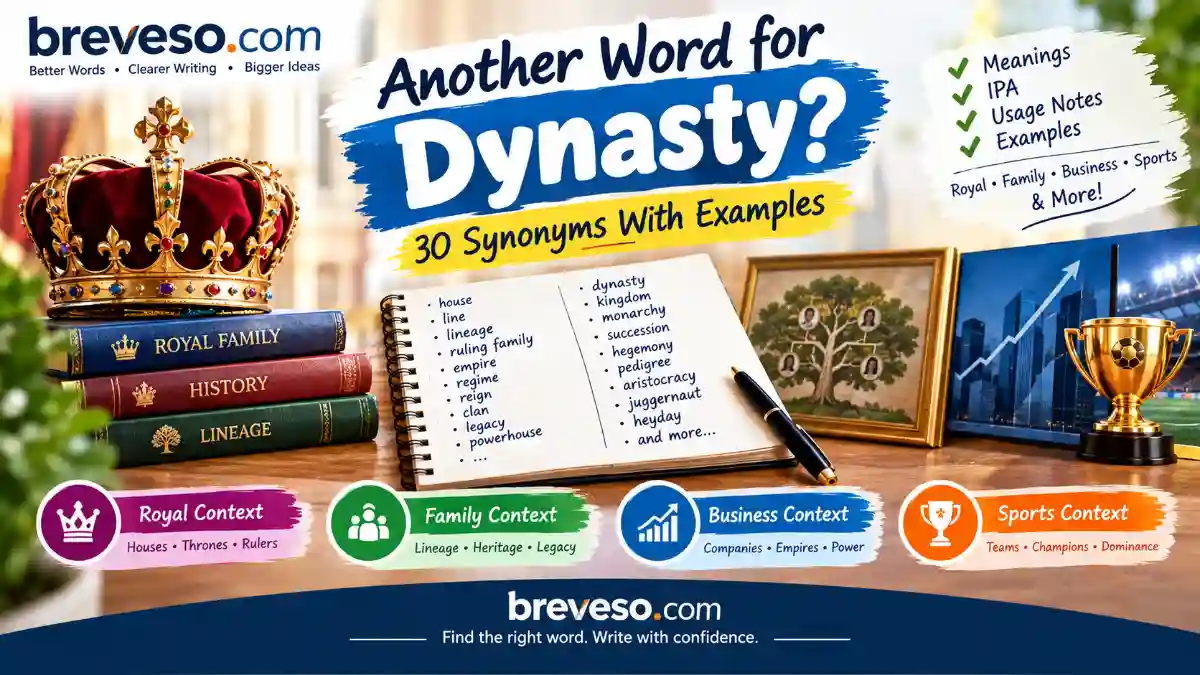
The closest everyday alternatives to dynasty are house, line, lineage, and ruling family. They all describe a family whose members hold power one after another. The best choice depends on what you mean. You might be talking about a royal family, a period of rule, a powerful non-royal family, or a sports team that keeps winning.
Dynasty began as a word for kings and emperors, but it is now also used for business families, political families, and champion teams. Some alternatives fit only one of these uses, so the right word depends on the context.
Quick list: house, royal house, line, lineage, ruling family, regime, reign, clan, empire, powerhouse
This article looks at 30 alternatives. Each one has a meaning, IPA, a usage note, and an example, so you can see how it differs from dynasty.
At a Glance: Dynasty Synonyms and Related Alternatives
| Alternative | Part of Speech | Meaning | Register / Tone | Ideal Context |
| House | Noun | A royal or noble family line | Neutral, historical | European royalty, noble families |
| Line | Noun | A series of family members, one after another | Neutral | Succession, family history |
| Lineage | Noun | Descent from an ancestor | Formal | Family history, genealogy |
| Ruling family | Noun phrase | A family that holds power over a country | Neutral | News, politics, history |
| Regime | Noun | A government in power | Neutral to critical | Modern politics, governments |
| Reign | Noun | The time a ruler is in power | Neutral | Single rulers |
| Empire | Noun | Many lands or peoples under one ruler | Neutral | Territory and power |
| Clan | Noun | A large group of related families | Neutral, informal | Powerful families |
| Powerhouse | Noun | A very strong person, team, or group | Informal | Sports, business |
| Legacy | Noun | Something passed down from the past | Neutral | Lasting influence |
Which Word Should You Use?
| If you want to… | Use | Why |
| Name a royal family in history | House or royal house | These are the standard terms, as in “House of Habsburg.” |
| Talk about one ruler’s time in power | Reign | A reign belongs to one ruler. A dynasty covers several. |
| Describe a government, not a family | Regime | It focuses on how a country is governed. |
| Talk about land and peoples ruled | Empire or kingdom | These words describe territory, not family. |
| Stress family descent | Lineage or bloodline | They focus on who descended from whom. |
| Describe a powerful non-royal family | Clan or political family | They suit families in politics, business, or society. |
| Describe a team that keeps winning | Powerhouse or juggernaut | They suit sports and business. |
| Describe the best years of a group | Heyday or golden age | They describe a peak period, not a family. |
Exploring the Multiple Meanings of “Dynasty”
1. A Ruling Family Line
- Meaning: A series of rulers from the same family.
- Explanation: This is the oldest and most common sense. Rule passes from one family member to another, often through several generations.
- Example: The Plantagenet dynasty produced 14 kings of England.
2. The Period of Rule
- Meaning: The time during which such a family stays in power.
- Explanation: Here the word works like a label for an era. This is why we say a vase is “from the Ming dynasty.”
- Example: Trade grew quickly during the Tang dynasty.
3. A Powerful Family Outside Royalty
- Meaning: A family that keeps wealth, influence, or power for a long time.
- Explanation: Dictionaries now include business and political families in this sense. It does not need a throne.
- Example: She was born into a powerful political dynasty.
4. A Sports Team With Long Success
- Meaning: A team that wins many championships over a long period.
- Explanation: This is a figurative use. The team may not have the same “family,” but it keeps its power for years.
- Example: The team built a dynasty by winning five titles in six years.
5. A Line of Notable People in One Field
- Meaning: A family or group in which success passes from one generation to the next.
- Explanation: People use this for artists, actors, or other professionals. It is informal and often loose in meaning.
- Example: Her family is a wrestling dynasty.
Sources: Merriam-Webster; Dictionary.com; Wikipedia (“Dynasty”); Grammarphobia.
Analyzing 30 Dynasty Alternatives in Detail
Some of these words are close synonyms for dynasty, while others are related alternatives that only fit certain contexts. Each usage note says which kind it is.
Group 1: Ruling-Family Terms
1. House
IPA: /haʊs/ (US and UK)
Definition: A family line, especially a royal or noble one.
- Usage: A close synonym in historical writing. A house may or may not have ruled, so it is slightly broader than dynasty.
- Example: The House of Habsburg ruled Austria until 1918.
2. Royal house
IPA: /ˈrɔɪ.əl haʊs/ (US and UK)
Definition: A family line whose members have ruled as kings or queens.
- Usage: A close synonym. It is clearer than house when you want to stress royalty.
- Example: The royal house gave the country four kings.
3. Line
IPA: /laɪn/ (US and UK)
Definition: A series of people from the same family, one after another.
- Usage: A direct but plainer synonym. It is often used with a ruler’s name or the word royal.
- Example: The last king of that line died without an heir.
4. Lineage
IPA: /ˈlɪn.i.ɪdʒ/ (US and UK)
Definition: Descent in a direct line from an ancestor.
- Usage: A related alternative. It stresses ancestry, not power or rule, so it does not always mean a ruling family.
- Example: The king traced his lineage back to the first emperor.
5. Ruling family
IPA: US /ˈruː.lɪŋ ˈfæm.ə.li/ · UK /ˈruː.lɪŋ ˈfæm.əl.i/
Definition: A family whose members hold power over a country or region.
- Usage: A plain, clear synonym for the first sense. It is common in news writing.
- Example: The ruling family has controlled the country for decades.
6. Royal family
IPA: US /ˈrɔɪ.əl ˈfæm.ə.li/ · UK /ˈrɔɪ.əl ˈfæm.əl.i/
Definition: The family of a king or queen.
- Usage: A related alternative. It names the current family, while dynasty covers the whole line over time.
- Example: The royal family waved from the palace balcony.
7. Dynast
IPA: /ˈdaɪ.næst/ (US and UK)
Definition: A ruler who belongs to a dynasty, or a member of a powerful family.
- Usage: A related word for a person, not a family. Do not use it where you mean the whole line.
- Example: The young dynast was expected to lead the family company.
Group 2: Rule and Government Terms
8. Regime
IPA: /reɪˈʒiːm/ (US and UK)
Definition: A form of government, or a particular government in power.
- Usage: A related alternative. It focuses on how a country is governed, and it is often used for governments the speaker dislikes. It does not require a family line.
- Example: The old regime fell after the revolution.
9. Reign
IPA: /reɪn/ (US and UK)
Definition: The period during which a monarch rules.
- Usage: A related word. A reign belongs to one ruler, so it is narrower than dynasty.
- Example: The kingdom grew rich during her reign.
10. Monarchy
IPA: US /ˈmɑː.nɑːr.ki/ · UK /ˈmɒn.ə.ki/
Definition: A government headed by a king or queen, or a country with such a government.
- Usage: A related word. It describes the system, not the family. A monarchy can be ruled by several dynasties over time.
- Example: The country was a monarchy for nearly a thousand years.
11. Empire
IPA: US /ˈɛm.paɪər/ · UK /ˈɛm.paɪə/
Definition: A large group of lands or peoples under one ruler or government.
- Usage: A related word that describes land, not family. A dynasty can rule an empire, but the two are not the same thing.
- Example: The Ottoman dynasty ruled a vast empire.
12. Era
IPA: US /ˈɪr.ə/ · UK /ˈɪə.rə/
Definition: A long period of time marked by certain events, people, or conditions.
- Usage: A related alternative for the “period of rule” sense. It works only when the focus is time.
- Example: Art flourished during the Ming era.
13. Rule
IPA: /ruːl/ (US and UK)
Definition: Government or control over a place, or the period of that control.
- Usage: A related alternative. It often appears with a family name, as in “Qing rule.”
- Example: Under Qing rule, the capital moved several times.
Group 3: Succession and Descent Terms
14. Succession
IPA: /səkˈsɛʃ.ən/ (US and UK)
Definition: A series of people who follow one another in the same position.
- Usage: A related word. It can describe a dynasty’s order of rulers, but it also fits any series, such as a succession of managers.
- Example: A succession of weak kings ended the family’s power.
15. Descent
IPA: /dɪˈsɛnt/ (US and UK)
Definition: Family origin, or the fact of being born into a particular family line.
- Usage: A related word that stresses ancestry. It does not suggest rule or power.
- Example: He claimed descent from the royal family.
16. Bloodline
IPA: /ˈblʌd.laɪn/ (US and UK)
Definition: A line of descent from one ancestor.
- Usage: A related word. It sounds more dramatic than lineage and is common in stories and fiction.
- Example: The throne passed along the royal bloodline.
17. Ancestry
IPA: /ˈæn.sɛs.tri/ (US and UK)
Definition: The line of people from whom someone is descended.
- Usage: A related word. It looks backward at ancestors, while dynasty looks at a line of rulers.
- Example: Her ancestry includes several kings.
Group 4: Powerful Families and Groups
18. Clan
IPA: /klæn/ (US and UK)
Definition: A large group of related families, often sharing a name.
- Usage: A related word, often used for non-royal families. It can sound informal or slightly dramatic when applied to politics or business.
- Example: The family clan controlled the region’s shipping.
19. Political family
IPA: US /pəˈlɪt.ɪ.kəl ˈfæm.ə.li/ · UK /pəˈlɪt.ɪ.kəl ˈfæm.əl.i/
Definition: A family with several members who hold public office.
- Usage: A descriptive phrase, not a dictionary entry. It is a clear plain-English alternative for the “political dynasty” sense.
- Example: The political family has produced two governors and a senator.
20. Aristocracy
IPA: US /ˌɛr.ɪˈstɑː.krə.si/ · UK /ˌær.ɪˈstɒk.rə.si/
Definition: The highest social class, made up of noble families.
- Usage: A related word. It names a whole class, not one family line.
- Example: Most of the land belonged to the aristocracy.
21. Establishment
IPA: /ɪˈstæb.lɪʃ.mənt/ (US and UK)
Definition: The group of leaders who hold power and influence in a society.
- Usage: A related word. It suggests a powerful circle, not a family, and can sound critical.
- Example: The newspaper challenged the political establishment.
22. Elite
IPA: /ɪˈliːt/ (US and UK)
Definition: The most powerful or privileged group within a larger group.
- Usage: A related word. It describes rank and power, not family descent.
- Example: A small elite controlled the country’s wealth.
Group 5: Sports and Long Success
23. Powerhouse
IPA: US /ˈpaʊ.ɚ.haʊs/ · UK /ˈpaʊ.ə.haʊs/
Definition: A person, team, or group with great strength or energy.
- Usage: A related alternative for the sports sense. It describes strength, but it does not require years of success.
- Example: The club became a powerhouse in European football.
24. Juggernaut
IPA: US /ˈdʒʌɡ.ɚ.nɑːt/ · UK /ˈdʒʌɡ.ə.nɔːt/
Definition: A huge, powerful force that is very hard to stop.
- Usage: A related word for a winning team or company. It stresses force and size more than family or time.
- Example: The team was a juggernaut all season.
25. Golden age
IPA: US /ˈɡoʊl.dən ˈeɪdʒ/ · UK /ˈɡəʊl.dən ˈeɪdʒ/
Definition: A period of great success and prosperity.
- Usage: A related alternative. It describes a time, not a team or family, and often looks back on the period fondly.
- Example: Fans still call the 1990s the club’s golden age.
26. Heyday
IPA: /ˈheɪ.deɪ/ (US and UK)
Definition: The period of greatest success or power.
- Usage: A related word. It points to the peak of a team, family, or business.
- Example: In its heyday, the family firm employed thousands of workers.
Group 6: Inheritance and Dominance
27. Legacy
IPA: /ˈlɛɡ.ə.si/ (US and UK)
Definition: Something handed down from earlier people or from the past.
- Usage: A related word. It is not a synonym, but it fits the idea of power or fame passing across generations.
- Example: The family’s legacy shaped the town for a century.
28. Hegemony
IPA: /hɪˈdʒɛm.ə.ni/ (US and UK)
Definition: Control or influence by one state or group over others.
- Usage: A formal related word. It describes dominance, not family. It fits long periods of power in politics, trade, or sport.
- Example: The league saw a decade of one club’s hegemony.
29. Pedigree
IPA: /ˈpɛd.ɪ.ɡriː/ (US and UK)
Definition: A record of a person’s or animal’s ancestors, or a distinguished family background.
- Usage: A related word that stresses background and status. It does not suggest ruling or winning.
- Example: The candidate came from a family with a strong political pedigree.
30. Kingdom
IPA: /ˈkɪŋ.dəm/ (US and UK)
Definition: A country or territory ruled by a king or queen.
- Usage: A related word for the land being ruled, not the ruling family.
- Example: The kingdom passed from one dynasty to another.
Sources: Merriam-Webster; Dictionary.com; Etymonline; Wikipedia (“Dynasty”).
Dynasty vs. House vs. Empire vs. Regime
These four words are often mixed up. Each one points to something different.
| Word | What it describes | Example |
| Dynasty | A line of rulers from one family, or their period of rule | The Qing dynasty |
| House | A royal or noble family, not always one that ruled | The House of Habsburg |
| Empire | The lands and peoples under one ruler | The Ottoman Empire |
| Regime | The government in power | The old regime |
A single dynasty can rule an empire, and the same house can be called a dynasty when it rules over several generations. A regime may or may not be a family line at all.
Sources: Merriam-Webster; Etymonline; Wikipedia (“Dynasty,” “House of Habsburg”).
Dynasty and Opposite/Paired Word Pairs
| Word | Paired Word | Note |
| Dynasty | Republic | A republic has no hereditary monarch, but dynasties can still appear in republics. |
| Dynasty | Interregnum | The gap between two reigns or ruling lines. |
| Dynasty | Dynast | The family line and one person in it. |
| Dynasty | Empire | The family and the lands it rules. |
| Dynasty | Succession | The line of rulers and the way power passes on. |
| Dynasty | Upstart | An informal contrast: an old family versus a newcomer. |
Dynasty has no perfect opposite. The pairs above are contrasts or close partners. A republic is the nearest political contrast, but it is not a strict antonym, because powerful families can still dominate a republic.
Sources: Merriam-Webster; Wikipedia (“Dynasty”).
Common Word Partners of “Dynasty”
| Pattern | Common Partners | Example |
| Adjective + dynasty | ruling, royal, imperial, ancient, political, business | The ruling dynasty lost power in 1912. |
| Name + dynasty | Ming, Qing, Tang, Habsburg, Plantagenet | The Tang dynasty ruled for nearly three centuries. |
| Verb + dynasty | found, establish, build, overthrow, end | He founded a dynasty that lasted two hundred years. |
| Dynasty + verb | rule, fall, collapse, last | The dynasty fell after a long civil war. |
| Type + dynasty | family, sports, political, business | The team built a sports dynasty in the 1980s. |
Sources: Merriam-Webster; Dictionary.com; Wikipedia (“Dynasty”).
Idiomatic Phrases Featuring “Dynasty”
Dynasty has no true idioms. The items below are established expressions, not idioms.
1. Political dynasty
- Meaning: A family whose members hold political office across generations.
- Example: She belongs to a well-known political dynasty.
2. Sports dynasty
- Meaning: A team that wins many titles over a long period.
- Example: Fans still talk about the sports dynasty of the 1990s.
3. Dynasty trust
- Meaning: A legal arrangement designed to pass family wealth through several generations.
- Example: The family set up a dynasty trust to protect its property.
4. The Virginia dynasty
- Meaning: A historical term for the early American presidents from Virginia, usually Jefferson, Madison, and Monroe.
- Example: Historians often discuss the Virginia dynasty as a single political era.
Sources: Dictionary.com; Merriam-Webster.
Word Formation of “Dynasty”
Etymology & Structure
Dynasty comes from Medieval Latin dynastia, from Greek dynasteia, meaning “power” or “lordship.” The Greek word comes from dynastes, “ruler,” which comes from dynasthai, “to have power.” Etymonline says the origin of dynasthai is unknown.
Date and History
Etymonline dates the English word to the mid-1400s, with an earlier form, dynastia, in the late 1300s. Merriam-Webster places the first known use in the 14th century. Historian Natalia Nowakowska notes that the word once meant “government” or “regime” in general. Its sense of a hereditary line of princes became standard after 1755, when volume 5 of the French Encyclopédie was published.
Word Class Variations
- Noun: dynasty (plural: dynasties)
- Noun (person): dynast
- Adjective: dynastic (also dynastical)
- Adverb: dynastically
Sources: Etymonline; Merriam-Webster; Dictionary.com; Nowakowska, University of Oxford.
Common Word-Choice Mistakes
- The dynast ruled for 300 years: use dynasty. A dynast is one person, and a dynasty is the family line.
- The dynasty ruled alone: use ruler or king when you mean one person.
- The dynasty covered three continents: use empire for land and territory.
- A dynasty politics: use dynastic politics, since dynastic is the adjective.
- He raised a dynasty: use founded or built a dynasty.
- The dynasty lasted one reign: use reign when only one ruler is involved.
- The team won a dynasty: use built a dynasty, because a dynasty is a period of success, not a prize.
Frequently Asked Questions
What is the closest synonym for dynasty?
The closest everyday synonyms are house, line, and ruling family. They all describe a family that holds power over time.
Is a dynasty the same as an empire?
No. A dynasty is a family line, and an empire is a large area under one ruler. A dynasty can rule an empire, but they are different things.
What is the difference between a dynasty and a house?
A house is a royal or noble family and may not have ruled. A dynasty is a line of rulers from one family.
Can dynasty be used for non-royal families?
Yes. Dictionaries include powerful business and political families, such as a “political dynasty.”
Can a sports team be a dynasty?
Yes. Merriam-Webster lists this sense. It describes a team that keeps winning over several years.
What is a person from a dynasty called?
A dynast. The word can mean a ruler in a dynasty or a member of a powerful family.
What is the adjective for dynasty?
Dynastic, as in “dynastic rule.” Dynastical also exists, but it is less common.
What is a more formal alternative to dynasty?
Lineage and hegemony are formal related words, though hegemony means dominance, not family.
What is the opposite of dynasty?
There is no exact opposite. A republic is the nearest political contrast, and an interregnum is the gap between two rulers.
How is dynasty pronounced?
In US English, it is often “DYE-nuh-stee.” Merriam-Webster notes that a British pronunciation, “DIN-uh-stee,” is also used.
Conclusion
The closest alternatives to dynasty are house, line, lineage, and ruling family. They work best when the focus is a family that held power across generations. Words like reign, regime, and empire are related, but they describe time, government, or land.
Context decides the best choice. Clan and political family suit powerful non-royal families. Powerhouse, juggernaut, and heyday suit sports and business. Legacy and pedigree describe what is passed down, not who rules.
To choose well, ask what you want to describe: a family, a period, a government, or a winning team. Pick the word that matches that focus, and check if it is a true synonym or a related alternative.

Ali Bismal is the founder and writer behind Breveso.com, where he helps readers find the perfect synonym for every word. What started as a simple love for words turned into a growing library of “another word for ___” guides covering emotions, actions, slang, and everyday language.
Ali believes the right word can sharpen a sentence, and the wrong one can blur it. That is why every Breveso guide is written in plain, simple English, grouped in a way that actually makes sense, and checked for real-world use.
He writes for students, writers, and anyone who has ever stared at a sentence thinking there must be a better word for this. Clean, useful content that answers the question fast, that is the whole mission.