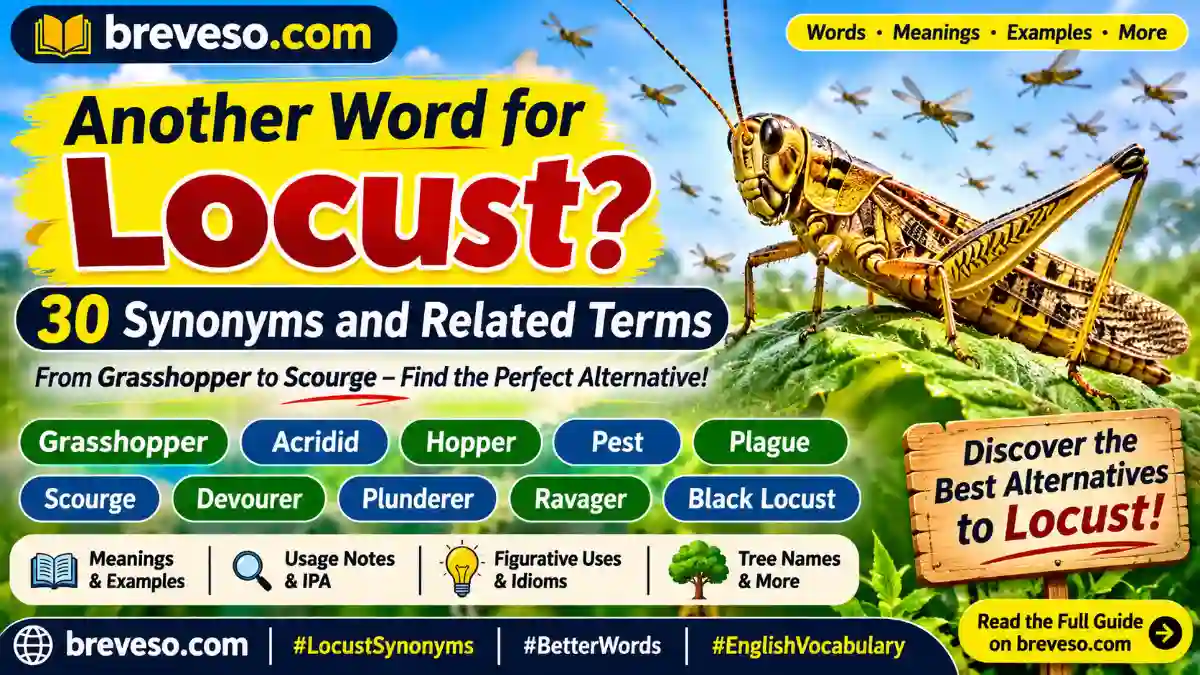
The closest everyday word for locust is grasshopper, because locusts are a type of grasshopper that swarms. Scientists also use acridid, and pest-control writers use hopper for young locusts. In figurative writing, people use scourge, plague, devourer, or plunderer for a greedy, destructive force.
The best alternative depends on the meaning you need. Locust can name an insect, a swarm-like threat, a noisy cicada in everyday US speech, or a tree such as the black locust. Each sense has its own set of related words.
Quick list: grasshopper, acridid, hopper, pest, plague, scourge, infestation, devourer, ravager, plunderer
This article covers 30 alternatives with meanings, IPA, usage notes, examples, and context. Some are close synonyms. Others only fit one sense of locust.
Table of Contents
- At a Glance: Locust Synonyms and Related Alternatives
- Which Word Should You Use?
- Exploring the Multiple Meanings of “Locust”
- Analyzing 30 Locust Alternatives in Detail
- Locust vs. Grasshopper vs. Cicada
- Locust and Related Word Pairs
- Common Word Partners of “Locust”
- Idiomatic Phrases Featuring “Locust”
- Word Formation of “Locust”
- Common Word-Choice Mistakes
- Frequently Asked Questions
- Conclusion
At a Glance: Locust Synonyms and Related Alternatives
| Alternative | Part of Speech | Meaning | Register / Tone | Ideal Context |
| Grasshopper | noun | Jumping, plant-eating insect | Neutral | Everyday speech, nature writing |
| Acridid | noun | Insect of the family Acrididae | Technical | Science and agriculture |
| Hopper | noun | Young, wingless locust | Technical | Pest control, farming |
| Cicada | noun | Loud, tree-dwelling insect | Neutral | US folk naming, nature talk |
| Pest | noun | Creature that harms crops | Neutral | Farming, news reports |
| Plague | noun | Large, harmful outbreak | Dramatic | Biblical or news writing |
| Scourge | noun | Cause of great suffering | Literary, formal | Figurative writing |
| Devourer | noun | One that eats greedily | Literary | Figurative writing |
| Plunderer | noun | One who robs by force | Formal | History, figurative use |
| Black locust | noun | North American tree | Neutral | Gardening, forestry |
Which Word Should You Use?
| If you want to… | Use | Why |
| Name the insect in plain English | grasshopper | Everyone knows it, and locusts belong to the group |
| Write in a scientific style | acridid | It names the insect family exactly |
| Talk about young locusts | hopper | Experts use it for the wingless stage |
| Describe an outbreak in the news | plague or infestation | Both focus on the size of the problem |
| Call a greedy group destructive | devourer or ravager | They suggest eating or wrecking everything |
| Write about armies or raiders | plunderer or pillager | They carry a sense of theft and force |
| Describe a person who lives off others | parasite | It points to taking without giving |
| Name the tree | black locust or honey locust | Each names a real tree species |
Exploring the Multiple Meanings of “Locust”
1. The Swarming Insect
- Meaning: A grasshopper that gathers in huge swarms and destroys crops.
- Explanation: Locusts are short-horned grasshoppers. When crowded, they change in behavior and body, then fly together in large groups. This sense is the most common one.
- Example: A swarm of locusts stripped the wheat fields in a single afternoon.
2. A Destructive Person or Force
- Meaning: Someone or something that eats up, ruins, or drains resources.
- Explanation: Writers use locust as a metaphor for greed or ruin. The sense draws on the insect’s habit of stripping land bare. It usually appears in the plural.
- Example: Critics called the investors locusts that left the company empty.
3. A Cicada (Informal, US)
- Meaning: A cicada, especially the periodical cicada.
- Explanation: Many Americans call cicadas locusts, as in “seventeen-year locust.” The two insects are unrelated, and true cicadas do not swarm to eat crops.
- Example: The seventeen-year locusts filled the trees with noise.
4. A Locust Tree
- Meaning: Any of several trees, such as the black locust or honey locust.
- Explanation: These trees have no link to the insect. Some dictionaries also use “locust” for the carob tree and its pods.
- Example: We planted a honey locust to shade the yard.
Sources: Merriam-Webster, Dictionary.com, Collins English Dictionary, Britannica
Analyzing 30 Locust Alternatives in Detail
Some alternatives below are close synonyms, while others fit only one meaning of locust. Each Usage note says which kind a word is.
Insect Terms
1. Grasshopper
IPA: US /ˈɡræsˌhɑːpər/ · UK /ˈɡrɑːsˌhɒpə/
Definition: A plant-eating insect with long back legs used for jumping.
- Usage: The closest everyday synonym, but not exact. Every locust is a grasshopper, yet most grasshoppers never form swarms.
- Example: A green grasshopper sat on the corn leaf, and it was not a locust.
2. Short-horned grasshopper
IPA: US /ˌʃɔːrtˈhɔːrnd ˈɡræsˌhɑːpər/ · UK /ˌʃɔːtˈhɔːnd ˈɡrɑːsˌhɒpə/
Definition: A grasshopper with short antennae, in the family Acrididae.
- Usage: The exact group that locusts belong to. It suits science and teaching texts.
- Example: Locusts are short-horned grasshoppers that swarm under certain conditions.
3. Acridid
IPA: /ˈækrɪdɪd/ (US and UK)
Definition: Any insect in the family Acrididae.
- Usage: A technical word. It covers locusts and ordinary short-horned grasshoppers alike, so it is broader than locust.
- Example: The museum labeled the specimen as an acridid.
4. Hopper
IPA: US /ˈhɑːpər/ · UK /ˈhɒpə/
Definition: A young locust that has no wings yet.
- Usage: A related term, not a full synonym. Pest-control writers use it for the nymph stage.
- Example: Crews sprayed the field before the hoppers grew wings.
Insects Often Confused With Locusts
5. Cicada
IPA: US /sɪˈkeɪdə/ · UK /sɪˈkɑːdə/
Definition: A large insect that makes a loud, buzzing sound from trees.
- Usage: Not a true synonym. Some Americans use locust for cicadas, but the insects are unrelated.
- Example: The cicadas sang so loudly that we could not talk outside.
6. Katydid
IPA: /ˈkeɪtidɪd/ (US and UK)
Definition: A green, long-horned insect that sings at night.
- Usage: A look-alike, not a synonym. Katydids resemble grasshoppers but do not form crop-destroying swarms.
- Example: A katydid called from the bush after sunset.
7. Cricket
IPA: /ˈkrɪkɪt/ (US and UK)
Definition: A jumping insect that chirps by rubbing its wings together.
- Usage: A related insect only. It appears in this list because people sometimes mix up jumping insects.
- Example: A cricket chirped under the porch all night.
Plague and Pest Terms
8. Pest
IPA: /pest/ (US and UK)
Definition: An insect or animal that harms crops or bothers people.
- Usage: A broad word, so it is a related term, not an exact synonym. Locusts count as pests, but so do many other creatures.
- Example: Farmers treat the locust as their most feared pest.
9. Plague
IPA: /pleɪɡ/ (US and UK)
Definition: A sudden, large outbreak of harmful creatures or disease.
- Usage: It describes the event, not the insect. “Plague of locusts” is a well-known expression with biblical roots.
- Example: A plague of locusts hit the region after the rains.
10. Scourge
IPA: US /skɜːrdʒ/ · UK /skɜːdʒ/
Definition: A cause of great suffering or trouble.
- Usage: A formal, literary word for a figurative locust. It names the harm, not the creature.
- Example: Hunger remained the scourge of the countryside.
11. Infestation
IPA: /ˌɪnfeˈsteɪʃən/ (US and UK)
Definition: The presence of harmful creatures in large numbers.
- Usage: A neutral news word for the problem a locust swarm causes. It does not name the insect.
- Example: Officials warned about a locust infestation near the border.
12. Swarm
IPA: US /swɔːrm/ · UK /swɔːm/
Definition: A large group of insects moving together.
- Usage: It describes behavior, not the insect itself. Locusts are famous for it.
- Example: A dark swarm covered the sky.
13. Blight
IPA: /blaɪt/ (US and UK)
Definition: Something that harms or ruins, or a disease that kills plants.
- Usage: A figurative, related word. The plant-disease meaning has no link to locusts.
- Example: The empty lots became a blight on the town.
Destroyers and Devourers
14. Devourer
IPA: US /dɪˈvaʊərər/ · UK /dɪˈvaʊərə/
Definition: One that eats greedily or uses up completely.
- Usage: A literary, figurative alternative. It fits the locust’s habit of eating everything.
- Example: The company became a devourer of small shops.
15. Destroyer
IPA: US /dɪˈstrɔɪər/ · UK /dɪˈstrɔɪə/
Definition: Someone or something that ruins or wrecks.
- Usage: A plain, general word. It lacks the eating image that locust carries.
- Example: The storm was a destroyer of crops and homes.
16. Ravager
IPA: US /ˈrævɪdʒər/ · UK /ˈrævɪdʒə/
Definition: One that causes great damage.
- Usage: A strong, literary word. It suits writing about war, fire, or disaster, and it works for locusts as a figure of speech.
- Example: Famine arrived as a ravager of villages.
17. Despoiler
IPA: US /dɪˈspɔɪlər/ · UK /dɪˈspɔɪlə/
Definition: Someone who robs or ruins a place.
- Usage: A formal, rare word. It matches the sense of stripping land bare.
- Example: Historians described the army as a despoiler of farmland.
18. Plunderer
IPA: US /ˈplʌndərər/ · UK /ˈplʌndərə/
Definition: One who steals goods by force, often during war.
- Usage: A related word for the human, figurative sense. It stresses theft more than eating.
- Example: The plunderers took everything from the harbor.
19. Pillager
IPA: US /ˈpɪlɪdʒər/ · UK /ˈpɪlɪdʒə/
Definition: One who strips a place of its goods by force.
- Usage: A close cousin of plunderer, found mostly in history writing.
- Example: Pillagers burned the barns and left the fields bare.
Raiders and Exploiters
20. Marauder
IPA: US /məˈrɔːdər/ · UK /məˈrɔːdə/
Definition: One who roams about in search of things to steal.
- Usage: It stresses movement and raiding. A swarm of locusts also moves from place to place.
- Example: Marauders crossed the hills each autumn.
21. Raider
IPA: US /ˈreɪdər/ · UK /ˈreɪdə/
Definition: One who attacks suddenly to steal or harm.
- Usage: A plain word for a human attacker. It is a distant figurative match for locust.
- Example: The raiders left before the guards arrived.
22. Looter
IPA: US /ˈluːtər/ · UK /ˈluːtə/
Definition: One who steals goods during a time of disorder.
- Usage: A related word only. It fits a crowd that takes everything, as locusts do.
- Example: Looters emptied the shop after the storm.
23. Predator
IPA: US /ˈpredətər/ · UK /ˈpredətə/
Definition: An animal that hunts others, or a person who exploits others.
- Usage: A weak match for locust, since locusts eat plants. It works only for the exploiting-person sense.
- Example: Lenders who trap poor families are financial predators.
24. Parasite
IPA: /ˈpærəsaɪt/ (US and UK)
Definition: A living thing that feeds on another, or a person who lives off others.
- Usage: A figurative alternative. It means taking without giving back, which is narrower than locust.
- Example: He saw the firm as a parasite on small farmers.
25. Vermin
IPA: US /ˈvɜːrmɪn/ · UK /ˈvɜːmɪn/
Definition: Small animals or insects that harm crops or spread disease.
- Usage: It groups locusts with other harmful creatures. It can sound harsh when used for people.
- Example: Farmers fought the vermin that ate their crops.
Tree Terms
26. Black locust
IPA: US /ˌblæk ˈloʊkəst/ · UK /ˌblæk ˈləʊkəst/
Definition: A North American tree with white flowers and hard wood.
- Usage: A specific tree, not a synonym. It fits only the tree sense of locust.
- Example: Black locust posts last for years in the ground.
27. Honey locust
IPA: US /ˈhʌni ˌloʊkəst/ · UK /ˈhʌni ˌləʊkəst/
Definition: A thorny North American tree with long, flat pods.
- Usage: Another named tree. People often plant it for shade.
- Example: The honey locust dropped long brown pods on the lawn.
28. False acacia
IPA: US /ˌfɔːls əˈkeɪʃə/ · UK /ˌfɒls əˈkeɪʃə/
Definition: Another name for the black locust.
- Usage: A related name for the tree, found in gardening and European sources.
- Example: The park labeled the tree as a false acacia.
29. Thorny locust
IPA: US /ˈθɔːrni ˈloʊkəst/ · UK /ˈθɔːni ˈləʊkəst/
Definition: Another name for the honey locust.
- Usage: A less common name for the same tree, and it mentions the thorns.
- Example: Gloves help when you trim a thorny locust.
30. Carob
IPA: /ˈkærəb/ (US and UK)
Definition: A Mediterranean tree whose sweet pods people eat.
- Usage: A related term only. Some dictionaries link locust bean to the carob pod.
- Example: The bakery used carob powder in place of cocoa.
Sources: Merriam-Webster, Dictionary.com, Collins English Dictionary, Britannica
Locust vs. Grasshopper vs. Cicada
| Insect | What It Is | Swarms and Eats Crops? | Key Note |
| Locust | A short-horned grasshopper | Yes, when crowded | A behavior-based label |
| Grasshopper | A jumping, plant-eating insect | Rarely at that scale | The wider group |
| Cicada | A loud, tree-dwelling insect | No | Unrelated to locusts |
A locust is not a separate family. It is a grasshopper that, under crowded conditions, changes behavior and joins a swarm. Cicadas live on tree sap, so they do not strip fields. The US habit of calling them locusts is a folk name.
Sources: Merriam-Webster, Britannica
Locust and Related Word Pairs
| Word | Paired Word | Note |
| Locust | Grasshopper | Same insect group, different behavior |
| Locust | Cicada | Often confused in the US |
| Black locust | Honey locust | Two different trees |
| Locusts | Wild honey | A biblical food pairing |
| Locusts | Famine | A common link in news and history |
Locust has no true antonym. Its figurative sense has no neat opposite, since a builder or a provider would only contrast with it loosely. The pairs above show the words people most often place next to it.
Sources: Merriam-Webster, Collins English Dictionary
Common Word Partners of “Locust”
| Pattern | Common Partners | Example |
| Noun + of locusts | swarm, plague, cloud | A cloud of locusts darkened the sky. |
| Adjective + locust | desert, migratory, red, black, honey | The desert locust can travel far. |
| Locust + noun | swarm, outbreak, bean, tree, wood | Locust bean gum thickens many foods. |
| Verb + locusts | control, track, fight | Teams track locusts by satellite and field reports. |
Sources: Collins English Dictionary, Merriam-Webster
Idiomatic Phrases Featuring “Locust”
1. Plague of locusts
- Meaning: A sudden, huge swarm of locusts, or any overwhelming flood of trouble. The phrase comes from the Bible’s story of the plagues of Egypt.
- Example: Reporters described the sales as a plague of locusts on the small stores.
2. The years the locust hath eaten
- Meaning: Years of loss and waste. The phrase comes from the Book of Joel in the King James Bible.
- Example: She called her long illness the years the locust hath eaten.
3. Locusts and wild honey
- Meaning: A plain, simple diet. The Gospels of Matthew and Mark describe John the Baptist eating it.
- Example: On the trail, they lived on locusts and wild honey, as the old saying goes.
Sources: Merriam-Webster, Collins English Dictionary
Word Formation of “Locust”
Etymology & Structure
Locust is a single root word with no clear prefix or suffix. It entered Middle English through Old French locuste, from Latin locusta. The Latin word meant both “locust” and “lobster.” English lobster and locust are related through that Latin source.
Date and History
Dictionary.com dates the word to the years 1150–1200 in Middle English.
Word Class Variations
- Noun: locust, locusts
- Adjective: locustal (rare), used in scientific writing
Locust has no standard verb or adverb form.
Sources: Etymonline, Dictionary.com, Merriam-Webster
Common Word-Choice Mistakes
- A locust of insects: a swarm of locusts.
- A plague of locust: a plague of locusts.
- Cicadas are locusts: cicadas are a different insect, though some people call them locusts.
- Locusts and grasshoppers are unrelated: locusts are grasshoppers that swarm.
- Locust tree means the insect’s home: the locust tree is a plant with no link to the insect.
- A locust is a cricket: a locust is a grasshopper, and a cricket is a different insect.
- Hopper for any adult locust: hopper means a young, wingless locust.
Frequently Asked Questions
What is the closest synonym for locust?
Grasshopper is the closest everyday word. It is broader, because only some grasshoppers swarm.
Is a locust a grasshopper?
Yes. A locust is a short-horned grasshopper that gathers in swarms under certain conditions.
What is the difference between a locust and a cicada?
They are unrelated insects. Locusts eat plants in large swarms, while cicadas drink tree sap and sing loudly.
What are young locusts called?
People call them hoppers. They have no wings and move by jumping and walking.
What is a formal word for locust?
Acridid is a formal, scientific term for the insect family that includes locusts.
What does locust mean figuratively?
It means a greedy person or force that eats up or ruins everything. Scourge and devourer fit this sense.
Can locust be used for people?
Yes, but only as a metaphor. It is usually harsh and plural, as in “financial locusts.”
Is the locust tree related to the insect?
No. The tree is a plant that shares the name. Black locust and honey locust are the main examples.
What is the plural of locust?
The plural is locusts. People say “a swarm of locusts,” not “a swarm of locust.”
What is the opposite of locust?
Locust has no true antonym. In the figurative sense, words like builder or provider contrast loosely.
Conclusion
The closest everyday alternative to locust is grasshopper. Acridid fits scientific writing, and hopper names the young, wingless stage. For figurative use, scourge, devourer, and plunderer carry the idea of greedy destruction.
Context decides the best choice. Locust can mean an insect, a destructive force, a cicada in casual US speech, or a tree. A word that fits one sense may fail in another.
To pick the right word, first decide which sense you mean. Then match the tone: plain for everyday talk, technical for science, dramatic for figurative writing.

Ali Bismal is the founder and writer behind Breveso.com, where he helps readers find the perfect synonym for every word. What started as a simple love for words turned into a growing library of “another word for ___” guides covering emotions, actions, slang, and everyday language.
Ali believes the right word can sharpen a sentence, and the wrong one can blur it. That is why every Breveso guide is written in plain, simple English, grouped in a way that actually makes sense, and checked for real-world use.
He writes for students, writers, and anyone who has ever stared at a sentence thinking there must be a better word for this. Clean, useful content that answers the question fast, that is the whole mission.