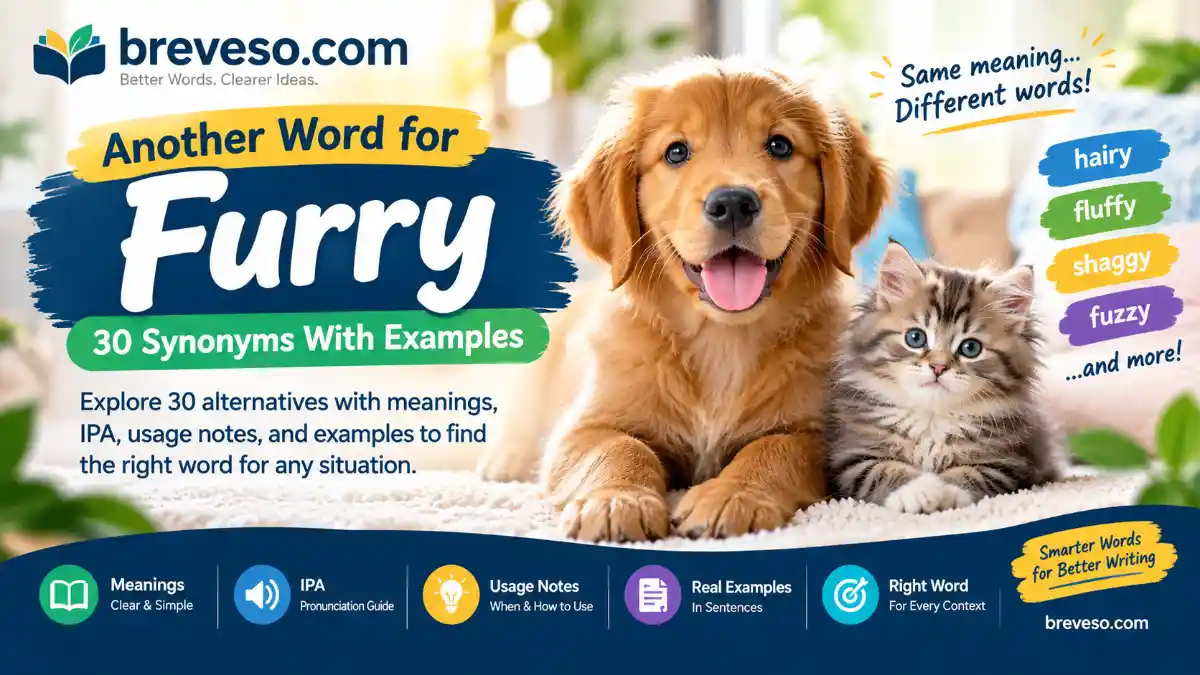
The closest everyday alternatives to furry are hairy, fuzzy, fluffy, and shaggy. Each one describes a coat or surface made of hair-like strands, but they differ in length, softness, and feel. For a more scientific tone, furred is a good fit.
Furry covers more than animal coats. It also describes plant leaves, slippers, a coated tongue, and even a thick voice. The best alternative depends on which of these senses you mean.
Quick list: hairy, fuzzy, fluffy, shaggy, furred, downy, woolly, velvety, plush, cuddly
This article examines 30 alternatives with meanings, IPA, usage notes, examples, and context.
At a Glance: Furry Synonyms and Related Alternatives
| Alternative | Part of Speech | Meaning | Register / Tone | Ideal Context |
| Furred | Adjective | Having fur | Formal, scientific | Nature and biology writing |
| Hairy | Adjective | Covered with hair | Neutral | Animals, people, plants |
| Fuzzy | Adjective | Covered with short, fine fibers | Informal, friendly | Peaches, leaves, blankets |
| Fluffy | Adjective | Soft, light, and puffy | Informal, warm | Pets, clouds, towels |
| Shaggy | Adjective | Long, rough, and untidy | Informal | Dogs, rugs, hair |
| Downy | Adjective | Covered with very fine, soft hair or feathers | Gentle, literary | Chicks, baby animals |
| Woolly | Adjective | Thick and curly like wool | Neutral | Sheep, mammoths, sweaters |
| Velvety | Adjective | Soft and smooth like velvet | Descriptive | Ears, petals, fabric |
| Cuddly | Adjective | Soft and pleasant to hold | Informal, affectionate | Toys, pets |
| Bushy | Adjective | Thick and dense | Neutral | Tails, eyebrows |
Which Word Should You Use?
| If you want to… | Use | Why |
| Describe a pet’s light, puffy coat | Fluffy | It stresses airy softness. |
| Describe a long, messy coat | Shaggy | It suggests length and untidiness. |
| Describe a peach skin or a leaf | Fuzzy | It fits short, fine surface hairs. |
| Write for a science audience | Furred | It sounds precise and neutral. |
| Describe a baby bird or newborn animal | Downy | It suggests very fine, gentle softness. |
| Describe a toy or cozy slipper | Cuddly or plush | Both focus on comfort. |
| Describe a thick tail | Bushy | It stresses dense growth. |
| Describe a thick, muffled voice | Thick or husky | Both match the voice sense of furry. |
Exploring the Multiple Meanings of “Furry”
1. Covered With Fur
- Meaning: Having a coat of fur.
- Explanation: This is the main sense and the one most people search for. It applies to animals and to clothing trimmed with fur.
- Example: The kitten has a furry white tail.
2. Like Fur in Texture
- Meaning: Soft or dense in a way that resembles fur.
- Explanation: Here, furry describes plants, fabrics, and even mold. No real fur is involved, only the look and feel.
- Example: Soft, furry moss covered the old stones.
3. Thick or Blurred in Quality
- Meaning: Thick, soft, and unclear, especially of a voice.
- Explanation: Merriam-Webster records this figurative sense, which also fits a coated tongue. It describes sound or feel, not appearance.
- Example: Her voice sounded furry after the long flight.
4. A Furry Animal (Noun)
- Meaning: An animal with fur, especially a small pet.
- Explanation: Merriam-Webster lists this noun sense, with the plural furries. It appears mostly in informal or pet-care writing.
- Example: The clinic treats small furries such as rabbits and hamsters.
5. A Member of the Furry Fandom (Noun)
- Meaning: A person who enjoys animal characters with human traits.
- Explanation: Wiktionary records this informal sense, and Merriam-Webster has listed it among its “Words We’re Watching.” It belongs to a specific community, so no ordinary synonym replaces it.
- Example: She is a furry who draws her own animal character.
Sources: Merriam-Webster; Oxford Advanced Learner’s Dictionary; Britannica Dictionary; Wiktionary; YourDictionary.
Analyzing 30 Furry Alternatives in Detail
Some alternatives are direct synonyms, while others are related words that fit only one sense of furry.
Core Synonyms
1. Furred
IPA: US /fɝːd/ · UK /fɜːd/
Definition: Having fur.
- Usage: A direct synonym. It sounds formal and suits science and nature writing.
- Example: Furred mammals grow a thicker coat before winter.
2. Hairy
IPA: US /ˈhɛri/ · UK /ˈheəri/
Definition: Covered with hair.
- Usage: A direct synonym for animals, people, and plants. It sounds less cute than furry and can feel rough or unpleasant.
- Example: The spider had long, hairy legs.
3. Fuzzy
IPA: (US and UK) /ˈfʌzi/
Definition: Covered with short, fine hairs or fibers.
- Usage: A close synonym for light, short fur and plant surfaces. Fuzzy can also mean unclear, which furry does not.
- Example: The peach felt fuzzy under her thumb.
4. Fluffy
IPA: (US and UK) /ˈflʌfi/
Definition: Soft, light, and puffy.
- Usage: A close synonym for coats that stand out from the body. It stresses lightness, so it also fits clouds and pancakes.
- Example: The fluffy puppy rolled across the rug.
5. Shaggy
IPA: (US and UK) /ˈʃæɡi/
Definition: Having long, rough, untidy hair.
- Usage: A direct synonym for long coats. It suggests mess, not softness.
- Example: A shaggy sheepdog waited at the gate.
Soft and Gentle Alternatives
6. Downy
IPA: (US and UK) /ˈdaʊni/
Definition: Covered with very fine, soft feathers or hair.
- Usage: A related alternative for baby birds and delicate surfaces. It sounds gentler and more poetic than furry.
- Example: The downy chick huddled beside its mother.
7. Fleecy
IPA: (US and UK) /ˈfliːsi/
Definition: Soft and thick, like a sheep’s coat.
- Usage: A related alternative that stresses warmth. Writers often pair it with fabric and clouds.
- Example: She pulled on a fleecy jacket.
8. Woolly
IPA: (US and UK) /ˈwʊli/
Definition: Covered with or resembling wool.
- Usage: A related alternative for thick, curly coats. Woolly can also mean vague, which furry does not.
- Example: The woolly mammoth survived the Ice Age cold.
9. Velvety
IPA: (US and UK) /ˈvɛlvɪti/
Definition: Soft and smooth, like velvet.
- Usage: A related alternative for short, close-lying texture. It works poorly for long fur.
- Example: The rabbit’s ears felt velvety.
10. Silky
IPA: (US and UK) /ˈsɪlki/
Definition: Soft, smooth, and shiny, like silk.
- Usage: A related alternative for fine, sleek hair. It describes the opposite of a rough, shaggy coat.
- Example: Sunlight made the cat’s silky coat shine.
Thick or Coarse Alternatives
11. Bushy
IPA: (US and UK) /ˈbʊʃi/
Definition: Growing thick and dense.
- Usage: A related alternative for tails and eyebrows. It stresses thickness, not softness.
- Example: The squirrel flicked its bushy tail.
12. Bristly
IPA: (US and UK) /ˈbrɪsli/
Definition: Having short, stiff hairs.
- Usage: A related alternative with the opposite feel. Furry suggests softness, while bristly suggests roughness.
- Example: Bristly hair ran along the boar’s back.
13. Hirsute
IPA: US /ˈhɝːsuːt/ · UK /ˈhɜːsjuːt/
Definition: Hairy, especially with a lot of body or facial hair.
- Usage: A formal, sometimes humorous synonym for hairy people. It rarely describes animals.
- Example: The hirsute professor stroked his thick beard.
14. Matted
IPA: (US and UK) /ˈmætɪd/
Definition: Tangled into a thick, messy mass.
- Usage: A related alternative for fur in poor condition. It carries a negative tone, unlike furry.
- Example: The stray dog’s matted coat needed a careful trim.
15. Wiry
IPA: US /ˈwaɪri/ · UK /ˈwaɪəri/
Definition: Stiff, coarse, and springy, as of hair.
- Usage: A related alternative with a rough feel. It fits terriers and some plants better than soft pets.
- Example: The terrier has a wiry coat.
Cute and Cuddly Alternatives
16. Cuddly
IPA: (US and UK) /ˈkʌdli/
Definition: Pleasant to hold close; soft and warm.
- Usage: A related alternative that describes how a thing invites a hug, not its surface.
- Example: She chose the cuddly bear at the toy shop.
17. Huggable
IPA: (US and UK) /ˈhʌɡəbl/
Definition: Easy and pleasant to hug.
- Usage: An informal related alternative. It stresses affection more than texture.
- Example: Visitors loved the huggable family dog.
18. Snuggly
IPA: (US and UK) /ˈsnʌɡli/
Definition: Soft and warm, good for snuggling.
- Usage: An informal related alternative, common for blankets, socks, and pets.
- Example: He wore snuggly socks all winter.
19. Soft
IPA: US /sɔːft/ · UK /sɒft/
Definition: Pleasant to touch; not hard or rough.
- Usage: A broad related alternative. Many soft things have no fur at all.
- Example: The kitten’s coat feels soft.
20. Plush
IPA: (US and UK) /plʌʃ/
Definition: Having a thick, soft surface or pile.
- Usage: A related alternative for toys and fabrics that imitate fur. It sounds odd for living animals.
- Example: The shop sells plush animals of every size.
Technical and Scientific Alternatives
21. Pilose
IPA: US /ˈpaɪloʊs/ · UK /ˈpaɪləʊs/
Definition: Covered with soft, fine hairs.
- Usage: A technical synonym in biology. Avoid it in everyday writing.
- Example: Botanists described the pilose stem.
22. Tomentose
IPA: US /toʊˈmɛntoʊs/ · UK /təʊˈmentəʊs/
Definition: Covered with dense, matted, short hairs.
- Usage: A technical word, mostly for plants. In plain English, you would say furry or fuzzy.
- Example: The tomentose underside of the leaf feels like felt.
23. Pubescent
IPA: (US and UK) /pjuːˈbɛsənt/
Definition: Covered with soft, short hairs.
- Usage: A technical word in biology. In everyday English, it usually means reaching puberty, so readers may misunderstand it.
- Example: The pubescent leaves feel soft.
24. Lanate
IPA: (US and UK) /ˈleɪneɪt/
Definition: Woolly; covered with long, soft, tangled hairs.
- Usage: A rare botanical term. It fits plant descriptions, not pets.
- Example: Lanate buds protect the flower from cold.
25. Hispid
IPA: (US and UK) /ˈhɪspɪd/
Definition: Covered with stiff or rough hairs.
- Usage: A technical related word. It describes prickly surfaces, so it does not match soft furry textures.
- Example: The hispid stem scratched her hand.
Alternatives for Voice and Coated Surfaces
26. Thick
IPA: (US and UK) /θɪk/
Definition: Low, heavy, and unclear, as of a voice.
- Usage: The closest match for the voice sense of furry.
- Example: His voice sounded thick when he woke up.
27. Husky
IPA: (US and UK) /ˈhʌski/
Definition: Low, rough, and slightly hoarse.
- Usage: A related alternative. A furry voice sounds soft and blurred, while a husky voice sounds rough and low.
- Example: She spoke in a husky whisper.
28. Muffled
IPA: (US and UK) /ˈmʌfəld/
Definition: Quiet and hard to hear clearly.
- Usage: A related alternative for sound that seems wrapped in cloth.
- Example: A muffled voice came through the door.
29. Indistinct
IPA: (US and UK) /ˌɪndɪˈstɪŋkt/
Definition: Not clear; hard to make out.
- Usage: A formal related alternative. It describes only sound or sight, never texture.
- Example: Indistinct words drifted down the hall.
30. Coated
IPA: US /ˈkoʊtɪd/ · UK /ˈkəʊtɪd/
Definition: Covered with a thin layer.
- Usage: A related alternative for the coated-tongue sense. It matches the verb fur, which Merriam-Webster defines as to coat or clog as if with fur.
- Example: Her tongue felt coated after the illness.
Sources: Merriam-Webster; Oxford Advanced Learner’s Dictionary; Britannica Dictionary; WordNet (Princeton University).
Furry vs. Fuzzy vs. Fluffy
These three words overlap, but each points to a different quality.
| Word | Main Idea | Typical Length | Common Use |
| Furry | Looks or feels like fur | Medium to long | Animals, slippers, hats |
| Fuzzy | Fine, short fibers | Very short | Peaches, leaves, blankets |
| Fluffy | Light and puffy | Varies | Kittens, clouds, towels |
Furry names the material. Fuzzy names the fineness of the strands, and fluffy names the airy shape. A kitten can be all three at once.
Sources: Merriam-Webster; Oxford Advanced Learner’s Dictionary.
Furry and Opposite/Paired Word Pairs
| Word | Paired Word | Note |
| Furry | Hairless | The plainest opposite for animals. |
| Furry | Smooth | Contrasts texture, as in a smooth lizard. |
| Furry | Bare | Fits skin or surfaces with no covering. |
| Furry | Scaly | Contrasts mammals with reptiles or fish. |
| Furry | Feathered | A natural pair, as in “furry and feathered friends.” |
Furry has no single perfect antonym. The best opposite depends on the sense: hairless for animals, smooth for texture.
Sources: Merriam-Webster; Oxford Advanced Learner’s Dictionary.
Common Word Partners of “Furry”
| Pattern | Common Partners | Example |
| furry + animal noun | animal, creature, friend, pet | Children love furry animals. |
| furry + clothing | hat, boots, slippers, coat | He wore a furry hat. |
| furry + body part | tail, ears, paws | The fox swished its furry tail. |
| soft/warm + and furry | soft and furry, warm and furry | The moss felt soft and furry. |
| small/little + furry | small furry animals | Small furry animals hide in the grass. |
| furry + plant or growth | leaves, mold | Furry mold spread across the bread. |
Sources: Merriam-Webster; Oxford Advanced Learner’s Dictionary; Britannica Dictionary.
Idiomatic Phrases Featuring “Furry”
Furry has few true idioms. The expressions below include one established phrase and two idioms built on its root word, fur.
1. Furry friend
- Meaning: A pet or other animal, often said with affection.
- Example: Our furry friend waits by the door every evening.
2. When the fur flies
- Meaning: When people begin to argue or fight angrily.
- Example: Wait until the fur flies at the next budget meeting.
3. Fur baby
- Meaning: A pet that its owner treats like a child.
- Example: She buys a new bed for her fur baby every winter.
Sources: Britannica Dictionary; Merriam-Webster; Wiktionary.
Word Formation of “Furry”
Etymology & Structure
English built furry from the noun fur plus the suffix -y, which means “full of” or “like.” Fur came from Middle English furre (“a piece of animal skin used to line a garment”). That came from early French furrer, “to stuff, fill, line,” from fuerre, “sheath,” which was of Germanic origin.
Date and History
Fur first appeared in English in the 14th century. Merriam-Webster dates the first known use of furry to around 1674, and Etymonline places it in the 1670s. Early meanings were “made of fur” and “covered with fur.”
Word Class Variations
- Adjective: furry (comparative furrier, superlative furriest)
- Noun: furry (plural furries); fur (plural furs)
- Verb: fur (past tense furred, present participle furring)
- Related derivative: furriness (noun)
Sources: Merriam-Webster; Etymonline; Oxford Advanced Learner’s Dictionary.
Common Word-Choice Mistakes
- A pubescent leaf in casual writing: say a furry or fuzzy leaf, because pubescent usually means reaching puberty.
- A hirsute puppy: say a furry or fluffy puppy, because hirsute fits people.
- A hairy teddy bear: say a plush or cuddly teddy bear.
- A furry feather: say a downy or fluffy feather.
- A bristly kitten: say a soft or fluffy kitten, because bristly means stiff.
- A furry shout: say a muffled shout, because the voice sense of furry means thick and soft.
Frequently Asked Questions
What is the closest synonym for furry?
Furred and hairy are the closest matches. Fuzzy works well when the hairs are short and fine.
What is a formal word for furry?
Furred is the simplest formal choice. Scientists may also use pilose or tomentose for plants.
What is the difference between furry and fuzzy?
Furry suggests a real or fur-like coat, while fuzzy suggests very short, fine fibers. A peach is fuzzy, and a rabbit is furry.
What is the difference between furry and fluffy?
Fluffy stresses lightness and puffiness. A coat can be fluffy without looking like true fur, as with a towel.
What is the opposite of furry?
Hairless, smooth, and bare are the usual opposites. The right one depends on the surface you describe.
Can furry describe people?
Rarely, because hairy fits body hair better. The noun furry instead names a member of the furry fandom.
Can furry describe a voice?
Yes. Merriam-Webster lists “thick in quality” as a sense, and the example is a furry voice.
What is a literary alternative for furry?
Downy, fleecy, and velvety all sound gentle and descriptive. Writers often choose them for soft, quiet scenes.
Is furry a noun?
Yes. Merriam-Webster lists it as a noun for a furry animal, with the plural furries.
Is furry the same as hairy?
Not always. Furry suggests a dense, soft coat, while hairy is broader and can sound rough.
Conclusion
The closest alternatives to furry are furred, hairy, fuzzy, and fluffy. Shaggy, downy, and woolly cover more specific coats, while cuddly and plush describe how a thing feels to hold.
Context decides the best choice. A peach is fuzzy, a chick is downy, and a sheepdog is shaggy. A thick voice needs a different set of words altogether, such as husky or muffled.
To choose well, first decide which sense of furry you mean. Then pick the word that matches the length, softness, and tone you want to show.

Ali Sultan is a writer and editor at Breveso.com, where he covers synonyms for emotions, everyday speech, and modern slang. He has spent years playing with words, first as an English literature student and later as a content editor. Ali believes no one should get stuck on a single word. His guides break synonyms down by tone and situation, so readers can pick the word that fits, not just the first one they find. He is currently building out Breveso’s collections on feelings, actions, and casual speech. His rule is simple: if a guide does not help a real person write a better sentence, it does not get published.