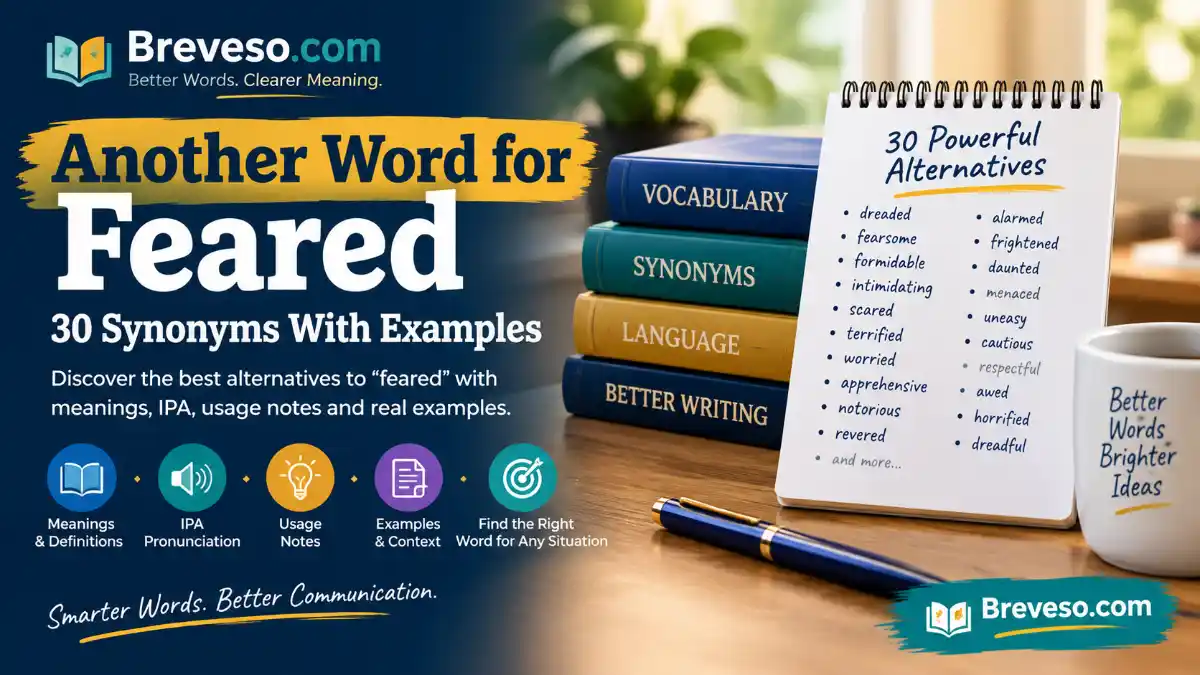
The closest everyday alternatives to “feared” are dreaded, scared, and fearsome. Which one fits depends on how you use the word. As a verb, “feared” means someone felt afraid of something (“she feared the dark”). As an adjective, it describes a person or thing that others dread (“a feared leader”).
The meaning can also shift toward worry (“I feared the worst”) or awe (“they feared God”). Each sense has its own best alternatives.
Quick list: dreaded, fearsome, formidable, intimidating, scared, terrified, worried, apprehensive, notorious
This article covers 30 alternatives with meanings, IPA, usage notes, examples, and context. Some are direct synonyms, and others fit only one sense of “feared.”
At a Glance: Feared Synonyms and Related Alternatives
| Alternative | Part of Speech | Meaning | Register / Tone | Ideal Context |
| dreaded | adjective / verb form | looked forward to with fear | neutral | events, tasks, outcomes |
| fearsome | adjective | causing fear | neutral to literary | animals, warriors, rivals |
| formidable | adjective | causing respect or fear through strength | formal | opponents, challenges |
| intimidating | adjective | making someone feel nervous or small | neutral | people, places, tasks |
| scared | adjective | afraid | informal | everyday feelings |
| terrified | adjective | extremely afraid | neutral, strong | sudden or intense fear |
| apprehensive | adjective | anxious about what may happen | formal | future events |
| worried | adjective / verb form | troubled by thoughts of problems | neutral | health, safety, news |
| revered | adjective / verb form | deeply respected | formal | leaders, teachers, sacred figures |
| notorious | adjective | known for something bad | formal, negative | criminals, places, reputations |
Which Word Should You Use?
| If you want to… | Use | Why |
| Say a person felt afraid of something | scared | It is simple and common in speech. |
| Describe an event someone worried about in advance | dreaded | It points to fear before the event. |
| Describe a rival or opponent others fear | formidable | It adds respect for their strength. |
| Describe a frightening animal or warrior | fearsome | It stresses the power to cause fear. |
| Say you expected bad news | suspected | It states the expectation without strong emotion. |
| Express quiet worry about the future | apprehensive | It sounds careful and formal. |
| Describe fear mixed with deep respect | revered | It shows awe, not terror. |
| Describe someone known for bad deeds | notorious | It focuses on reputation. |
Exploring the Multiple Meanings of “Feared”
1. Was afraid of something
- Meaning: Felt fear toward a person, thing, or situation.
- Explanation: This is the basic verb sense. The object of the fear follows directly, as in “feared heights.” Here “scared” and “frightened” work well.
- Example: As a child, he feared the dark basement.
2. Widely dreaded by others
- Meaning: Regarded with fear by many people.
- Explanation: Here “feared” works as an adjective before a noun. It often describes people with power, such as rulers, coaches, or critics, but it can also describe diseases or storms. “Fearsome” and “formidable” fit best.
- Example: The feared coach never needed to raise his voice.
3. Expected something bad
- Meaning: Thought that something unpleasant was true or likely.
- Explanation: In this sense, “feared” often opens a clause with “that.” It sounds polite and a little formal, so it suits news and reports.
- Example: Doctors feared the infection had spread.
4. Worried about someone’s safety
- Meaning: Felt concern for another person or thing.
- Explanation: This sense takes “for” (“feared for her life”). The fear is on behalf of someone else, not toward a threat.
- Example: Her parents feared for her safety on the long trip.
5. Held in awe or reverence
- Meaning: Respected deeply, especially toward God.
- Explanation: This older, religious sense appears in phrases like “the fear of God.” Modern readers usually hear it as respect, not terror.
- Example: In the old story, the villagers feared the gods and honored them each spring.
Sources: Dictionary.com (Dictionary.com Unabridged and Collins English Dictionary entries for fear and fearful); Oxford Advanced Learner’s Dictionary.
Analyzing 30 Feared Alternatives in Detail
Some of these words are direct synonyms of “feared,” while others are related alternatives that fit only one sense.
Everyday Alternatives for Being Afraid
1. Dreaded
IPA: /ˈdrɛdɪd/ (US and UK)
Definition: Regarded with great fear or anxiety, often about something to come.
- Usage: A close synonym in senses 1 and 2. It leans toward fear of a future event.
- Example: The dreaded meeting finally started at nine.
2. Scared
IPA: US /skɛrd/ · UK /skeəd/
Definition: Feeling fear or alarm.
- Usage: An informal, direct synonym for the verb sense. It describes the person who feels fear, not the thing that causes it.
- Example: She was scared of the thunder.
3. Frightened
IPA: /ˈfraɪtnd/ (US and UK)
Definition: Afraid or made afraid.
- Usage: A direct synonym. It sounds a little more serious than “scared.”
- Example: The frightened child hid behind his mother.
4. Terrified
IPA: US /ˈtɛrəfaɪd/ · UK /ˈterɪfaɪd/
Definition: Extremely afraid.
- Usage: A stronger alternative to “feared.” Choose it when the fear is intense.
- Example: He was terrified of flying.
5. Alarmed
IPA: US /əˈlɑrmd/ · UK /əˈlɑːmd/
Definition: Suddenly worried or frightened by possible danger.
- Usage: A related alternative. It suggests a quick reaction, not lasting fear.
- Example: Residents were alarmed by the loud noise.
Words for People or Things That Others Fear
6. Fearsome
IPA: US /ˈfɪrsəm/ · UK /ˈfɪəsəm/
Definition: Causing fear because of size, power, or appearance.
- Usage: A strong match for sense 2. The word describes the source of fear, not the person who feels it.
- Example: The fearsome dog guarded the gate.
7. Formidable
IPA: US /ˈfɔrmɪdəbəl/ · UK /ˈfɔːmɪdəbəl/
Definition: Inspiring fear or respect through strength or ability.
- Usage: A formal alternative. It often adds admiration and works well for opponents.
- Example: She was a formidable debater.
8. Intimidating
IPA: /ɪnˈtɪmɪdeɪtɪŋ/ (US and UK)
Definition: Making someone feel nervous or less confident.
- Usage: A related alternative. It describes a social effect more than true danger.
- Example: The tall, silent manager seemed intimidating.
9. Menacing
IPA: /ˈmɛnəsɪŋ/ (US and UK)
Definition: Suggesting that harm may come.
- Usage: A related alternative. It stresses a threatening look or tone.
- Example: A menacing figure stood in the doorway.
10. Forbidding
IPA: US /fərˈbɪdɪŋ/ · UK /fəˈbɪdɪŋ/
Definition: Looking unfriendly or threatening.
- Usage: A related alternative. Writers use it for places and faces more than for people with power.
- Example: The forbidding castle sat on a cliff.
11. Terrifying
IPA: US /ˈtɛrəfaɪɪŋ/ · UK /ˈterɪfaɪɪŋ/
Definition: Causing extreme fear.
- Usage: A strong alternative to “feared” when you describe a cause of fear.
- Example: The storm was terrifying.
Words for Expecting Something Bad
12. Worried
IPA: US /ˈwɜrid/ · UK /ˈwʌrid/
Definition: Troubled by thoughts of problems that may happen.
- Usage: A good match for senses 3 and 4. It sounds softer than “feared.”
- Example: He worried that the flight would be late.
13. Apprehensive
IPA: /ˌæprɪˈhɛnsɪv/ (US and UK)
Definition: Anxious about something that may happen.
- Usage: A formal, close alternative for fear about the future.
- Example: She felt apprehensive about the results.
14. Anxious
IPA: /ˈæŋkʃəs/ (US and UK)
Definition: Feeling nervous or uneasy.
- Usage: A related alternative. The fear is vague and has no clear danger.
- Example: The team was anxious before the final.
15. Suspected
IPA: /səˈspɛktɪd/ (US and UK)
Definition: Thought something was true without proof.
- Usage: A related alternative for sense 3 only. It has no emotion of its own.
- Example: Police suspected the fire was deliberate.
16. Uneasy
IPA: US /ʌnˈizi/ · UK /ʌnˈiːzi/
Definition: Worried or uncomfortable.
- Usage: A mild, related alternative. It suits a quiet doubt, not true fear.
- Example: He felt uneasy about the deal.
Words for Awe and Respect
17. Revered
IPA: US /rɪˈvɪrd/ · UK /rɪˈvɪəd/
Definition: Treated with deep respect.
- Usage: A match for sense 5 only. It has no sense of terror.
- Example: The revered teacher taught for fifty years.
18. Venerated
IPA: /ˈvɛnəreɪtɪd/ (US and UK)
Definition: Honored with deep respect, often for age or holiness.
- Usage: A formal, related alternative. It fits religious or historic figures.
- Example: The saint was venerated across the region.
19. Awestruck
IPA: US /ˈɔˌstrʌk/ · UK /ˈɔːstrʌk/
Definition: Filled with wonder, sometimes mixed with fear.
- Usage: A related alternative. It describes the person who feels awe.
- Example: The visitors stood awestruck before the canyon.
20. Respected
IPA: /rɪˈspɛktɪd/ (US and UK)
Definition: Admired for ability or character.
- Usage: A related alternative. It pairs often with “feared” but does not mean the same thing.
- Example: The judge was respected by everyone.
Words About Reputation and Power
21. Notorious
IPA: US /noʊˈtɔriəs/ · UK /nəʊˈtɔːriəs/
Definition: Widely known for something bad.
- Usage: A related alternative. It points to a bad name, not a feeling of fear.
- Example: The notorious thief escaped again.
22. Infamous
IPA: /ˈɪnfəməs/ (US and UK)
Definition: Well known for evil or shameful acts.
- Usage: A related alternative. It is stronger and more negative than “notorious.”
- Example: The infamous pirate raided ships for years.
23. Ruthless
IPA: US /ˈruθləs/ · UK /ˈruːθləs/
Definition: Having no pity.
- Usage: A related alternative. It explains why someone is feared.
- Example: The ruthless boss fired people without warning.
24. Redoubtable
IPA: /rɪˈdaʊtəbəl/ (US and UK)
Definition: Causing fear and respect, especially as an opponent.
- Usage: A formal, literary alternative close to “formidable.”
- Example: The team faced a redoubtable champion.
Strong and Figurative Alternatives
25. Petrified
IPA: US /ˈpɛtrəfaɪd/ · UK /ˈpetrɪfaɪd/
Definition: So afraid that one cannot move.
- Usage: An intense alternative to “terrified.”
- Example: She stood petrified as the car slid toward her.
26. Horrified
IPA: US /ˈhɔrəfaɪd/ · UK /ˈhɒrɪfaɪd/
Definition: Filled with shock and fear.
- Usage: A related alternative. It mixes fear with disgust or shock.
- Example: Fans were horrified by the crash.
27. Cowered
IPA: US /ˈkaʊərd/ · UK /ˈkaʊəd/
Definition: Crouched or moved back in fear.
- Usage: A related verb that shows fear through action.
- Example: The puppy cowered under the table.
28. Shunned
IPA: /ʃʌnd/ (US and UK)
Definition: Avoided on purpose.
- Usage: A related alternative. People may shun what they fear, but the word does not state the fear.
- Example: Neighbors shunned the empty house.
29. Recoiled
IPA: /rɪˈkɔɪld/ (US and UK)
Definition: Moved back suddenly in fear or dislike.
- Usage: A related verb for a fast physical reaction.
- Example: He recoiled from the snake.
30. Spooked
IPA: US /spukt/ · UK /spuːkt/
Definition: Suddenly frightened.
- Usage: An informal alternative, often used for animals and nervous crowds.
- Example: The loud bang spooked the horses.
Sources: Dictionary.com (including Collins English Dictionary entries); Oxford Advanced Learner’s Dictionary.
Feared vs. Fearful vs. Fearsome vs. Afraid
These four words share a root, yet they point in different directions.
| Word | Who or what is described | Example |
| feared | The thing others fear, or the verb for the act of fearing | The feared storm arrived. |
| fearful | The person who feels fear, or the thing that causes it | The fearful child stayed home. |
| fearsome | The thing that causes fear | A fearsome lion stood nearby. |
| afraid | The person who feels fear (used after a verb) | I am afraid of heights. |
Dictionaries also list an old-fashioned, informal use of “fearful” meaning “very bad,” as in “a fearful mess.” That use is rare today.
Sources: Dictionary.com; Oxford Advanced Learner’s Dictionary.
Feared and Opposite/Paired Word Pairs
| Word | Paired Word | Note |
| feared | respected | A common pair. Many leaders earn both, but the two ideas differ. |
| feared | loved | A classic contrast, often used when discussing leadership. |
| feared | hated | Often paired, since fear and hatred can grow together. |
| feared | fearless | Close in form, but fearless describes a person who feels no fear. |
| feared | trusted | Shows a leader who guides without frightening people. |
| feared | admired | Admiration needs no fear. |
The best opposite depends on the sense. If “feared” describes how people see a leader, “loved” or “trusted” is the natural contrast. If it describes a person’s own feelings, “unafraid” or “fearless” fits better.
Sources: Dictionary.com (entries for fear and fearful).
Common Word Partners of “Feared”
| Pattern | Common Partners | Example |
| feared + the worst | feared the worst | When she did not call, he feared the worst. |
| feared + for | feared for his life, feared for their safety | We feared for the sailors during the storm. |
| feared + that | feared that it was too late | She feared that it was too late to apply. |
| adverb + feared | widely feared, long feared, most feared | The disease was widely feared. |
| feared + noun | feared leader, feared opponent, feared predator | The feared predator ruled the reef. |
| feared + and + adjective | feared and respected, feared and hated | He was both feared and respected. |
Sources: Oxford Advanced Learner’s Dictionary (fearful and its common patterns); Dictionary.com example sentences for fear.
Idiomatic Phrases Featuring “Feared”
The phrases below are established expressions. They are fixed patterns, not figurative idioms in the strict sense.
1. Feared the worst
- Meaning: Expected that something very bad had happened or would happen.
- Example: The family feared the worst when the boat did not return.
2. Feared for one’s life
- Meaning: Believed one was in serious danger.
- Example: The hikers feared for their lives when the snow began.
3. It is feared that…
- Meaning: People believe something bad may be true. News reports often use this opening.
- Example: It is feared that several roads will close.
4. Feared and revered
- Meaning: Respected with a mix of awe and fear.
- Example: In the legend, the dragon was feared and revered.
Sources: Dictionary.com; Oxford Advanced Learner’s Dictionary.
Word Formation of “Feared”
Etymology & Structure
“Feared” is the past tense and past participle of the verb fear, formed by adding -ed. The verb comes from Old English fǣran, which meant “to frighten.” The noun fear comes from the same family. Dictionary.com’s entry for the related word afeard traces it to Old English āfǣred, “frightened,” from afǣran (“to frighten”) and fǣran (“to fear”).
Date and History
Dictionary.com places the roots of this word family in Old English, before the year 1000. The related adjective fearful is recorded in Middle English, between 1300 and 1350, as ferful(l), built from fear and -ful.
Word Class Variations
- Verb: fear, fears, feared, fearing
- Noun: fear, fearfulness
- Adjective: feared, fearful, fearless, fearsome, unfearing
- Adverb: fearfully, fearlessly
Sources: Dictionary.com (entries for fear, fearful, and afeard).
Common Word-Choice Mistakes
- He feared from spiders: use “He feared spiders” or “He was afraid of spiders.”
- She feared to the dark: use “She feared the dark.”
- A fearing leader: use “a feared leader” when others fear him.
- A scared leader: use “a fearsome leader” when he scares others.
- A fearful dog attacked us: use “a fearsome dog” for a dog that causes fear, since “fearful” often means the dog is afraid.
- He had a feared of snakes: use “He had a fear of snakes.”
- They feared that it will fail: use “They feared that it would fail.”
Frequently Asked Questions
What is the closest synonym for feared?
“Dreaded” is the closest for most uses. “Scared” and “frightened” fit when you describe a person’s feelings.
What is a formal alternative to feared?
“Apprehensive” and “formidable” both sound formal. The first describes worry, and the second describes a person or force that inspires fear or respect.
What is a stronger word than feared?
“Terrified” and “petrified” show stronger fear. “Terrifying” describes the cause of that fear.
Is feared the same as fearful?
No. “Feared” often describes the thing people fear, while “fearful” usually describes the person who feels fear.
Can feared describe people?
Yes. A “feared leader” is someone others dread. The word does not describe how that person feels.
What is the difference between feared and respected?
Feared means people dread someone. Respected means people admire them. A person can be both, but one does not guarantee the other.
What does “feared the worst” mean?
It means the person expected very bad news or a terrible result.
What is the opposite of feared?
It depends on the sense. “Loved” or “trusted” opposes a feared leader, while “fearless” or “unafraid” opposes a person who feels fear.
What is a literary alternative to feared?
“Redoubtable” and “fearsome” both suit formal or literary writing.
Can feared mean respected?
Only in the older religious sense, as in “the fear of God.” Modern readers usually read “feared” as dread.
Conclusion
The closest alternatives to “feared” are “dreaded,” “scared,” and “fearsome.” “Dreaded” suits events and outcomes. “Scared” and “frightened” describe a person’s feelings. “Fearsome” and “formidable” describe the source of the fear.
Context matters because “feared” carries several meanings. It can describe fear, worry, reputation, or awe, and each sense calls for a different word. “Apprehensive” would sound strange for a dangerous tiger, and “fearsome” would sound strange for someone nervous about a test.
To choose well, first ask who feels the fear. Then decide whether the feeling is panic, quiet worry, or respect. That answer will usually point to the right word.

Ali Bismal is the founder and writer behind Breveso.com, where he helps readers find the perfect synonym for every word. What started as a simple love for words turned into a growing library of “another word for ___” guides covering emotions, actions, slang, and everyday language.
Ali believes the right word can sharpen a sentence, and the wrong one can blur it. That is why every Breveso guide is written in plain, simple English, grouped in a way that actually makes sense, and checked for real-world use.
He writes for students, writers, and anyone who has ever stared at a sentence thinking there must be a better word for this. Clean, useful content that answers the question fast, that is the whole mission.