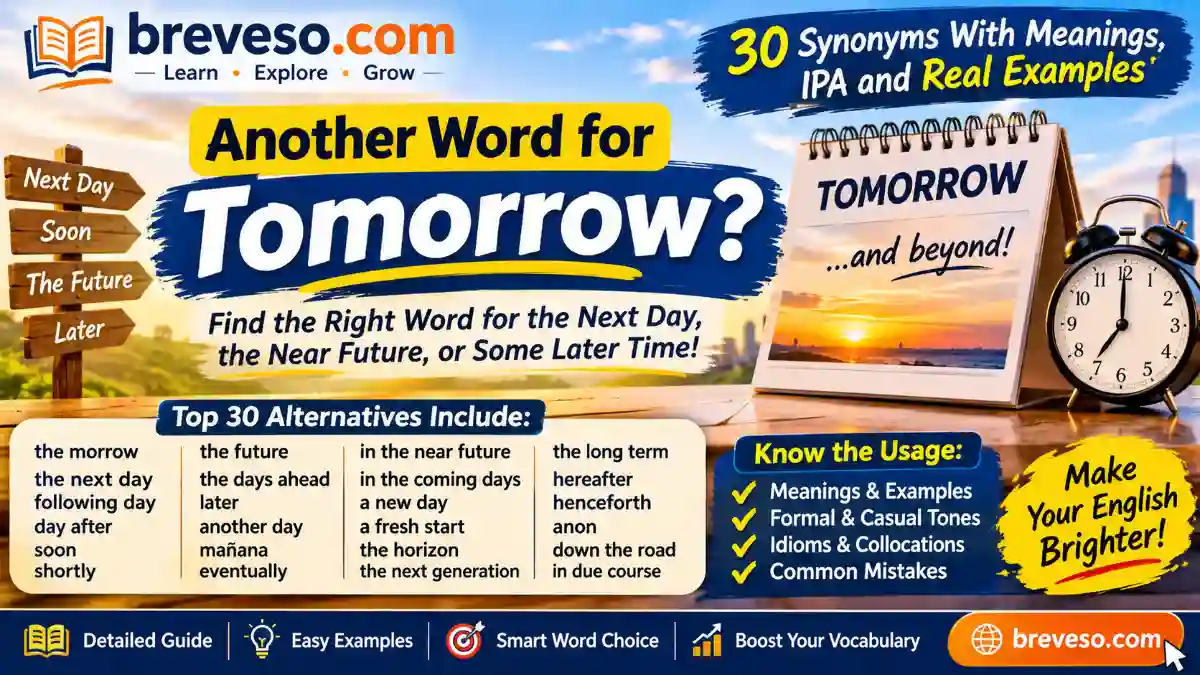
The simplest another word for tomorrow is the next day or the following day. A more old-fashioned choice is the morrow. These phrases all point to the day after today. When you mean “soon” or “in the future,” words like soon, shortly, and the future fit better.
The best alternative depends on what you mean. Tomorrow can name a calendar day, a vague time ahead, or a hopeful idea about the future. Some alternatives also carry a tone, such as formal, poetic, or casual.
Quick list: the morrow, the next day, the following day, the day after, soon, shortly, the future, the days ahead, later
This article looks at 30 alternatives with meanings, IPA, usage notes, examples, and context. It also covers collocations, idioms, word history, and common mistakes.
Table of Contents
- At a Glance: Tomorrow Synonyms and Related Alternatives
- Which Word Should You Use?
- Exploring the Multiple Meanings of “Tomorrow”
- Analyzing 30 Tomorrow Alternatives in Detail
- Tomorrow vs. the Morrow vs. the Next Day vs. the Following Day
- Tomorrow and Opposite/Paired Word Pairs
- Common Word Partners of “Tomorrow”
- Idiomatic Phrases Featuring “Tomorrow”
- Word Formation of “Tomorrow”
- Common Word-Choice Mistakes
- Frequently Asked Questions
- Conclusion
At a Glance: Tomorrow Synonyms and Related Alternatives
| Alternative | Part of Speech | Meaning | Register / Tone | Ideal Context |
| the morrow | noun | the day after the present day | Literary, old-fashioned | Poetry, historical writing |
| next day | noun / adverb | the day after a stated day | Neutral | Stories, reports |
| following day | noun / adverb | the day after a stated day | Formal | Written accounts, news |
| day after | noun phrase | the day that comes after an event | Neutral | Events with a clear reference point |
| soon | adverb | in a short time | Neutral | Promises, plans |
| shortly | adverb | in a short time | Formal | Announcements, business |
| the future | noun | time that has not come yet | Neutral | Plans, goals |
| the days ahead | noun phrase | the coming days | Neutral | Forecasts, advice |
| later | adverb | after the present time | Casual | Daily talk |
| mañana | adverb / noun | tomorrow, or an unspecified later time | Humorous, informal | Jokes about delay |
Which Word Should You Use?
| If you want to… | Use | Why |
| Name the day after today in a story | the next day | It works from any starting point, not only today. |
| Sound formal in a report | the following day | It reads clean and professional. |
| Sound poetic or old-fashioned | the morrow | It has a literary, historical feel. |
| Say something will happen soon | shortly | It sounds polite and businesslike. |
| Talk about plans and goals | the future | It covers any time ahead, not one day. |
| Refer to the coming few days | the days ahead | It fits weather and schedules. |
| Delay something politely | another day | It sounds kind and low-pressure. |
| Joke about putting things off | mañana | It suggests a habit of delay. |
Exploring the Multiple Meanings of “Tomorrow”
1. The Day After Today (Adverb)
- Meaning: On the day after today.
- Explanation: Here, tomorrow tells you when something happens. It needs no preposition, so you say “tomorrow,” not “on tomorrow.”
- Example: The museum opens tomorrow.
2. The Day After Today (Noun)
- Meaning: The calendar day that follows the present one.
- Explanation: As a noun, tomorrow can be the subject of a sentence or follow a possessive word. It often appears with a time word, such as “tomorrow’s weather.”
- Example: Tomorrow is my sister’s birthday.
3. The Future in General
- Meaning: Time that has not happened yet.
- Explanation: Tomorrow often stands for the future as a whole, not one exact day. This sense appears in phrases like “plan for tomorrow.”
- Example: The school teaches skills for tomorrow’s jobs.
4. A Hopeful Idea of Change
- Meaning: A chance for a better time to come.
- Explanation: Writers and speakers use this figurative sense for hope. It carries a gentle, positive feeling that today’s problems may ease.
- Example: She told herself that tomorrow could be better.
Sources: Merriam-Webster, Collins Dictionary, Dictionary.com
Analyzing 30 Tomorrow Alternatives in Detail
Some alternatives below are direct synonyms for the day after today. Others are related words that fit only certain contexts, and each Usage note says which is which.
Core Alternatives for the Day After Today
1. The morrow
IPA: US /ˈmɔːroʊ/ · UK /ˈmɒrəʊ/
Definition: The day after the present day, in old or literary English.
- Usage: This is a true synonym, but it sounds old-fashioned. It appears mostly in poetry, history, and the fixed phrase “on the morrow.”
- Example: The army would march on the morrow.
2. Next day
IPA: /ˌnɛkst ˈdeɪ/ (US and UK)
Definition: The day that comes right after a day already named.
- Usage: It matches tomorrow only when the starting point is today. In stories about the past, it works as the usual replacement.
- Example: We arrived on Friday and left the next day.
3. Following day
IPA: US /ˈfɑːloʊɪŋ ˌdeɪ/ · UK /ˈfɒləʊɪŋ ˌdeɪ/
Definition: The day that comes after another day in a sequence.
- Usage: It is a formal twin of “the next day.” News reports and official writing prefer it.
- Example: The committee met again the following day.
4. Day after
IPA: US /ˌdeɪ ˈæftər/ · UK /ˌdeɪ ˈɑːftə/
Definition: The day that comes after a stated event or date.
- Usage: It needs a reference point, such as “the day after the party.” Alone, it does not mean tomorrow, so treat it as a related alternative.
- Example: The shop opens the day after the festival ends.
5. A day from now
IPA: /ə ˌdeɪ frəm ˈnaʊ/ (US and UK)
Definition: One day after the present moment.
- Usage: This related phrase counts about twenty-four hours, not a calendar day. If you speak at night, it may land on a different date than tomorrow.
- Example: I will have your answer a day from now.
Near-Future Time Expressions
6. Soon
IPA: /suːn/ (US and UK)
Definition: Within a short time from now.
- Usage: This is a related alternative, not an exact synonym. It names no particular day, so it fits promises and rough plans.
- Example: The package should arrive soon.
7. Shortly
IPA: US /ˈʃɔːrtli/ · UK /ˈʃɔːtli/
Definition: In a short time; before long.
- Usage: This related word sounds more formal than soon. Announcements and business emails use it often.
- Example: The doctor will see you shortly.
8. Before long
IPA: US /bɪˌfɔːr ˈlɔːŋ/ · UK /bɪˌfɔː ˈlɒŋ/
Definition: After only a short time has passed.
- Usage: It is a related phrase that suits both past stories and future guesses. It never points to one exact day.
- Example: Before long, the snow will melt.
9. In the near future
IPA: US /ɪn ðə ˌnɪr ˈfjuːtʃər/ · UK /ɪn ðə ˌnɪə ˈfjuːtʃə/
Definition: At a time not far from now.
- Usage: This related phrase is neutral and a bit formal. It gives a wider window than tomorrow, from days to months.
- Example: The company plans to open a second shop in the near future.
10. In the coming days
IPA: /ɪn ðə ˌkʌmɪŋ ˈdeɪz/ (US and UK)
Definition: During the next few days.
- Usage: It is a related phrase that covers a short stretch, not one day. Weather reports and news stories use it often.
- Example: Temperatures should rise in the coming days.
Words for the Future in General
11. The future
IPA: US /ðə ˈfjuːtʃər/ · UK /ðə ˈfjuːtʃə/
Definition: The time that has not come yet.
- Usage: It matches the third meaning of tomorrow. It is a related word, since it has no link to one calendar day.
- Example: She saves part of her pay for the future.
12. The days ahead
IPA: /ðə ˌdeɪz əˈhɛd/ (US and UK)
Definition: The period of time that is coming soon.
- Usage: This related phrase carries a gentle, thoughtful tone. It fits advice, forecasts, and speeches.
- Example: The days ahead will be busy for the team.
13. What lies ahead
IPA: /wʌt ˌlaɪz əˈhɛd/ (US and UK)
Definition: The events that will happen later.
- Usage: It works as a related, slightly dramatic phrase. People use it when the future feels uncertain.
- Example: Nobody knows what lies ahead.
14. The long term
IPA: US /ðə ˌlɔːŋ ˈtɜːrm/ · UK /ðə ˌlɒŋ ˈtɜːm/
Definition: A period far into the future.
- Usage: It is related but not close. Tomorrow means the next day, while the long term means years away.
- Example: In the long term, the city wants to cut traffic.
Formal and Literary Alternatives
15. Futurity
IPA: US /fjuːˈtʊrəti/ · UK /fjuːˈtjʊərəti/
Definition: Future time; the quality of being yet to come.
- Usage: This is a rare, formal word. It matches only the “future in general” sense of tomorrow, never the next day.
- Example: The poem speaks to futurity, to readers not yet born.
16. Hereafter
IPA: US /hɪrˈæftər/ · UK /hɪərˈɑːftə/
Definition: From now on; also, the life after death.
- Usage: It is a related word with limits. It does not mean the next day, and its other meaning is the afterlife. Legal and formal writing uses the “from now on” sense.
- Example: Hereafter, all visitors must sign in.
17. Henceforth
IPA: US /ˌhɛnsˈfɔːrθ/ · UK /ˌhɛnsˈfɔːθ/
Definition: From this time onward.
- Usage: This related word marks a change that starts now and continues. It does not point to tomorrow.
- Example: Henceforth, the meeting will start at nine.
18. Anon
IPA: US /əˈnɑːn/ · UK /əˈnɒn/
Definition: Soon; in a short while (old-fashioned).
- Usage: It is a related, archaic word. You will mostly see it in older books and plays.
- Example: I shall return anon.
Figurative Alternatives for Hope and Change
19. A new day
IPA: US /ə ˌnuː ˈdeɪ/ · UK /ə ˌnjuː ˈdeɪ/
Definition: A fresh period with a chance for change.
- Usage: This figurative phrase echoes the hopeful sense of tomorrow. It is related, not literal.
- Example: Do not worry about the mistake, because a new day brings a fresh chance.
20. A fresh start
IPA: US /ə ˌfrɛʃ ˈstɑːrt/ · UK /ə ˌfrɛʃ ˈstɑːt/
Definition: A chance to begin again.
- Usage: It is a related phrase for the hopeful meaning of tomorrow. It suggests leaving a problem behind.
- Example: She treated the move as a fresh start.
21. The horizon
IPA: /ðə həˈraɪzn/ (US and UK)
Definition: The point where future events begin to appear.
- Usage: In figurative speech, “on the horizon” means coming soon. This is a related image, not a true synonym.
- Example: Big changes are on the horizon.
22. The next generation
IPA: /ðə ˌnɛkst ˌdʒɛnəˈreɪʃn/ (US and UK)
Definition: The young people who will lead later.
- Usage: It matches the phrase “tomorrow’s leaders.” This related alternative focuses on people, not time.
- Example: The program trains the next generation of nurses.
23. The years to come
IPA: US /ðə ˌjɪrz tə ˈkʌm/ · UK /ðə ˌjɪəz tə ˈkʌm/
Definition: The period of years that will follow.
- Usage: This related phrase sounds calm and thoughtful. It stretches well past tomorrow.
- Example: Her work will inspire people in the years to come.
Alternatives for Putting Things Off
24. Later
IPA: US /ˈleɪtər/ · UK /ˈleɪtə/
Definition: At a time after now.
- Usage: This related word covers anything from minutes to weeks. People use it when they do not want to name a day.
- Example: I will finish the report later.
25. Another day
IPA: US /əˌnʌðər ˈdeɪ/ · UK /əˌnʌðə ˈdeɪ/
Definition: A different day, not today.
- Usage: It is a related phrase for polite delay. It softens a no.
- Example: Let’s talk about it another day.
26. Some other time
IPA: US /sʌm ˌʌðər ˈtaɪm/ · UK /sʌm ˌʌðə ˈtaɪm/
Definition: At an unnamed time that is not now.
- Usage: This is a related phrase that often turns down an invitation kindly. It rarely leads to a firm plan.
- Example: I cannot join you tonight, but maybe some other time.
27. Mañana
IPA: US /mɑːnˈjɑːnə/ · UK /mæˈnjɑːnə/
Definition: Tomorrow, or an unspecified time in the future.
- Usage: This Spanish loanword is a related alternative. English speakers use it with a joking tone to suggest putting things off.
- Example: His motto was always mañana, never today.
28. Eventually
IPA: /ɪˈvɛntʃuəli/ (US and UK)
Definition: In the end, after some time or effort.
- Usage: It is related but far from exact. It suggests a longer wait than tomorrow.
- Example: The stain will fade eventually.
29. Down the road
IPA: US /ˌdaʊn ðə ˈroʊd/ · UK /ˌdaʊn ðə ˈrəʊd/
Definition: At some point in the future.
- Usage: This informal idiom is related and vague. Business talk uses it for plans with no date.
- Example: We may add more features down the road.
30. In due course
IPA: US /ɪn ˌduː ˈkɔːrs/ · UK /ɪn ˌdjuː ˈkɔːs/
Definition: At the proper time.
- Usage: It is a formal, related phrase that promises action without a date. Letters and emails often use it.
- Example: You will receive a reply in due course.
Sources: Merriam-Webster, Collins Dictionary, Dictionary.com
Tomorrow vs. the Morrow vs. the Next Day vs. the Following Day
These four phrases overlap, but each has its own job.
| Phrase | Counts From | Best Use | Example |
| tomorrow | Today (the moment of speaking) | Everyday speech and writing | I will call you tomorrow. |
| the morrow | Today or a past day | Poetry, historical tone | They set out on the morrow. |
| the next day | Any day already named | Stories and reports | She left the next day. |
| the following day | Any day already named | Formal writing | The vote took place the following day. |
The key difference is the starting point. Tomorrow always starts from the present, while “the next day” and “the following day” start from a day you have already mentioned. In a story set in the past, “tomorrow” would confuse the reader, so use “the next day” instead.
The phrase “the day after tomorrow” works the same way, only one day further ahead.
Sources: Merriam-Webster, Collins Dictionary
Tomorrow and Opposite/Paired Word Pairs
| Word | Paired Word | Note |
| tomorrow | yesterday | The natural opposite: next day versus previous day. |
| tomorrow | today | The two sit side by side, as in “today and tomorrow.” |
| the day after tomorrow | the day before yesterday | A matching pair two days from now on each side. |
| tomorrow’s news | yesterday’s news | A common contrast for what is fresh and what is old. |
| the future | the past | The wider-time version of the same opposite. |
Yesterday is the true antonym, since it names the day before today. Today is not an opposite, but it often pairs with tomorrow when people talk about plans and delay.
Sources: Merriam-Webster, Collins Dictionary
Common Word Partners of “Tomorrow”
| Pattern | Common Partners | Example |
| tomorrow + time of day | morning, afternoon, evening, night | I will see you tomorrow morning. |
| preposition + tomorrow | by, until, from, for | Please send it by tomorrow. |
| the day after + tomorrow | the day after tomorrow | The trip starts the day after tomorrow. |
| tomorrow’s + noun | weather, news, meeting, plans | Tomorrow’s weather looks sunny. |
| see you + tomorrow | see you tomorrow | See you tomorrow at school. |
| noun + of tomorrow | the leaders of tomorrow, the world of tomorrow | They teach the leaders of tomorrow. |
Sources: Collins Dictionary, Merriam-Webster
Idiomatic Phrases Featuring “Tomorrow”
1. Tomorrow is another day
- Meaning: Things may improve later, so do not give up after a bad day.
- Example: You failed the test, but tomorrow is another day.
2. Tomorrow never comes
- Meaning: People who delay a task may never do it, because the right time never seems to arrive.
- Example: He keeps saying he will start exercising, but tomorrow never comes.
3. Here today, gone tomorrow
- Meaning: Something lasts only a short time, or a person does not stay in one place.
- Example: Fashion trends are here today, gone tomorrow.
4. Jam tomorrow
- Meaning: A promise of good things that never actually arrive. It is mostly British English and comes from a joke in Lewis Carroll’s Through the Looking-Glass.
- Example: The manager keeps promising bonuses, but it is all jam tomorrow.
Sources: Merriam-Webster, Collins Dictionary, Wiktionary
Word Formation of “Tomorrow”
Etymology & Structure
Merriam-Webster traces tomorrow to Middle English to morgen, which came from Old English tō morgen, built from “to” plus morgen, meaning “morrow” or “morning.” So the word began as two parts: a small word meaning “on” or “at,” and a word for morning. Over time, “morrow” came to mean the following day, and “tomorrow” kept that sense. The word “morn” comes from the same family.
Date and History
Dictionary.com lists the first recorded use between 1225 and 1275. Merriam-Webster also places the first known use in the 13th century. Older spellings include to morrow and to-morrow, and Wiktionary marks “to-morrow” as archaic.
Word Class Variations
- Adverb: on the day after today (“We leave tomorrow.”)
- Noun: the day after today, or the future (“Tomorrow is Friday.”)
- Possessive form: tomorrow’s (“tomorrow’s weather”)
- Related words: morrow, morn, morning
Tomorrow has no verb form and no standard adjective form.
Sources: Merriam-Webster, Dictionary.com, Etymonline, Wiktionary
Common Word-Choice Mistakes
- Wrong: “I will see you on tomorrow.” Correct: “I will see you tomorrow.”
- Wrong: “She said, ‘I will come the next day.'” Correct: “I will come tomorrow.” (Use “the next day” only when telling the story afterward.)
- Wrong: “The tomorrow’s meeting is at ten.” Correct: “Tomorrow’s meeting is at ten.”
- Wrong: “I will call you on the morrow.” Correct: “I will call you tomorrow.” (The morrow sounds old-fashioned in daily speech.)
- Wrong: “Henceforth, I will send it.” for the next day. Correct: “I will send it tomorrow.” (Henceforth means “from now on.”)
- Wrong: “Tommorow” or “tomorow.” Correct: “Tomorrow.” (One m, two r’s.)
- Wrong: “Tomorrow night evening.” Correct: “Tomorrow evening” or “tomorrow night.”
Frequently Asked Questions
What is the closest synonym for tomorrow?
The next day is the closest match when the starting point is today. “The following day” and “the morrow” also work, though the morrow sounds old-fashioned.
Is “the morrow” still used?
Yes, but mostly in poetry, historical writing, and fixed phrases like “on the morrow.” In everyday speech, people say tomorrow.
What is the difference between tomorrow and the next day?
Tomorrow counts from today. The next day counts from any day already mentioned, so it suits stories about the past.
What is a formal way to say tomorrow in writing?
“The following day” is a formal choice for past events. For future events, “tomorrow” is still standard, even in formal writing.
What is the opposite of tomorrow?
Yesterday is the natural opposite. It names the day before today.
Can tomorrow mean the future?
Yes. Phrases like “plan for tomorrow” and “the leaders of tomorrow” use tomorrow for the future in general.
What is another word for tomorrow morning?
“First thing tomorrow” is a casual option. For stories about the past, “the next morning” fits.
Does mañana mean tomorrow in English?
It does, since mañana is the Spanish word for tomorrow. English speakers also use it to joke about putting things off.
What do you call the day after tomorrow?
The usual phrase is “the day after tomorrow.” No common single word replaces it in modern English.
How do you spell tomorrow?
Write it with one m and two r’s: t-o-m-o-r-r-o-w.
Conclusion
The closest alternatives to tomorrow are the next day, the following day, and the morrow. They all point to the day after today, though each carries a different tone. The morrow sounds poetic, while the following day sounds formal.
Context decides which word works best. Soon, shortly, and later suggest a rough time, and the future and the days ahead describe a wider stretch. Phrases like another day and mañana soften or joke about delay.
To choose, ask what you really mean. If you want one exact day, use tomorrow or the next day. If you mean a vague time ahead, pick a word from the near-future or putting-off groups.
Related reading:

Ali Bismal is the founder and writer behind Breveso.com, where he helps readers find the perfect synonym for every word. What started as a simple love for words turned into a growing library of “another word for ___” guides covering emotions, actions, slang, and everyday language.
Ali believes the right word can sharpen a sentence, and the wrong one can blur it. That is why every Breveso guide is written in plain, simple English, grouped in a way that actually makes sense, and checked for real-world use.
He writes for students, writers, and anyone who has ever stared at a sentence thinking there must be a better word for this. Clean, useful content that answers the question fast, that is the whole mission.