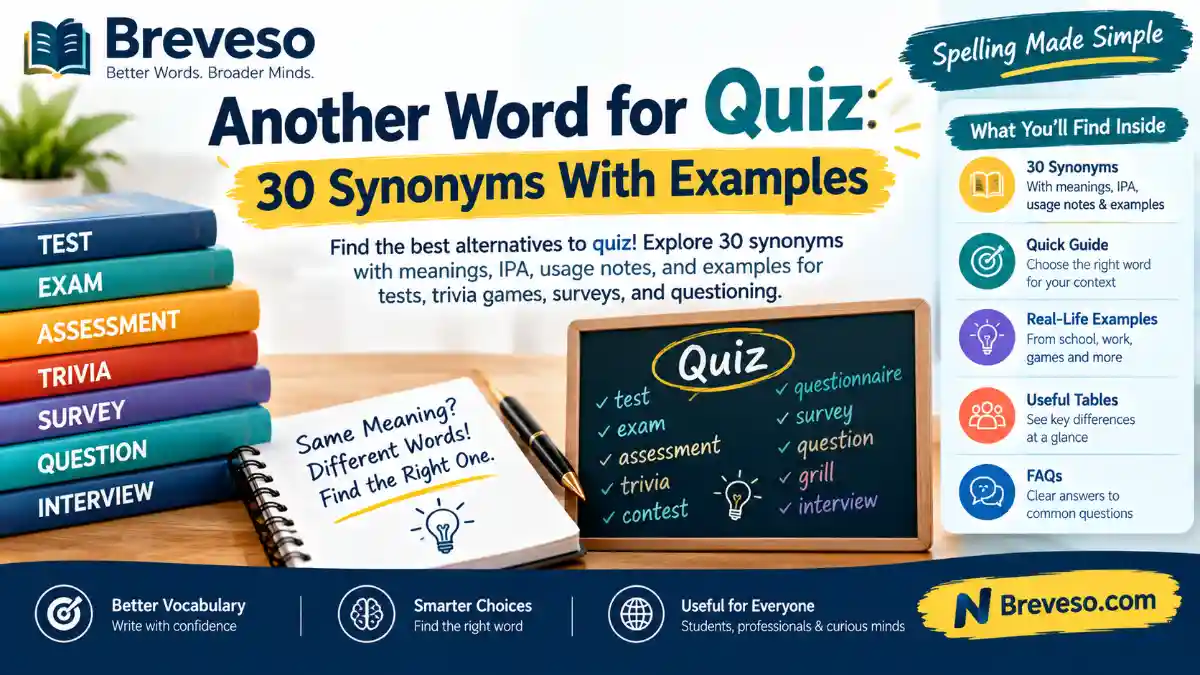
Another word for quiz is test. Other common choices are exam, assessment, and trivia. The best pick depends on your meaning. A quiz can be a short school check. It can be a game of questions. It can also be an online set of questions that sorts people into results.
As a verb, quiz means to question someone closely. Question, grill, and interview all work here. Two older senses, an odd person and to mock, are rare today.
Quick list: test, exam, assessment, trivia, contest, questionnaire, survey, question, grill
This guide covers 30 alternatives. Each entry gives a meaning, IPA, a usage note, and an example. Each note says if the word is a close synonym or a related option.
At a Glance: Quiz Synonyms and Related Alternatives
| Alternative | Part of Speech | Meaning | Tone | Best Context |
| Test | noun, verb | Questions or tasks that measure skill | Neutral | School, work, training |
| Exam | noun | A formal test of knowledge | Neutral to formal | Courses, licenses |
| Assessment | noun | A judgment of skill or progress | Formal | Schools, workplaces |
| Trivia | noun | Small facts used as questions | Informal | Pub nights, games |
| Contest | noun | A fight for a prize | Neutral | School or TV events |
| Questionnaire | noun | A written list of questions for many people | Neutral to formal | Research, online forms |
| Survey | noun, verb | A study that gathers opinions or facts | Neutral | Polls, research |
| Question | verb | To ask someone questions | Neutral | News, daily talk |
| Grill | verb | To question hard for a long time | Informal | Family, news |
| Interview | noun, verb | A planned talk built on questions | Neutral | Jobs, media |
Which Word Should You Use?
| If you want to… | Use | Why |
| Describe a longer school check | Test | It counts for more than a quiz. |
| Describe a major, formal school check | Exam | It signals high stakes and a set date. |
| Judge skill across several tasks | Assessment | It covers more than a short set of questions. |
| Name a game of questions | Trivia or contest | Both stress fun and winning. |
| Gather opinions with no right answers | Survey or questionnaire | Neither checks knowledge. |
| Ask someone a run of questions | Question | It is neutral and fits any setting. |
| Show hard, long questioning | Grill | It sounds informal and intense. |
| Sound formal in official writing | Examination | It fits notices, rules, and reports. |
The Meanings of “Quiz”
1. A Short Test in School
- Meaning: A brief oral or written test of knowledge.
- Explanation: Merriam-Webster lists this as a main sense. In North American English, a quiz is a very short, informal test. It carries less weight than an exam.
- Example: The teacher gave us a quiz on yesterday’s chapter.
2. A Game or Competition
- Meaning: A contest where players answer questions to show what they know.
- Explanation: Both North American and British English use this sense. It covers pub quizzes, radio quizzes, and TV quiz shows.
- Example: Our team won the pub quiz on Thursday.
3. An Online or Self-Check Quiz
- Meaning: A set of questions people answer for fun, learning, or self-discovery.
- Explanation: Websites and magazines publish these quizzes daily. Some have right answers. Others only sort people into result types. The second kind is closer to a questionnaire.
- Example: She took an online quiz to find out which career suited her.
4. To Question Closely (Verb)
- Meaning: To ask someone many questions about a topic.
- Explanation: Merriam-Webster lists “to question closely” as a verb sense. The tone is informal. It can sound playful or pushy, based on context.
- Example: Her aunt quizzed her about the wedding plans.
5. An Older Sense: An Odd Person, or to Mock
- Meaning: An eccentric person, or the act of making fun of someone.
- Explanation: Dictionaries list these as the earliest senses, from the late 1700s. They are rare now. They explain the word quizzical.
- Example: In the 1780s, people called an odd neighbor a quiz.
Sources: Merriam-Webster; Oxford Learner’s Dictionaries; Etymonline
30 Quiz Alternatives in Detail
Some words below are close synonyms. Others are related words that fit one sense or setting.
Core Test Words
1. Test
IPA: /tɛst/ (US and UK)
Definition: A set of questions or tasks that measures knowledge or skill.
- Usage: The closest everyday synonym. A test runs longer and counts for more than a quiz. The two words overlap a lot.
- Example: Our biology teacher announced a test for Friday.
2. Exam
IPA: /ɪɡˈzæm/ (US and UK)
Definition: A formal test of knowledge, given at the end of a course.
- Usage: An exam carries higher stakes than a quiz. It fits school, college, and work settings.
- Example: Maria studied all weekend for her final exam.
3. Examination
IPA: /ɪɡˌzæmɪˈneɪʃən/ (US and UK)
Definition: The formal word for a test, or a close look at something.
- Usage: Formal. Official notices use it. It sounds too heavy for a short class quiz.
- Example: Candidates must pass a written examination to get a license.
4. Assessment
IPA: /əˈsɛsmənt/ (US and UK)
Definition: A judgment of someone’s skill, knowledge, or progress.
- Usage: Broader than quiz. It covers projects, essays, and observation. Schools use it for any measure of learning.
- Example: Each unit ends with a short assessment.
5. Evaluation
IPA: /ɪˌvæljuˈeɪʃən/ (US and UK)
Definition: A careful judgment of quality, ability, or progress.
- Usage: A related option, not an exact synonym. It fits work, medical, and training settings better than quick class checks.
- Example: Every new teacher gets an evaluation after three months.
School and Training Checks
6. Recitation
IPA: /ˌrɛsɪˈteɪʃən/ (US and UK)
Definition: The act of saying learned material aloud.
- Usage: A related option. It names spoken answers in class, so it fits only the oral kind of quiz.
- Example: The class held a daily recitation of the multiplication tables.
7. Drill
IPA: /drɪl/ (US and UK)
Definition: A repeated exercise that builds a skill through practice.
- Usage: A related option. A drill trains a skill. A quiz checks it.
- Example: Mr. Lee ended the lesson with a spelling drill.
8. Viva
IPA: /ˈvaɪvə/ (US and UK)
Definition: An oral exam. The word is short for viva voce.
- Usage: A related option, found in British English. It names a spoken exam at university level. It sounds too serious for a light class check.
- Example: She defended her thesis in a two-hour viva.
9. Mock
IPA: US /mɑːk/ · UK /mɒk/
Definition: A practice test that copies a real exam.
- Usage: A related option, found in British English. It fits a practice quiz taken before a big exam.
- Example: Priya scored well on her chemistry mock.
10. Practical
IPA: /ˈpræktɪkəl/ (US and UK)
Definition: An exam that tests hands-on skill, not written knowledge.
- Usage: A related option. It fits science, driving, and trade courses where doing matters more than answering.
- Example: The biology practical involves using a microscope.
Games and Contests
11. Trivia
IPA: /ˈtrɪviə/ (US and UK)
Definition: Small facts used as questions in games.
- Usage: A direct match for fun quizzes. It names the facts themselves, as in “trivia night.”
- Example: Our team won trivia night at the local café.
12. Contest
IPA: US /ˈkɑːntɛst/ · UK /ˈkɒntɛst/
Definition: A competition where people try to win a prize.
- Usage: A related option. It drops the focus on questions. Add detail, as in “quiz contest.”
- Example: Our school ran a spelling contest in the spring.
13. Competition
IPA: US /ˌkɑːmpəˈtɪʃən/ · UK /ˌkɒmpəˈtɪʃən/
Definition: An event where people or teams try to beat one another.
- Usage: A related option. It sounds more formal than contest. It suits regional or national quiz events.
- Example: Six schools entered the science competition.
14. Game
IPA: /ɡeɪm/ (US and UK)
Definition: An activity played for fun with set rules.
- Usage: A related option for light, social quizzes. It hides the question-and-answer idea.
- Example: The family played a guessing game after dinner.
15. Brainteaser
IPA: US /ˈbreɪnˌtiːzər/ · UK /ˈbreɪnˌtiːzə/
Definition: A puzzle that makes you think hard.
- Usage: A related option. A brainteaser rewards clever thinking over memory.
- Example: The magazine ends every issue with a brainteaser.
Questionnaires and Self-Check Tools
16. Questionnaire
IPA: US /ˌkwɛstʃəˈnɛr/ · UK /ˌkwɛstʃəˈnɛə/
Definition: A written list of questions asked of many people.
- Usage: A related option for online “quizzes” with no right answers. The tone is neutral to formal.
- Example: She filled out a short questionnaire about her study habits.
17. Survey
IPA: US /ˈsɜːrveɪ/ · UK /ˈsɜːveɪ/
Definition: A study that gathers opinions or facts by asking questions.
- Usage: A related option. Surveys gather views. Quizzes check knowledge.
- Example: The library sent a survey to every member.
18. Poll
IPA: US /poʊl/ · UK /pəʊl/
Definition: A count of opinions or votes.
- Usage: A related option. A poll asks what people think, so no answer is wrong.
- Example: Fans voted in an online poll for their favorite song.
19. Inventory
IPA: US /ˈɪnvənˌtɔːri/ · UK /ˈɪnvəntri/
Definition: In psychology, a list of questions that measures traits or interests.
- Usage: A related option from career and psychology settings. Everyday readers find it technical.
- Example: The counselor gave students a career interest inventory.
20. Self-assessment
IPA: /ˌsɛlf əˈsɛsmənt/ (US and UK)
Definition: A check where people judge their own skills or knowledge.
- Usage: A good match for a quiz people take alone to see where they stand.
- Example: Learners finish a self-assessment before they start the course.
Verbs for Questioning
21. Question
IPA: /ˈkwɛstʃən/ (US and UK)
Definition: To ask someone questions to get information.
- Usage: A neutral verb that matches the “question closely” sense of quiz.
- Example: Reporters questioned the coach after the game.
22. Interview
IPA: US /ˈɪntərvjuː/ · UK /ˈɪntəvjuː/
Definition: To ask someone questions in a planned, formal talk.
- Usage: A related option. It implies a set meeting. It does not imply a knowledge check.
- Example: The panel interviewed five candidates on Monday.
23. Grill
IPA: /ɡrɪl/ (US and UK)
Definition: To question someone hard for a long time.
- Usage: An informal verb. It fits the “question closely” sense of quiz, with more force.
- Example: My parents grilled me about the trip.
24. Interrogate
IPA: /ɪnˈtɛrəɡeɪt/ (US and UK)
Definition: To question someone closely in a formal or forceful way.
- Usage: Stronger than quiz. Police and military settings use it most. It sounds harsh at school or home.
- Example: Officers interrogated the suspect for hours.
25. Cross-examine
IPA: US /ˌkrɔːs ɪɡˈzæmɪn/ · UK /ˌkrɒs ɪɡˈzæmɪn/
Definition: To question a witness in court to test earlier answers.
- Usage: A related option for legal settings. Writers also use it for sharp questioning in daily life.
- Example: The lawyer cross-examined the main witness for an hour.
Formal and Older Alternatives
26. Catechism
IPA: /ˈkætəkɪzəm/ (US and UK)
Definition: A set of formal questions and answers used to teach or test, mainly in religion.
- Usage: A related option with a religious root. In general writing, it describes a long run of questions.
- Example: The reporter faced a catechism of tough questions.
27. Inquiry
IPA: US /ɪnˈkwaɪri/ · UK /ɪnˈkwaɪəri/
Definition: A request for information, or an official investigation.
- Usage: A related option. It matches the sense of “a questioning.” It does not mean a test of knowledge. British writers spell it enquiry.
- Example: The council opened an inquiry into the problem.
28. Probe
IPA: US /proʊb/ · UK /prəʊb/
Definition: To investigate closely, or a detailed investigation.
- Usage: A related option. It suggests deeper digging than a quiz.
- Example: Journalists probed the mayor about the budget.
29. Tease
IPA: /tiːz/ (US and UK)
Definition: To make fun of someone, in a playful or unkind way.
- Usage: It matches only the old verb sense of quiz, “to mock.” That sense is rare today. Skip it for the school sense.
- Example: The boys teased him about his strange hat.
30. Eccentric
IPA: /ɪkˈsɛntrɪk/ (US and UK)
Definition: A person whose behavior is odd or unconventional.
- Usage: It matches only the old noun sense, “an odd person.” Modern readers do not expect it as a swap for the test sense.
- Example: The village saw him as a lovable eccentric.
Sources: Merriam-Webster; Oxford Learner’s Dictionaries; standard dictionary senses for each alternative
Quiz vs. Test vs. Exam
These three words overlap. Schools also set their own labels. Still, common patterns exist.
| Word | Length | Weight | Setting |
| Quiz | Very short | Low | Class checks, pub nights, online fun |
| Test | Medium | Medium | Unit checks, training courses |
| Exam | Long | High | Final exams, licenses |
Oxford Learner’s Dictionaries says North American English calls a very short, informal test a quiz. Both North American and British English also use quiz for a contest of questions. That is why a pub quiz is a game, not a school task.
Sources: Oxford Learner’s Dictionaries; Merriam-Webster
Quiz and Paired Words
| Word | Paired Word | Note |
| Quiz | Answer | The most natural pair. Every quiz question needs an answer. |
| Quiz | Question | A quiz is a set of questions. |
| Quiz | Exam | A contrast in size. Exams are longer and count for more. |
| Quiz | Quizmaster | The person who asks the questions at a quiz event. |
| Quiz | Quizzee | The person being questioned. Rare. First seen in 1940. |
| Quiz | Contestant | The person who plays in a quiz game or show. |
Quiz has no true antonym. The pairs above show how the word works in real use. They are not strict opposites.
Sources: Etymonline; Merriam-Webster; Oxford Learner’s Dictionaries
Common Word Partners of “Quiz”
| Pattern | Partners | Example |
| adjective + quiz | pop, pub, radio, television, general knowledge | The pop quiz surprised everyone. |
| quiz + noun | show, night, program | We never miss quiz night. |
| verb + quiz | take, give, hold, complete, compile | She completed the quiz in ten minutes. |
| quiz + preposition | quiz on, quiz about | He wrote a quiz about world capitals. |
| quiz someone + preposition | quiz (someone) about, quiz (someone) on | Reporters quizzed the minister about the plan. |
Sources: Oxford Learner’s Dictionaries; Merriam-Webster
Phrases That Use “Quiz”
Quiz has no strong idioms. The items below are set expressions. Their meanings stay clear from the words alone.
1. Pop quiz
- Meaning: An unannounced quiz in class.
- Example: Our teacher sprang a pop quiz on Monday morning.
2. Pub quiz
- Meaning: A trivia contest held in a pub. Teams play against each other.
- Example: The pub quiz starts at eight on Thursdays.
3. Quiz show
- Meaning: A radio or TV program where contestants answer questions.
- Example: My grandfather still watches the same quiz show every evening.
4. Quizmaster
- Meaning: The person who leads a quiz and reads out the questions.
- Example: The quizmaster read the final question twice.
Sources: Oxford Learner’s Dictionaries; Etymonline
Word Formation of “Quiz”
Origin and Structure
The origin of quiz is unknown. Etymonline links it to a slang noun for an odd person. The American Heritage Dictionary lists the origin as unknown. Oxford Learner’s Dictionaries ties the verb to the act of looking at someone through an eyeglass. The word inquisitive shaped its meaning.
A popular story says a Dublin theater manager named Daly invented the word on a bet. No one has found proof of this.
Quiz is a one-syllable base word. It has no prefix or suffix. The plural doubles the z: quizzes. The verb forms do the same: quizzed, quizzing.
Date and History
Merriam-Webster dates the first known use to 1781. Etymonline records the slang noun for an odd person in 1782. It records quizzical in 1789. The school sense came later. Quiz class appears in medical schools from 1853. The noun spelling appears from 1854. The verb meaning “to examine” appears by 1886. Quiz-master appears in schoolrooms by 1866. Radio use follows by 1949.
Word Forms
- Noun: quiz, quizzes
- Verb: quiz, quizzes, quizzed, quizzing
- Noun (person): quizzer, quizmaster
- Adjective: quizzical
- Adverb: quizzically
Quizzical grows from the older odd-person sense, not the school sense. Today it describes a look of mild puzzlement or teasing.
Sources: Etymonline; Merriam-Webster; Oxford Learner’s Dictionaries; American Heritage Dictionary
Common Word-Choice Mistakes
- Quizs: use quizzes.
- Quized: use quizzed.
- Quizical look: use quizzical look.
- The teacher did us a quiz: use “The teacher gave us a quiz.”
- The class took a poll on verbs: use “The class took a quiz on verbs.”
- Final quiz worth 60 percent of the grade: use final exam.
- The teacher cross-examined the class about homework: use “The teacher quizzed the class about homework.”
Frequently Asked Questions
What is the closest synonym for quiz?
Test is the closest everyday synonym. It covers the same school meaning. A test is longer.
What is the difference between a quiz and a test?
A quiz is shorter and less formal. A test covers more material and counts for more.
Is a quiz the same as an exam?
No. An exam is formal, long, and high stakes. A quiz is a quick check.
What is a formal word for quiz?
Examination and assessment are the main formal choices. Both fit official writing and school policy.
What is another word for a quiz game?
Trivia, contest, and competition all work. Trivia fits casual nights. Contest and competition suit events with prizes.
What is another word for quiz as a verb?
Question, grill, and interview work well. Grill sounds informal and intense. Question is neutral.
Can quiz mean to mock someone?
Yes, in an older sense. Merriam-Webster lists “to make fun of.” Most modern readers do not expect this meaning.
What is the opposite of quiz?
Quiz has no true antonym. Answer is its most natural paired word.
Is a quiz the same as a survey?
No. A quiz checks knowledge or sorts results. A survey gathers opinions or facts with no right answers.
What do you call the person who runs a quiz?
A quizmaster. Etymonline records quiz-master by 1866 for school use. It records radio use by 1949.
Conclusion
The closest alternatives to quiz are test, exam, and assessment. For games, trivia and contest fit best. For questioning someone, use question, grill, or interview.
Context shapes the choice. A quiz is short and light. A test is longer. An exam is formal. A survey or questionnaire asks for opinions. A trivia night is play.
To pick the right word, ask what the quiz does. For a knowledge check, test, exam, or assessment fits best. Trivia or contest suits an entertaining format. When you describe questioning itself, choose the verb that matches your tone.

Ali Bismal is the founder and writer behind Breveso.com, where he helps readers find the perfect synonym for every word. What started as a simple love for words turned into a growing library of “another word for ___” guides covering emotions, actions, slang, and everyday language.
Ali believes the right word can sharpen a sentence, and the wrong one can blur it. That is why every Breveso guide is written in plain, simple English, grouped in a way that actually makes sense, and checked for real-world use.
He writes for students, writers, and anyone who has ever stared at a sentence thinking there must be a better word for this. Clean, useful content that answers the question fast, that is the whole mission.