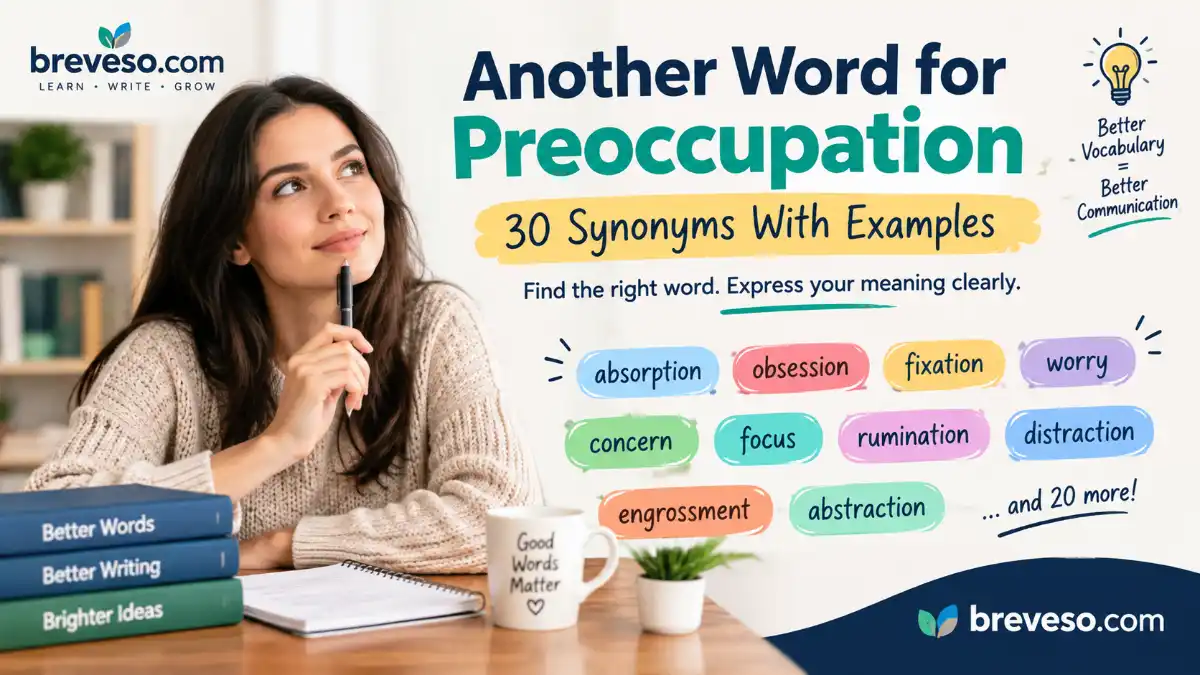
Another word for preoccupation is absorption. If the focus is unhealthy or hard to stop, obsession or fixation fit better. For a worried mind, use worry or concern. For the thing that fills your thoughts, use focus or priority.
The best alternative depends on what “preoccupation” means in your sentence. It can describe a state of mind (deep thought), a thing (your main concern), a feeling (constant worry), or an unhealthy level of focus. Each sense has different natural substitutes.
Quick list: absorption, engrossment, obsession, fixation, worry, concern, focus, rumination, distraction, abstraction
This article looks at 30 alternatives. Each has a meaning, IPA, usage note, and example sentence, so you can choose the right word for your context.
At a Glance: Preoccupation Synonyms and Related Alternatives
| Alternative | Part of Speech | Meaning | Register / Tone | Ideal Context |
| Absorption | noun | Deep mental focus on something | Neutral, slightly formal | Describing deep concentration |
| Engrossment | noun | Being completely taken up by something | Formal | Reading, work, hobbies |
| Obsession | noun | A thought or interest that dominates the mind | Neutral, strong | Unhealthy or intense focus |
| Fixation | noun | An unhealthy or fixed attachment to one thing | Neutral, often critical | Repeated, stuck attention |
| Worry | noun | Anxious thinking about a problem | Everyday | Concerns and fears |
| Concern | noun | Something that troubles or interests you | Neutral | Everyday and professional use |
| Focus | noun | The main center of attention | Neutral | Priorities and goals |
| Rumination | noun | Repeated, unproductive thinking | Formal, psychological | Mental health, reflection |
| Distraction | noun | A state where the mind is pulled away | Neutral | Lack of attention |
| Abstraction | noun | Being lost in thought | Formal, literary | Describing a distant, thoughtful look |
Which Word Should You Use?
| If you want to… | Use | Why |
| Describe deep, healthy focus | absorption or engrossment | Both suggest focus without a negative edge |
| Describe an unhealthy, hard-to-stop thought | obsession | It implies the thought controls the person |
| Describe being stuck on one idea | fixation | It stresses being “fixed” in place |
| Describe constant anxious thinking | worry or rumination | Both centre on troubled thoughts |
| Name the main thing on someone’s mind | concern or focus | Both work as the thing, not the state |
| Describe someone who is not paying attention | distraction or abstraction | Both stress a mind that is elsewhere |
| Describe a favourite topic someone keeps returning to | hobbyhorse | It is informal and slightly humorous |
| Write in a formal or literary style | abstraction or prepossession | Both sound formal or older |
Exploring the Multiple Meanings of “Preoccupation”
1. A State of Mental Absorption
- Meaning: The state of being so absorbed in thought that you do not notice other things.
- Explanation: This is the most common sense. The mind is busy with one subject, so the person seems distant or inattentive. It is not always negative.
- Example: Her preoccupation made her miss the first two questions.
2. Something That Fills the Mind
- Meaning: A subject, problem, or interest that occupies a person’s thoughts.
- Explanation: Here the word is a countable noun and names the thing itself, not the state. It is often plural. It can describe a person, a group, or a whole society.
- Example: Money was his main preoccupation that year.
3. Worry or Anxious Concern
- Meaning: A concern that stays in the mind and causes unease.
- Explanation: This sense overlaps with worry. It is a little more formal and suggests the worry takes attention away from other things.
- Example: His preoccupation with the test results kept him awake.
4. Excessive or Unhealthy Focus
- Meaning: An extreme level of attention on one subject, often at the cost of other parts of life.
- Explanation: Psychology and medical writing often use “preoccupation with” for repeated, intrusive thoughts about one subject. In everyday speech it is milder than “obsession.”
- Example: Her preoccupation with her appearance began to affect her studies.
5. An Older Sense: Bias
- Meaning: Prejudice or a mind already made up (older, now rare).
- Explanation: In earlier English, the word could mean a bias that blocked fair judgment. Modern readers will usually not understand it this way.
- Example: Historical writing may refer to a judge’s “preoccupation” in favor of one side.
Sources: Etymonline (history of the word and its older senses); Dictionary.com and Merriam-Webster (current senses).
Analyzing 30 Preoccupation Alternatives in Detail
Some alternatives below are close synonyms, while others are related words that fit only one sense of “preoccupation.” Usage notes say which is which.
Core Synonyms: Absorbed in Thought
1. Absorption
IPA: US /əbˈsɔːrpʃən/ · UK /əbˈsɔːpʃən/
Definition: The state of being completely taken up by something.
- Usage: A close synonym for sense 1. It is neutral and slightly formal, and it often sounds positive.
- Example: His absorption in the book was so deep that he missed his stop.
2. Engrossment
IPA: US /ɪnˈɡroʊsmənt/ · UK /ɪnˈɡrəʊsmənt/
Definition: The condition of having your attention fully held by something.
- Usage: A formal, close synonym for sense 1. It is rarer than “absorption” and fits writing better than speech.
- Example: The children’s engrossment in the game surprised their teacher.
3. Abstraction
IPA: /æbˈstrækʃən/ (US and UK)
Definition: A state of being lost in thought and not aware of what is around you.
- Usage: A formal or literary synonym for the “distant mind” meaning of sense 1. It does not mean worry.
- Example: She stared out of the window with a look of abstraction.
4. Immersion
IPA: US /ɪˈmɝːʒən/ · UK /ɪˈmɜːʃən/
Definition: Deep involvement in an activity or subject.
- Usage: A related alternative, not an exact synonym. It describes full involvement in an activity, not a mind drifting in thought.
- Example: His immersion in his research left little time for friends.
5. Concentration
IPA: US /ˌkɑːnsənˈtreɪʃən/ · UK /ˌkɒnsənˈtreɪʃən/
Definition: The act of focusing all your attention on one thing.
- Usage: A related alternative. It is chosen and controlled, while preoccupation often happens without choice.
- Example: Her concentration was so strong that she did not hear the bell.
Obsessive Alternatives
6. Obsession
IPA: /əbˈsɛʃən/ (US and UK)
Definition: An idea or interest that fills the mind and is hard to put aside.
- Usage: A stronger alternative for sense 4. Use it when the thought feels out of control, not just busy.
- Example: His obsession with winning cost him his friendships.
7. Fixation
IPA: /fɪkˈseɪʃən/ (US and UK)
Definition: A strong and often unhealthy attachment to one idea or subject.
- Usage: A close synonym for sense 4. It stresses being stuck on one thing and is usually critical.
- Example: Her fixation on small mistakes made her work slow.
8. Compulsion
IPA: /kəmˈpʌlʃən/ (US and UK)
Definition: A strong urge to do something that is hard to resist.
- Usage: A related alternative. It describes the urge to act, not the state of thinking, so it is not an exact synonym.
- Example: He felt a compulsion to check his phone every minute.
9. Infatuation
IPA: /ɪnˌfætʃuˈeɪʃən/ (US and UK)
Definition: A strong but often short-lived attraction to a person or thing.
- Usage: A related alternative. It fits a mind full of one person or idea, usually romantic, and often suggests the feeling will pass.
- Example: His infatuation with the new singer lasted only a summer.
10. Hang-up
IPA: /ˈhæŋ ʌp/ (US and UK)
Definition: An emotional problem or worry that a person cannot easily stop thinking about.
- Usage: An informal alternative for sense 4. It suggests a personal problem, not a simple interest.
- Example: He has a hang-up about speaking in public.
11. Monomania
IPA: US /ˌmɑːnoʊˈmeɪniə/ · UK /ˌmɒnəʊˈmeɪniə/
Definition: An extreme focus on a single subject or idea.
- Usage: A rare, formal, and strong alternative. Use it only for extreme cases, as it sounds dramatic.
- Example: The captain’s monomania drove the crew into danger.
Worry and Concern Alternatives
12. Worry
IPA: US /ˈwɝːi/ · UK /ˈwʌri/
Definition: A feeling of unease about something that may go wrong.
- Usage: A close synonym for sense 3. It is plain, common, and less formal than “preoccupation.”
- Example: Her main worry was the rent.
13. Anxiety
IPA: /æŋˈzaɪəti/ (US and UK)
Definition: A feeling of fear or unease about what might happen.
- Usage: A related alternative. It describes the feeling, while preoccupation describes where attention goes.
- Example: His anxiety about the exam grew each night.
14. Concern
IPA: US /kənˈsɝːn/ · UK /kənˈsɜːn/
Definition: Something that matters to a person or causes worry.
- Usage: A close synonym for senses 2 and 3. It is neutral and works in professional writing.
- Example: Safety was the committee’s chief concern.
15. Rumination
IPA: /ˌruːmɪˈneɪʃən/ (US and UK)
Definition: Long, repeated thinking about something, often an unpleasant subject.
- Usage: A related alternative. It stresses repeated thinking and is common in psychology.
- Example: Rumination about the argument kept him up all night.
16. Brooding
IPA: /ˈbruːdɪŋ/ (US and UK)
Definition: Thinking in a deep, unhappy way about something.
- Usage: A related alternative for a gloomy, silent kind of worry. It is a noun here, from the verb “brood.”
- Example: Her brooding over the loss worried her family.
Main Focus or Interest Alternatives
17. Focus
IPA: US /ˈfoʊkəs/ · UK /ˈfəʊkəs/
Definition: The center of attention or activity.
- Usage: A close synonym for sense 2, where preoccupation names the thing. It has no negative tone.
- Example: The team’s focus this year is customer service.
18. Interest
IPA: /ˈɪntrəst/ (US and UK)
Definition: Something a person likes to learn about or do.
- Usage: A related alternative. It is milder and lacks the suggestion of mental overload.
- Example: Old maps became his main interest.
19. Priority
IPA: US /praɪˈɔːrəti/ · UK /praɪˈɒrəti/
Definition: Something treated as more important than other things.
- Usage: A related alternative for sense 2. It suggests a decision, while preoccupation suggests a pull on the mind.
- Example: Finding a new home became her top priority.
20. Passion
IPA: /ˈpæʃən/ (US and UK)
Definition: A strong liking or enthusiasm for an activity or idea.
- Usage: A related alternative. It is positive, which is the opposite of the usual tone of preoccupation.
- Example: Music was his lifelong passion.
21. Hobbyhorse
IPA: US /ˈhɑːbiˌhɔːrs/ · UK /ˈhɒbiˌhɔːs/
Definition: A favorite subject that a person talks about often.
- Usage: An informal, slightly humorous alternative for sense 2. It suggests a subject someone returns to again and again.
- Example: Parking rules are his favorite hobbyhorse.
Distraction and Daydream Alternatives
22. Distraction
IPA: /dɪˈstrækʃən/ (US and UK)
Definition: A state in which the mind is drawn away from what it should be focused on.
- Usage: A related alternative for the effect of preoccupation. A person who is preoccupied may be distracted, but the two are not the same.
- Example: She answered in a tone of distraction.
23. Reverie
IPA: /ˈrɛvəri/ (US and UK)
Definition: A state of pleasant, dreamy thought.
- Usage: A literary alternative for sense 1. It is gentle and positive, with no suggestion of worry.
- Example: A knock at the door broke his reverie.
24. Daydreaming
IPA: /ˈdeɪdriːmɪŋ/ (US and UK)
Definition: Letting your mind drift to pleasant thoughts while awake.
- Usage: A related alternative. It is relaxed and not necessarily tied to one subject.
- Example: Daydreaming made the lesson feel short.
25. Absent-mindedness
IPA: /ˌæbsəntˈmaɪndɪdnəs/ (US and UK)
Definition: A habit of forgetting things or not noticing what is around you because your mind is elsewhere.
- Usage: A related alternative. It describes a lasting trait, while preoccupation can be temporary.
- Example: His absent-mindedness caused him to leave his keys at work.
26. Woolgathering
IPA: /ˈwʊlˌɡæðərɪŋ/ (US and UK)
Definition: Aimless, dreamy thinking.
- Usage: An old-fashioned, informal alternative. It suggests idle wandering thoughts, not serious focus.
- Example: He was caught woolgathering during the meeting.
Formal and Older Alternatives
27. Intentness
IPA: /ɪnˈtɛntnəs/ (US and UK)
Definition: The quality of being closely and steadily focused.
- Usage: A formal, close synonym for the focused sense. It is uncommon today.
- Example: The intentness on her face showed she was solving the puzzle.
28. Rapture
IPA: US /ˈræptʃər/ · UK /ˈræptʃə/
Definition: A state of great joy or deep absorption.
- Usage: A related literary alternative. It adds strong joy, so use it only when that fits.
- Example: The audience listened in rapture.
29. Prepossession
IPA: /ˌpriːpəˈzɛʃən/ (US and UK)
Definition: An opinion or idea already fixed in the mind before other thoughts can enter.
- Usage: A rare, formal word close to the older “bias” sense of preoccupation. It is not common in everyday English.
- Example: Her prepossession against the plan was clear from the start.
30. Fascination
IPA: /ˌfæsɪˈneɪʃən/ (US and UK)
Definition: The state of being strongly attracted by something interesting.
- Usage: A related alternative. It is positive and curious, while preoccupation can be negative.
- Example: His fascination with space started in childhood.
Sources: Merriam-Webster, Collins Dictionary, Dictionary.com, Wiktionary.
Preoccupation vs. Obsession vs. Fixation
These three words are often mixed up. They all describe a mind held by one subject, but they differ in strength and tone.
| Word | Strength | Core idea | Example |
| Preoccupation | Mild to strong | The mind is busy with something, often for a time | Her preoccupation with the move made her quiet. |
| Obsession | Strong | The thought is hard to control | His obsession with the game took over his life. |
| Fixation | Strong | The mind is stuck on one point | She has a fixation on one old mistake. |
A preoccupation can be short and ordinary, such as before a big event. An obsession is usually more extreme and longer lasting. Fixation puts the emphasis on being “stuck,” often from an early or repeated cause. In everyday writing, “preoccupation” is the safer choice when you do not want to suggest a serious problem.
Sources: Merriam-Webster; Collins Dictionary.
Preoccupation and Opposite/Paired Word Pairs
| Word | Paired Word | Note |
| Preoccupation | Indifference | A natural contrast: the mind is full of something versus not caring |
| Preoccupation | Unconcern | Means lack of worry; contrasts with the worry sense |
| Preoccupation | Detachment | A calm distance from a subject |
| Preoccupation | Attentiveness | Contrasts with a distracted mind, though not an exact antonym |
| Preoccupation | Obsession | A commonly associated pair; obsession is stronger |
“Preoccupation” has no single perfect opposite, because it can describe a state, a thing, or a feeling. The pairs above are the closest contrasts or most common companion words, depending on the sense.
Sources: Merriam-Webster; Collins Thesaurus.
Common Word Partners of “Preoccupation”
| Pattern | Common Partners | Example |
| preoccupation + with | with money, with death, with appearance, with work | His preoccupation with work worried his wife. |
| adjective + preoccupation | main, chief, constant, growing, obsessive | Safety was the chief preoccupation of the team. |
| adjective + preoccupation | national, public, cultural | Fame is a cultural preoccupation. |
| verb + preoccupation | show, share, develop, explain | Many teenagers develop a preoccupation with their phones. |
| preoccupation + of | of the age, of the time | Cost is the preoccupation of the time. |
| self- + preoccupation | self-preoccupation | Self-preoccupation can make listening difficult. |
Sources: Collins Dictionary; Merriam-Webster; Cambridge Dictionary.
Idiomatic Phrases Featuring “Preoccupation”
“Preoccupation” has no widely accepted idioms. The following are established expressions, not true idioms.
1. Preoccupied with
- Meaning: Having your mind taken up by something.
- Example: She was preoccupied with the move and forgot the call.
2. An all-consuming preoccupation
- Meaning: A concern that takes up nearly all of a person’s attention.
- Example: Getting into college became his all-consuming preoccupation.
3. A national preoccupation
- Meaning: A subject that a whole country thinks and talks about a great deal.
- Example: Football is a national preoccupation in many countries.
4. Self-preoccupied
- Meaning: Too busy with your own thoughts and needs to notice others.
- Example: He was too self-preoccupied to see her distress.
Sources: Merriam-Webster; Collins Dictionary.
Word Formation of “Preoccupation”
Etymology & Structure
The word comes from Latin praeoccupationem, meaning a seizing beforehand or anticipation. It builds on praeoccupare, which joins prae (“before”) and occupare (“seize”). In English the structure is pre- (“before”) + occupy + -ation (a noun ending for actions or states).
Date and History
The earliest English use dates from the 1550s and meant the state of occupying or seizing something beforehand. The modern meaning of prior mental absorption appeared in 1854. An older secondary meaning of bias or prejudice dates from about 1600.
Word Class Variations
- Noun: preoccupation, preoccupations (plural); self-preoccupation
- Verb: preoccupy (recorded from the 1560s), preoccupies, preoccupying, preoccupied
- Adjective: preoccupied (recorded from 1823); preoccupying; self-preoccupied
Sources: Etymonline (preoccupation, preoccupy); Wiktionary (preoccupy).
Common Word-Choice Mistakes
- Preoccupation about money: use preoccupation with money.
- He has a preoccupation for football: use a preoccupation with football, or a passion for it.
- She felt a deep preoccupation of fear: use anxiety or fear, since preoccupation does not name a feeling by itself.
- Using obsession for every busy mind: use preoccupation for mild or temporary focus.
- I am so preoccupation today: use the adjective, preoccupied.
- Treating distraction as an exact synonym: distraction is the effect, preoccupation is often the cause.
- Using passion for a worry: passion is positive, so use concern or worry.
Frequently Asked Questions
What is the closest synonym for preoccupation?
Absorption is the closest for a busy mind. For worry, use concern. For an unhealthy level of focus, use obsession or fixation.
What is a formal alternative to preoccupation?
Engrossment, abstraction, and intentness are formal. “Concern” also works in professional writing.
What is a literary alternative to preoccupation?
Reverie and rapture are literary. Abstraction fits a distant, thoughtful look.
Is preoccupation the same as obsession?
No. Preoccupation can be mild and short-lived, while obsession is stronger and harder to control.
Can preoccupation be positive?
Yes. It can describe happy absorption in a hobby or task, although it often has a worried tone.
Can preoccupation mean worry?
Yes. It can describe worry that stays in the mind and pulls attention away from other things.
What is the opposite of preoccupation?
There is no single opposite. Indifference or unconcern fits the “caring” sense, and attentiveness fits the “distracted” sense.
What is the difference between preoccupation and distraction?
Preoccupation is a mind busy with one thing, and distraction is a mind pulled away from something else. One often causes the other.
Is preoccupation a countable noun?
It can be both. It is uncountable for the state and countable for things on a person’s mind: “her many preoccupations.”
What is the verb form of preoccupation?
The verb is “preoccupy,” and its adjective form is “preoccupied.”
Conclusion
The closest alternatives to preoccupation are absorption, engrossment, concern, and focus. For stronger or unhealthy cases, obsession and fixation fit better. Worry and rumination suit anxious thinking.
Context matters because the word has several senses. It can describe a state of mind, the thing that fills the mind, a worry, or an excessive focus. A word that fits one sense may be wrong in another.
To choose well, first decide which sense you mean. Then pick a word with the right strength and tone: mild for everyday use, stronger for serious cases, and formal or literary for careful writing.

Ali Sultan is a writer and editor at Breveso.com, where he covers synonyms for emotions, everyday speech, and modern slang. He has spent years playing with words, first as an English literature student and later as a content editor. Ali believes no one should get stuck on a single word. His guides break synonyms down by tone and situation, so readers can pick the word that fits, not just the first one they find. He is currently building out Breveso’s collections on feelings, actions, and casual speech. His rule is simple: if a guide does not help a real person write a better sentence, it does not get published.