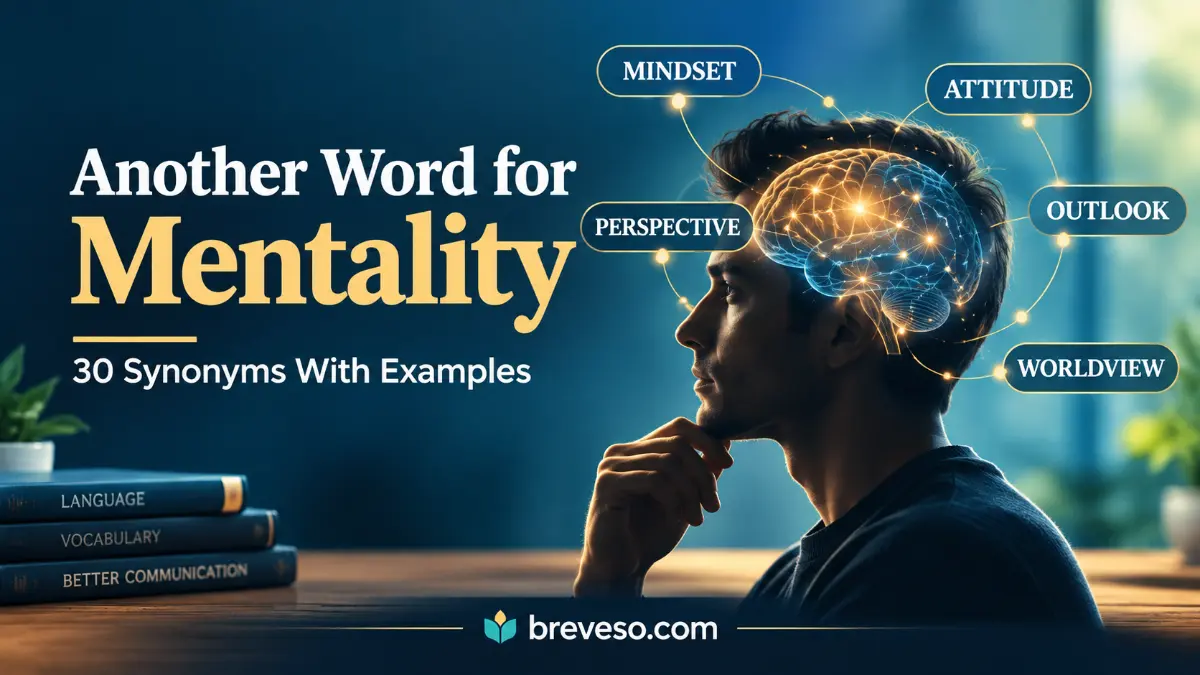
The closest everyday alternative to “mentality” is mindset. Attitude, outlook, and way of thinking also work well. Which one fits depends on what you mean. “Mentality” can describe how a person thinks, how a whole group thinks, or, in older usage, how well a person can think.
Choosing the right word depends on the meaning you want to express. For a personal view of life, consider “outlook.” When describing shared beliefs in a team or school, “ethos” or “culture” may fit better. If you mean mental ability, use “intelligence” for greater clarity.
Quick list: mindset, attitude, outlook, perspective, worldview, thinking, intellect, disposition, ethos
This article covers 30 alternatives. Each one has a meaning, IPA, a usage note, an example, and notes on the context where it works best.
At a Glance: Mentality Synonyms and Related Alternatives
| Alternative | Part of Speech | Meaning | Register / Tone | Ideal Context |
| Mindset | noun | A person’s usual way of thinking | Neutral, common | Work, sports, self-improvement |
| Attitude | noun | A settled way of feeling or thinking about something | Neutral, common | Behavior, school, work |
| Outlook | noun | A general view of life or the future | Neutral | Personal views, forecasts |
| Perspective | noun | A way of seeing an issue | Neutral | Discussions, debates |
| Worldview | noun | An overall way of understanding the world | Formal | Culture, philosophy |
| Thinking | noun | The way someone reasons or what they believe | Neutral, informal | “That kind of thinking” |
| Intellect | noun | The power of the mind to reason | Formal | Mental ability |
| Intelligence | noun | Ability to learn and solve problems | Neutral | Tests, schools |
| Disposition | noun | A natural, lasting tendency | Formal | Character descriptions |
| Ethos | noun | The spirit and beliefs of a group | Formal | Schools, companies, movements |
Which Word Should You Use?
| If you want to… | Use | Why |
| Describe a person’s usual way of thinking | mindset | It is the closest everyday match. |
| Talk about feelings toward one thing | attitude | It focuses on a specific person, task, or issue. |
| Describe a person’s general view of life | outlook | It suggests how someone sees life or the future. |
| Compare how two people see an issue | perspective | It stresses the angle of view. |
| Describe a group’s shared beliefs and values | ethos | It suits schools, companies, and movements. |
| Describe a deep set of beliefs about the world | worldview | It is broader and more formal. |
| Talk about brain power | intelligence | It is clearer than “mentality” in this sense. |
| Describe a short-term mental state | frame of mind | It shows the state is temporary. |
Exploring the Multiple Meanings of “Mentality”
1. A Person’s Way of Thinking
- Meaning: The set of one’s mind; a view or outlook.
- Explanation: This is the most common modern sense. It describes the thinking habits behind how someone acts or decides. It is often paired with a describing word, such as “competitive” or “positive.”
- Example: She has a competitive mentality and hates to lose.
2. A Shared Way of Thinking in a Group
- Meaning: The common outlook of a team, crowd, or community.
- Explanation: “Mentality” is often used for groups. Many well-known phrases use it this way, such as herd, mob, and siege mentality.
- Example: The team has a “never give up” mentality.
3. Mental Capacity
- Meaning: Mental capacity or endowment, as in “a person of average mentality.”
- Explanation: This sense is about how well a mind works. It is older and less common now. Most speakers choose “intelligence” instead.
- Example: The test was built for children of average mentality.
4. Mental Makeup or Character
- Meaning: The state or quality of mental or intellectual ability, and a mental inclination or character.
- Explanation: Here the word describes the kind of mind a person has, including their usual habits of thought and feeling. It overlaps with “disposition” and “psychology.”
- Example: It is hard to understand the mentality of someone who takes such risks.
5. A Narrow or Fixed Outlook (Critical Use)
- Meaning: A way of thinking the speaker sees as limited, closed, or unfair.
- Explanation: The word is often used when the speaker disapproves, as in “small-town mentality.” Most of the well-known compounds are critical, which suggests the word often carries judgment. This sense comes from usage rather than a separate dictionary entry.
- Example: I am tired of the “us versus them” mentality in this office.
Sources: Dictionary.com (including Collins English Dictionary text); Wiktionary
Analyzing 30 Mentality Alternatives in Detail
Some alternatives below are direct synonyms for the “way of thinking” sense. Others are related words that fit only one sense or one context, and each usage note says which is which.
Group 1: Core Synonyms (Way of Thinking)
1. Mindset
IPA: /ˈmaɪndˌsɛt/ (US and UK)
Definition: A person’s usual way of thinking, along with the attitudes and beliefs that go with it.
- Usage: The closest everyday synonym. It is neutral and common in work, sports, and education. “Mentality” is more often used for groups or in critical remarks.
- Example: She started the new job with a learning mindset.
2. Attitude
IPA: US /ˈætəˌtuːd/ · UK /ˈætɪtjuːd/
Definition: A settled way of thinking or feeling about someone or something, usually shown in behavior.
- Usage: A close synonym, but narrower. “Attitude” usually points to feelings about one thing, while “mentality” covers a wider way of thinking.
- Example: His attitude toward feedback has changed a lot.
3. Outlook
IPA: /ˈaʊtˌlʊk/ (US and UK)
Definition: A person’s general view of life or of the future.
- Usage: A close synonym when you mean how someone sees life. It often comes with words like “positive” or “gloomy.”
- Example: Her cheerful outlook helped the whole team.
4. Perspective
IPA: US /pərˈspɛktɪv/ · UK /pəˈspektɪv/
Definition: A particular way of viewing something, shaped by experience.
- Usage: A related alternative, not an exact synonym. It focuses on the angle of view, not on a lasting habit of thought.
- Example: Living abroad gave him a new perspective on money.
5. Viewpoint
IPA: /ˈvjuːˌpɔɪnt/ (US and UK)
Definition: A position from which something is considered; a point of view.
- Usage: A related alternative. It describes an opinion on an issue, not a general way of thinking.
- Example: From a teacher’s viewpoint, the plan makes sense.
Group 2: Thinking Styles and Worldview
6. Thinking
IPA: /ˈθɪŋkɪŋ/ (US and UK)
Definition: The way someone reasons, or the ideas and opinions they hold on a subject.
- Usage: A good informal substitute in phrases like “that kind of thinking,” which often replaces “that kind of mentality.”
- Example: That kind of thinking will not solve the problem.
7. Philosophy
IPA: US /fɪˈlɑːsəfi/ · UK /fɪˈlɒsəfi/
Definition: A set of beliefs or principles that guide how someone acts or lives.
- Usage: A related alternative. It sounds more deliberate and thoughtful than “mentality,” as in “a personal philosophy.”
- Example: Her philosophy is to finish small tasks first.
8. Worldview
IPA: US /ˈwɜːrldˌvjuː/ · UK /ˈwɜːldvjuː/
Definition: The overall way a person or group understands the world.
- Usage: A related, more formal alternative. It is broader than “mentality” and includes deep beliefs and values.
- Example: Their religious worldview shapes their daily lives.
9. Approach
IPA: US /əˈproʊtʃ/ · UK /əˈprəʊtʃ/
Definition: A way of dealing with a task, problem, or person.
- Usage: A related alternative. It is about the method someone uses, not their inner thinking.
- Example: Her approach to studying is very organized.
10. Frame of mind
IPA: /ˌfreɪm əv ˈmaɪnd/ (US and UK)
Definition: A person’s mental or emotional state at a particular time.
- Usage: A related alternative. It describes a passing state, while “mentality” suggests something longer lasting.
- Example: I was in a better frame of mind after a walk.
Group 3: Mental Ability
11. Intellect
IPA: /ˈɪntəlɛkt/ (US and UK)
Definition: The power of the mind to think, reason, and understand.
- Usage: A formal alternative that matches only the “mental capacity” sense, not “way of thinking.”
- Example: The teacher praised her sharp intellect.
12. Intelligence
IPA: /ɪnˈtɛlɪdʒəns/ (US and UK)
Definition: The ability to learn, understand, and solve problems.
- Usage: The clearest everyday word for the “mental capacity” sense. It does not mean a mindset.
- Example: The puzzle tests logic and general intelligence.
13. Brainpower
IPA: US /ˈbreɪnˌpaʊər/ · UK /ˈbreɪnˌpaʊə/
Definition: Mental ability, or the combined intelligence of a group of people.
- Usage: An informal, related alternative for the “capacity” sense.
- Example: The company hired the best brainpower in the city.
14. Wits
IPA: /wɪts/ (US and UK)
Definition: The ability to think quickly and clearly, especially in a hard situation.
- Usage: A related alternative, almost always plural. It suggests quick thinking, not a lasting outlook.
- Example: He survived the trip by using his wits.
15. Cognition
IPA: US /kɑːɡˈnɪʃn/ · UK /kɒɡˈnɪʃn/
Definition: The mental process of learning, knowing, and understanding.
- Usage: A technical, related term used in psychology and science. It does not mean an outlook or attitude.
- Example: Lack of sleep can harm memory and cognition.
Group 4: Character and Psychology
16. Psychology
IPA: US /saɪˈkɑːlədʒi/ · UK /saɪˈkɒlədʒi/
Definition: The mental and emotional makeup of a person or group; also the study of the mind.
- Usage: A related alternative for the “mental makeup” sense, as in “the psychology of a crowd.”
- Example: The coach understands the psychology of young players.
17. Disposition
IPA: /ˌdɪspəˈzɪʃn/ (US and UK)
Definition: A person’s natural tendency or usual mood.
- Usage: A formal, related alternative. It stresses natural character more than beliefs.
- Example: He has a calm and friendly disposition.
18. Temperament
IPA: /ˈtɛmprəmənt/ (US and UK)
Definition: A person’s nature, especially how they react emotionally.
- Usage: A related alternative. It is about feelings and reactions, not thinking habits.
- Example: Her steady temperament suits a stressful job.
19. Psyche
IPA: /ˈsaɪki/ (US and UK)
Definition: The human mind, especially its deep mental and emotional side.
- Usage: A formal, related alternative used in psychology and serious writing.
- Example: The long illness left a mark on his psyche.
20. Mind
IPA: /maɪnd/ (US and UK)
Definition: The part of a person that thinks, feels, and reasons.
- Usage: A broad word that can replace “mentality” in some phrases, such as “a creative mind.” It is less specific.
- Example: She has a creative mind and loves new ideas.
Group 5: Shared Outlook of a Group
21. Ethos
IPA: US /ˈiːθɑːs/ · UK /ˈiːθɒs/
Definition: The characteristic spirit and beliefs of a group, culture, or community.
- Usage: A formal alternative to “group mentality.” It is neutral or positive, while “mentality” can sound critical.
- Example: The school has an ethos of respect and hard work.
22. Spirit
IPA: /ˈspɪrɪt/ (US and UK)
Definition: The attitude or mood shared by a group, as in “team spirit.”
- Usage: A related alternative. It is warm and often positive.
- Example: The team’s spirit stayed strong after the loss.
23. Culture
IPA: US /ˈkʌltʃər/ · UK /ˈkʌltʃə/
Definition: The shared customs, values, and ways of working of a group.
- Usage: A related alternative for organizations. It covers habits and values, not just thinking.
- Example: The company has a culture of openness.
24. Mood
IPA: /muːd/ (US and UK)
Definition: The general feeling of a person or group at a certain time.
- Usage: A related alternative. It is short term, while “mentality” suggests something longer lasting.
- Example: The mood in the city was hopeful.
25. Climate
IPA: /ˈklaɪmət/ (US and UK)
Definition: The general attitudes or conditions in a place or period.
- Usage: A related alternative used mostly in set phrases such as “a climate of fear” or “a climate of trust.”
- Example: A climate of distrust grew inside the office.
Group 6: Beliefs and Leanings
26. Beliefs
IPA: /bɪˈliːfs/ (US and UK)
Definition: Ideas that a person accepts as true.
- Usage: A related alternative. Beliefs are part of a mentality, but they are not the same thing.
- Example: Their beliefs shape how they raise their children.
27. Stance
IPA: /stæns/ (US and UK)
Definition: A position or attitude on an issue, often stated publicly.
- Usage: A related alternative common in news and politics. It describes a position on one issue, not general thinking.
- Example: The mayor took a firm stance on safety.
28. Inclination
IPA: /ˌɪnklɪˈneɪʃn/ (US and UK)
Definition: A natural tendency or leaning toward something.
- Usage: A related, formal alternative. It points to a leaning, not a full way of thinking.
- Example: She has an inclination to trust people quickly.
29. Bias
IPA: /ˈbaɪəs/ (US and UK)
Definition: A leaning toward one side, often in an unfair way.
- Usage: A related alternative for critical use only. It fits when “mentality” means an unfair or one-sided view.
- Example: The report shows a clear bias against small farms.
30. Orientation
IPA: /ˌɔːriənˈteɪʃn/ (US and UK)
Definition: A person’s basic attitudes, interests, or direction of thought.
- Usage: A related, formal alternative that usually needs a describing word, as in “customer orientation.”
- Example: The firm has a strong customer orientation.
Sources: Dictionary.com; Collins English Dictionary; Merriam-Webster (standard senses of the alternatives)
Mentality vs. Mindset vs. Attitude
These three words are easy to confuse. They overlap, but each has a different focus.
| Word | Main Focus | Typical Use | Example |
| Mentality | A way of thinking, often of a group, sometimes critical | “Herd mentality,” “winning mentality” | The team has a strong winning mentality. |
| Mindset | A person’s habitual way of thinking | Personal growth, work, sports | She keeps a positive mindset. |
| Attitude | A feeling or stance toward something specific | Behavior, tone, response | His attitude toward the test was relaxed. |
A simple rule can help you choose the right word. Use “mindset” for a person’s thinking habits, “attitude” for their feelings about a specific subject, and “mentality” for a shared or fixed way of thinking. Common compounds often describe group behavior or negative views, including herd mentality, mob mentality, siege mentality, victim mentality, and crab mentality.
Sources: Dictionary.com; Wiktionary
Mentality and Opposite/Paired Word Pairs
| Word | Paired Word | Note |
| Winning mentality | Defeatist mentality | A natural contrast in sports and work. |
| Open mentality | Closed mentality | Describes how willing someone is to accept new ideas. |
| Short-term mentality | Long-term mentality | Common in business and planning. |
| Individual mentality | Group (herd) mentality | Contrasts thinking alone with following the crowd. |
| Mentality | Behavior | Thinking versus action; they are related but not opposites. |
| Mentality | Physical ability | Often paired in sports talk, as in “mentality and fitness.” |
“Mentality” has no true dictionary antonym. The pairs above are natural contrasts that appear in real use, not strict opposites. In most cases the contrast comes from the describing word placed before “mentality,” not from a separate opposite noun.
Sources: Dictionary.com; Wiktionary
Common Word Partners of “Mentality”
| Pattern | Common Partners | Example |
| adjective + mentality | competitive, positive, short-term, small-town, old-fashioned, liberal | He has a short-term mentality about money. |
| noun + mentality | victim, bunker, trench, pack | The group slipped into a victim mentality. |
| phrase + mentality | “us versus them,” “no pain, no gain,” “family first” | We need to drop the “us versus them” mentality. |
| verb + mentality | change, shift, adopt, have | The coach wants to shift the team’s mentality. |
| mentality + of | mentality of the team, mentality of a child | He has the mentality of a ten-year-old. |
Dictionary.com’s example sentences include “bunker mentality” and “no pain, no gain mentality.” The best-known group compounds are explained in the next section.
Sources: Dictionary.com; Wiktionary
Idiomatic Phrases Featuring “Mentality”
“Mentality” appears in few true idioms. The phrases below are strongly established expressions. Most are compounds, and their meaning is easy to work out from the words.
1. Herd mentality
- Meaning: The tendency to follow what most people do without thinking independently.
- Example: Herd mentality pushed many people to buy the same stock.
2. Mob mentality
- Meaning: The way people in a crowd may act more emotionally or more aggressively than they would alone.
- Example: Police feared that mob mentality would turn the protest violent.
3. Siege mentality
- Meaning: A defensive attitude that comes from feeling that others are hostile or attacking.
- Example: After months of criticism, the staff developed a siege mentality.
4. Crab mentality
- Meaning: An attitude in which people try to pull others down because they cannot succeed themselves. The name comes from the picture of crabs trapped in a bucket.
- Example: Crab mentality at the office made it hard to celebrate anyone’s promotion.
Sources: Wiktionary; Dictionary.com
Word Formation of “Mentality”
Etymology & Structure
“Mentality” is built from the adjective mental plus the suffix -ity. Mental came from Late Latin mentalis, meaning “of the mind,” which came from Latin mens (“mind”) and the Proto-Indo-European root men-, “to think.” The suffix -ity forms nouns that name a state or quality. Wiktionary also notes that “mentality” is a doublet of the French-derived word mentalité.
Date and History
Etymonline dates “mentality” to the 1690s, with the meaning “mental action or power.” The sense “intellectual activity” is recorded by 1856, and “mental character or disposition” by 1895. Dictionary.com gives a similar date range of 1685 to 1695.
Word Class Variations
- Noun: mentality (plural: mentalities)
- Related adjective: mental
- Related adverb: mentally
- Related noun: supermentality
“Mentality” is used only as a noun. It has no verb form of its own.
Sources: Etymonline; Dictionary.com; Wiktionary
Common Word-Choice Mistakes
- “He has mentality problems”: say “mental health problems.”
- “She has a mentality illness”: say “mental illness.”
- “The two teams have different mentality”: say “different mentalities.”
- “I’m in a bad mentality today”: say “in a bad mood” or “a bad frame of mind.”
- “He has a lot of mentality” (meaning rude or sassy): say “a lot of attitude.”
- “The test measures mentality” (meaning brain power): say “intelligence” for clarity.
- “He has mentality of a child”: say “the mentality of a child.”
Frequently Asked Questions
What is the closest synonym for mentality?
“Mindset” is the closest everyday synonym. It describes a person’s usual way of thinking.
What is a formal alternative to mentality?
“Worldview,” “disposition,” and “ethos” are formal choices. Use “ethos” for groups and “worldview” for deep beliefs.
What is the difference between mentality and attitude?
“Attitude” is a feeling or stance toward something specific. “Mentality” is a broader way of thinking.
Can mentality describe a group?
Yes. Phrases such as “team mentality” and “herd mentality” are common. “Ethos” and “culture” are neutral options for groups.
Is mentality a negative word?
Not always, as in “a winning mentality.” It does often appear in critical phrases like “victim mentality” or “siege mentality.”
What is another word for a winning mentality?
“Winning mindset” and “competitive spirit” both work. “Will to win” is a natural alternative phrase.
Can mentality mean intelligence?
In an older sense, yes. Dictionaries list “mental capacity” as a meaning. Today “intelligence” is clearer.
What is the opposite of mentality?
There is no true opposite. You can contrast it by changing the describing word, such as “open” versus “closed.”
Is mentality the same as mental health?
No. “Mentality” is about how someone thinks. “Mental health” is about psychological well-being.
Where does the word mentality come from?
It is formed from “mental” plus “-ity,” and it dates to the 1690s. “Mental” traces back to the Latin word for “mind.”
Conclusion
The closest everyday alternatives to “mentality” are “mindset,” “attitude,” and “outlook.” For groups, “ethos” and “culture” work well. For mental ability, “intelligence” and “intellect” are better choices.
Context matters because “mentality” has several senses. It can mean a personal way of thinking, a shared group outlook, or mental capacity. It can also sound critical, which many alternatives do not.
To choose the right word, first decide which sense you mean. Then think about tone, and ask whether you describe a person or a group. If you want a neutral word, try “mindset.” If you want a formal one, try “worldview” or “ethos.”

Ali Sultan is a writer and editor at Breveso.com, where he covers synonyms for emotions, everyday speech, and modern slang. He has spent years playing with words, first as an English literature student and later as a content editor. Ali believes no one should get stuck on a single word. His guides break synonyms down by tone and situation, so readers can pick the word that fits, not just the first one they find. He is currently building out Breveso’s collections on feelings, actions, and casual speech. His rule is simple: if a guide does not help a real person write a better sentence, it does not get published.