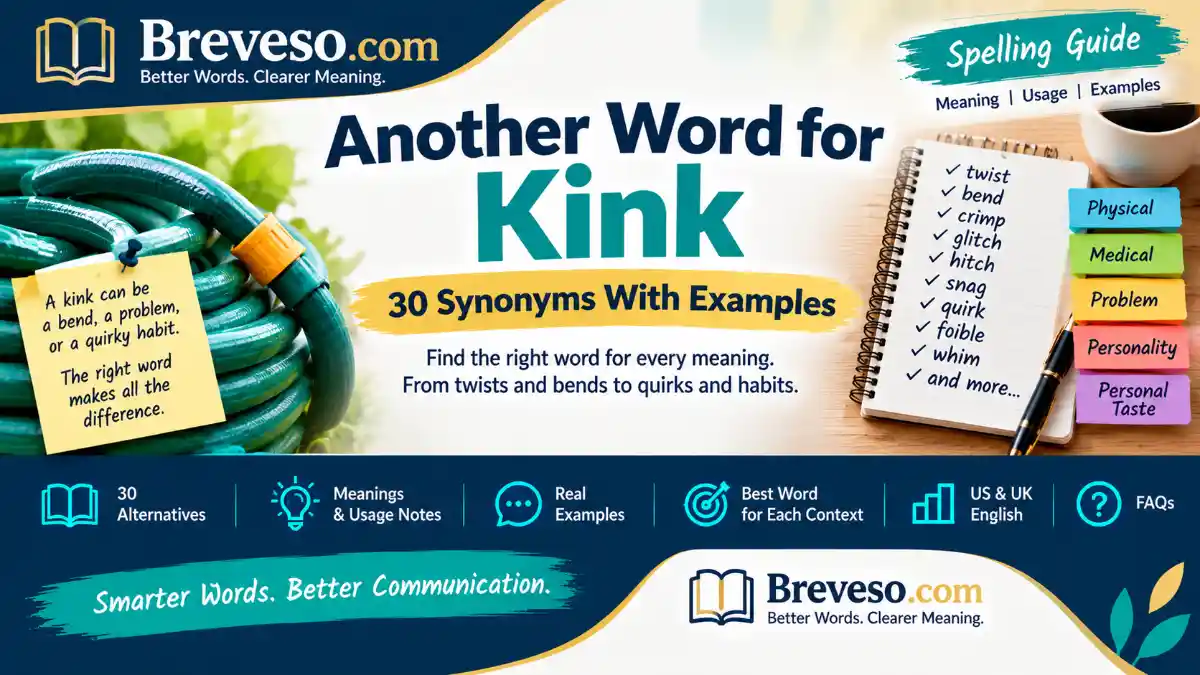
The closest everyday alternatives to kink are twist, bend, and crimp when you mean a sharp turn in something straight. Glitch, hitch, and snag fit when kink means a small problem in a plan or system. Quirk and foible suit an odd habit in a person.
The best word depends on meaning and context, because kink has at least five senses. It can describe a bent hose, a stiff neck, a flaw in a plan, an odd trait, or an informal term for an unconventional personal taste. Each sense needs a different replacement.
Quick list: twist, bend, crimp, crick, glitch, hitch, snag, quirk, foible, whim
This article examines 30 alternatives with meanings, IPA, usage notes, examples, and context. Some are close synonyms, while others fit only one sense.
At a Glance: Kink Synonyms and Related Alternatives
| Alternative | Part of Speech | Meaning | Register / Tone | Ideal Context |
| Twist | noun | a turn in something long | neutral | rope, wire, cable |
| Bend | noun | a curve or angle in something straight | neutral | pipes, roads, tubes |
| Crick | noun | sudden stiffness in the neck or back | informal | sleeping badly, sore neck |
| Glitch | noun | a small fault in a machine or program | informal | apps, devices, systems |
| Hitch | noun | a minor problem that causes delay | neutral | events, plans, schedules |
| Snag | noun | an unexpected obstacle | informal | deals, projects, repairs |
| Quirk | noun | an odd habit or feature | friendly, informal | people, objects, places |
| Foible | noun | a small, harmless weakness in character | literary, gentle | describing personality |
| Whim | noun | a sudden idea or wish | neutral | impulsive choices |
| Predilection | noun | a strong liking for something | formal | polite, neutral writing about tastes |
Which Word Should You Use?
| If you want to… | Use | Why |
| Describe a sharp fold in a hose or cable | twist, bend, or crimp | These words name the physical shape directly |
| Describe a stiff neck after sleeping badly | crick | It is the standard word for this exact pain |
| Name a small fault in an app or machine | glitch | It points to a technical fault, often brief |
| Describe a small delay in a plan | hitch | It stresses the interruption, not the cause |
| Describe an unexpected obstacle in a deal | snag | It suggests something caught and slowed progress |
| Describe a harmless odd habit | quirk | It sounds warm and friendly |
| Write about a personal trait in a formal text | idiosyncrasy | It suits academic or careful writing |
| Describe a polite, neutral personal taste | predilection | It keeps a formal, neutral tone |
Exploring the Multiple Meanings of “Kink”
1. A Tight Twist or Bend in Something Long
- Meaning: A sharp bend, fold, or twist in a rope, wire, hose, thread, or hair.
- Explanation: This is the oldest sense. A kink often blocks flow or movement, so people want to remove it. Compared with a gentle curve, a kink suggests a tight, unwanted bend.
- Example: A kink in the garden hose stopped the water.
2. A Painful Stiffness in a Muscle
- Meaning: A sudden, sore stiffness, especially in the neck or back.
- Explanation: Dictionaries list this as a type of muscle spasm. People most often say “a kink in my neck,” and British speakers also use crick, rick, and wrick.
- Example: I woke up with a kink in my neck.
3. A Flaw or Difficulty in a Plan or System
- Meaning: A small problem that may stop something from working smoothly.
- Explanation: This figurative sense treats a plan like a hose. Water cannot flow freely, and neither can the plan. The problem is usually minor and fixable.
- Example: The team still has a few kinks to fix before the launch.
4. An Odd Notion or Mental Quirk
- Meaning: A strange idea, whim, or peculiar trait in a person.
- Explanation: Etymonline records this figurative sense in American English in 1803. It treats the mind as something with a twist in it. Today it sounds older than the other senses.
- Example: He had a kink in his thinking that made him distrust all banks.
5. An Informal Word for an Unconventional Personal Taste
- Meaning: A personal preference, especially a sexual one, that differs from what many people consider typical.
- Explanation: The word appears in this sense in the 1960s and 1970s. It is informal and does not carry a medical diagnosis. Writers who need a formal or clinical tone choose different words.
- Example: The magazine ran a candid column about kinks and personal taste.
Sources: Etymonline (kink); Wiktionary (kink); Princeton WordNet via Hyperdic (kink)
Analyzing 30 Kink Alternatives in Detail
Some alternatives below are close synonyms for one sense of kink, while others are related words that fit only certain contexts. Each usage note says which is which.
Bends and Twists
1. Twist
IPA: /twɪst/ (US and UK)
Definition: A turn or bend in something long, such as a rope, wire, or hair.
- Usage: This is the closest everyday synonym for the physical sense. A twist can be gentle, while a kink is usually tight and sharp.
- Example: There was a twist in the cord, so the lamp would not reach the wall.
2. Bend
IPA: /bɛnd/ (US and UK)
Definition: A curve or angle in something that was straight.
- Usage: Bend is broader than kink. A bend can be smooth and planned, while a kink suggests a sharp, unwanted fold.
- Example: The plumber found a bend in the pipe that slowed the water.
3. Crimp
IPA: /krɪmp/ (US and UK)
Definition: A small fold, wave, or pinch in a material such as hair, metal, or hose.
- Usage: This is a related alternative, not an exact synonym. A crimp is often made on purpose, as in crimped hair, while a kink usually happens by accident.
- Example: A crimp in the hose cut the flow to a trickle.
4. Coil
IPA: /kɔɪl/ (US and UK)
Definition: A length of rope, wire, or hair wound into rings or spirals.
- Usage: Coil is a related word, not a synonym. A coil repeats a loop many times, while a kink is one sharp fold.
- Example: The cable lay in a neat coil on the floor.
Curls and Tangles
5. Curl
IPA: US /kɜːrl/ · UK /kɜːl/
Definition: A small spiral or curved lock of hair, or any shape like it.
- Usage: Curl fits the hair sense of kink and sounds softer and more positive. It does not work for hoses, plans, or sore muscles.
- Example: She straightened her hair, but one stubborn curl stayed at the back.
6. Tangle
IPA: /ˈtæŋɡəl/ (US and UK)
Definition: A twisted mass of threads, hair, or wires that is hard to separate.
- Usage: Tangle is a related alternative. A kink is one sharp fold, while a tangle involves many pieces caught together.
- Example: He spent ten minutes working a tangle out of the fishing line.
7. Knot
IPA: US /nɑːt/ · UK /nɒt/
Definition: A lump or fastening made by tying or twisting rope, thread, hair, or muscle.
- Usage: Knot fits both the rope sense and the muscle sense, as in “a knot in my shoulder.” A knot usually holds tight until someone loosens it, while a kink may relax by itself.
- Example: The massage therapist found a knot in her shoulder.
Muscle Stiffness
8. Crick
IPA: /krɪk/ (US and UK)
Definition: A sudden, painful stiffness in the neck or back.
- Usage: This is the closest synonym for the neck sense of kink, especially in the phrase “a crick in the neck.” The tone is informal.
- Example: Sleeping on the sofa gave me a crick in my neck.
9. Cramp
IPA: /kræmp/ (US and UK)
Definition: A sudden, painful tightening of a muscle.
- Usage: Cramp is a related alternative. It often describes legs, feet, or the stomach, while kink and crick usually describe the neck or back.
- Example: A cramp in her calf woke her at night.
10. Spasm
IPA: /ˈspæzəm/ (US and UK)
Definition: A sudden, involuntary tightening of a muscle.
- Usage: Spasm is a broader, more medical term. A kink in the neck counts as one kind of muscle spasm.
- Example: A back spasm kept him from lifting the box.
11. Stiffness
IPA: /ˈstɪfnəs/ (US and UK)
Definition: Difficulty in moving a body part, or the quality of being hard to bend.
- Usage: Stiffness is plain and widely understood. It sounds less specific than crick because it names the condition and not the sudden onset.
- Example: Morning stiffness in the neck eased after a warm shower.
Technical Problems and Hitches
12. Glitch
IPA: /ɡlɪtʃ/ (US and UK)
Definition: A small, often sudden fault in a machine, program, or system.
- Usage: Glitch is the closest synonym for “kinks in the system” in a technical setting. It sounds informal and suggests a problem that may pass quickly.
- Example: A glitch in the app deleted my draft.
13. Hitch
IPA: /hɪtʃ/ (US and UK)
Definition: A minor problem that causes a delay or interruption.
- Usage: Hitch is a close synonym for a kink in a plan. It focuses on the delay, and it appears in the common phrase “without a hitch.”
- Example: The wedding went ahead without a hitch.
14. Snag
IPA: /snæɡ/ (US and UK)
Definition: An unexpected problem or obstacle.
- Usage: Snag is informal and fits plans, deals, and repairs. It suggests something caught and slowed progress, as in “hit a snag.”
- Example: The builders hit a snag when the permit did not arrive.
15. Bug
IPA: /bʌɡ/ (US and UK)
Definition: An error or fault in computer software or hardware.
- Usage: Bug is a related alternative with a narrower range. It fits technology only, while kink can also describe a plan or an event.
- Example: The team fixed the bug before the update went out.
Minor Problems and Flaws
16. Hiccup
IPA: /ˈhɪkʌp/ (US and UK)
Definition: A small, short-lived problem or setback.
- Usage: Hiccup is a mild, informal word. It suggests the problem will pass quickly, unlike a kink that needs fixing.
- Example: The delay was just a hiccup in an otherwise smooth launch.
17. Wrinkle
IPA: /ˈrɪŋkəl/ (US and UK)
Definition: A small difficulty or complication in a plan.
- Usage: Wrinkle is a figurative, related alternative. It suggests a small complication, not a fault in how something works.
- Example: The new rule added a wrinkle to our travel plans.
18. Flaw
IPA: /flɔː/ (US and UK)
Definition: A fault or weakness that spoils something or makes it less than perfect.
- Usage: Flaw is stronger than kink. A flaw can sit deep in the design, while a kink is often a smaller problem that someone can fix.
- Example: The test revealed a flaw in the design.
Quirks and Odd Habits
19. Quirk
IPA: US /kwɜːrk/ · UK /kwɜːk/
Definition: An odd habit or feature of a person or thing.
- Usage: Quirk is the closest everyday synonym for the “odd trait” sense. The tone is warm and often affectionate.
- Example: One of his quirks is arranging his books by color.
20. Idiosyncrasy
IPA: US /ˌɪdioʊˈsɪŋkrəsi/ · UK /ˌɪdiəˈsɪŋkrəsi/
Definition: A distinctive habit, feature, or way of behaving that belongs to one person or group.
- Usage: Idiosyncrasy is the formal option. Academic and careful writing favor it over quirk.
- Example: Every writer has idiosyncrasies of style.
21. Eccentricity
IPA: US /ˌɛksənˈtrɪsəti/ · UK /ˌɛksɛnˈtrɪsɪti/
Definition: Unusual or odd behavior, especially in a person.
- Usage: Eccentricity is a related alternative. It is stronger and more noticeable than a quirk.
- Example: The professor’s eccentricity amused his students.
22. Foible
IPA: /ˈfɔɪbəl/ (US and UK)
Definition: A small weakness or odd habit in someone’s character that is usually harmless.
- Usage: Foible has a gentle, slightly literary tone. Writers often use it in the plural.
- Example: She laughed at her own foibles.
Whims and Oddities
23. Whim
IPA: /wɪm/ (US and UK)
Definition: A sudden wish or idea, often without a strong reason.
- Usage: Whim matches the older “odd notion” sense of kink. It describes a passing impulse more than a lasting trait.
- Example: She booked the trip on a whim.
24. Crotchet
IPA: US /ˈkrɑːtʃɪt/ · UK /ˈkrɒtʃɪt/
Definition: A strange or stubborn idea or habit.
- Usage: Crotchet is old-fashioned and rare. Wiktionary lists it among the older meanings of kink, so treat it as a literary choice.
- Example: The old judge had a crotchet about noise in court.
25. Peculiarity
IPA: US /pɪˌkjuːliˈærəti/ · UK /pɪˌkjuːliˈærɪti/
Definition: A strange or distinctive feature or habit.
- Usage: Peculiarity is neutral and works for both people and things. It suggests something unusual without judging it.
- Example: One peculiarity of the old clock is that it runs fast on cold days.
Personal Tastes and Preferences
Kink can also mean an unconventional personal taste in an informal way. The words below sound more formal or more clinical, and none matches the casual tone exactly.
26. Fetish
IPA: /ˈfɛtɪʃ/ (US and UK)
Definition: A strong attraction to a particular object, body part, or activity, or an excessive devotion to something.
- Usage: Fetish is narrower than kink because it centers on one object or focus. It is not a general synonym.
- Example: The company has a fetish for cutting costs.
27. Paraphilia
IPA: /ˌpærəˈfɪliə/ (US and UK)
Definition: A clinical term for an intense, lasting sexual interest that differs from what many people consider typical.
- Usage: Wiktionary lists paraphilia as a synonym for this sense. It is a medical and psychological term, while kink is informal and carries no diagnosis.
- Example: The psychology textbook includes a chapter on paraphilia.
28. Proclivity
IPA: US /proʊˈklɪvəti/ · UK /prəˈklɪvɪti/
Definition: A natural tendency or liking for something.
- Usage: Proclivity is a formal, related alternative. It covers habits and tastes of all kinds, not only personal or sexual ones.
- Example: He has a proclivity for risky investments.
29. Predilection
IPA: US /ˌprɛdəˈlɛkʃən/ · UK /ˌpriːdɪˈlɛkʃən/
Definition: A strong liking or preference for something.
- Usage: Predilection is polite and formal. It keeps a neutral tone, so writers use it when kink would sound too casual.
- Example: She has a predilection for old maps.
30. Fancy
IPA: /ˈfænsi/ (US and UK)
Definition: A liking or desire for something, often a passing one.
- Usage: Fancy is a mild, related alternative. It suggests a light, changeable interest, not a deep or lasting one.
- Example: Her latest fancy is pottery.
Sources: Etymonline (kink); Wiktionary (kink); Princeton WordNet via Hyperdic (kink)
Kink vs. Glitch vs. Snag vs. Hitch
Four of the most common figurative alternatives look alike, but each points to a different part of a problem.
| Word | Best Used For | What It Suggests | Example |
| Kink | A flaw inside a plan or system | A hidden fault that needs smoothing out | The process still has a few kinks. |
| Glitch | A fault in a machine or program | A short, often sudden malfunction | A glitch froze the screen. |
| Snag | An obstacle in a project or deal | Something caught and slowed progress | The sale hit a snag at the last step. |
| Hitch | A delay in an event or schedule | An interruption that breaks the flow | The trip went ahead without a hitch. |
Kink works best when the problem sits inside the way something is built, such as a process or a routine. Glitch belongs to technology. Snag and hitch both describe obstacles, but snag stresses the thing in the way, while hitch stresses the delay it causes.
Sources: Etymonline (kink); Wiktionary (kink); Princeton WordNet via Hyperdic (kink)
Kink and Its Opposite or Paired Words
| Word | Paired Word | Note |
| Kink (in a rope or hose) | Straight | The clearest opposite for the physical sense |
| Kink (in hair) | Straight or smooth | Describes hair with no tight bend |
| Kink (in a plan) | Smooth | A smooth process has no kinks to fix |
| Kinks (in a system) | Seamless | A seamless system runs without visible problems |
| Kink (an odd trait) | Norm | Names what most people consider ordinary |
Kink has no single perfect antonym, because each sense needs its own contrast. Straight and smooth cover most cases. In practice, kink also pairs with action words such as straighten, smooth, and fix.
Sources: Etymonline (kink); Wiktionary (kink); Princeton WordNet via Hyperdic (kink)
Common Word Partners of “Kink”
| Pattern | Common Partners | Example |
| kink in + object | hose, cable, rope, pipe, wire | There is a kink in the hose, so no water comes out. |
| kink in + body part | neck, back, shoulder | I woke up with a kink in my neck. |
| kink in + process | plan, system, schedule, supply chain | The new system still has a kink or two. |
| adjective + kink | small, minor, last, final | We fixed the final kink on Friday. |
| verb + kink | remove, fix, straighten out, develop | The cable developed a kink after months of use. |
| kinked + noun | hose, cable, tube, wire | A kinked tube can block the flow. |
Sources: Wiktionary (kink); Princeton WordNet via Hyperdic (kink)
Idiomatic Phrases Featuring “Kink”
Kink has few true idioms. The phrases below are strongly established expressions, so treat them as set phrases and not as colorful idioms.
1. Work out the kinks (or iron out the kinks)
- Meaning: Fix small problems in a plan, system, or product before it is ready.
- Example: We still need to work out the kinks before the app goes live.
2. Kinks in the system
- Meaning: Small flaws in how a process or organization works.
- Example: Customers noticed kinks in the system on opening day.
3. A kink in the neck
- Meaning: A sore, stiff neck, usually from sleeping or sitting in an awkward position.
- Example: Hours at the desk left her with a kink in her neck.
Sources: Wiktionary (kink); Princeton WordNet via Hyperdic (kink)
Word Formation of “Kink”
Etymology & Structure
The noun kink comes from Dutch kink, meaning a twist in a rope. Etymonline links it to Old Norse kikna, “to bend backward” or “to sink at the knees,” and to the verb kick. Wiktionary traces the root to a Proto-Germanic form meaning “to bend or turn.” The word has one syllable and no prefix or suffix.
Wiktionary also lists a separate, older kink that means a fit of coughing or loud laughter. It comes from Middle English kinken and has a different origin, so it is rare today.
Date and History
Etymonline dates the noun to the 1670s, first as a nautical term for a twist in a rope. The verb appears in the 1690s as an intransitive verb and in 1800 as a transitive one. The figurative sense of an odd notion or mental twist appears in American English in 1803, in the writing of Thomas Jefferson. The sexual sense appears in 1973, with a related use for a person in 1965.
Word Class Variations
- Noun: kink, kinks
- Verb: kink, kinks, kinked, kinking
- Adjective: kinked (bent or twisted), kinky (first recorded in 1844 for something full of kinks)
- Related noun: kinkiness
Sources: Etymonline (kink); Wiktionary (kink)
Common Word-Choice Mistakes
- Kink in the armor: use “chink in the armor” for a small weakness in someone’s defense.
- Crick in the plan: use “kink in the plan.” Crick only describes a stiff neck or back.
- A serious kink in the economy: use “crisis” or “breakdown.” Kink suggests a small, fixable problem.
- A glitch in the hose: use “kink in the hose.” Glitch fits technology, not physical objects.
- Fetish for travel: use “love of travel.” Fetish is narrower and often carries sexual or extreme meaning.
- Calling hair “kinky”: use “curly” or “coily.” Kinky can sound sexual or insulting in this setting.
- Paraphilia as a casual word: use “kink” in casual speech. Paraphilia is a clinical term.
Frequently Asked Questions
1. What is the closest synonym for kink?
It depends on the sense. Twist or bend fits a bent hose, glitch or snag fits a problem, and quirk fits an odd habit.
2. What is another word for a kink in a plan?
Hitch, snag, glitch, and wrinkle all work. Hitch stresses delay, while snag stresses an obstacle.
3. What is another word for a kink in the neck?
Crick is the closest. Cramp, spasm, and stiffness also fit, with different shades of meaning.
4. What is the difference between a kink and a glitch?
A glitch is a fault in a machine or program. A kink can also describe a problem in a plan, a routine, or a physical object.
5. What does “work out the kinks” mean?
It means to fix small problems before something is ready. Writers also say “iron out the kinks.”
6. Is kink a formal word?
It is neutral to informal. For formal writing, choose flaw, idiosyncrasy, or predilection, depending on the sense.
7. What does kink mean for hair?
It describes a tight curl or twist in a strand. Curl and coil are friendlier alternatives.
8. What is the opposite of kink?
Straight and smooth work best. Seamless fits systems and processes.
9. Can kink be a verb?
Yes. A hose or wire can kink when it bends too sharply, and the past form is kinked.
10. What is a neutral word for kink in the personal-taste sense?
Preference, predilection, and proclivity are all neutral and polite. They suit writing that needs a formal tone.
Conclusion
The closest everyday alternatives to kink are twist, bend, crick, glitch, snag, and quirk. Each one matches a different sense, from a bent hose to a stiff neck to a small problem in a plan.
Context decides which word works. Glitch belongs to technology, crick belongs to the neck, and foible belongs to personality. A word that fits one sense can sound wrong in another.
To choose the right alternative, first ask what the kink is. A shape calls for twist or bend, while a problem calls for hitch or snag. If it’s a trait, go with quirk or idiosyncrasy.

Ali Bismal is the founder and writer behind Breveso.com, where he helps readers find the perfect synonym for every word. What started as a simple love for words turned into a growing library of “another word for ___” guides covering emotions, actions, slang, and everyday language.
Ali believes the right word can sharpen a sentence, and the wrong one can blur it. That is why every Breveso guide is written in plain, simple English, grouped in a way that actually makes sense, and checked for real-world use.
He writes for students, writers, and anyone who has ever stared at a sentence thinking there must be a better word for this. Clean, useful content that answers the question fast, that is the whole mission.