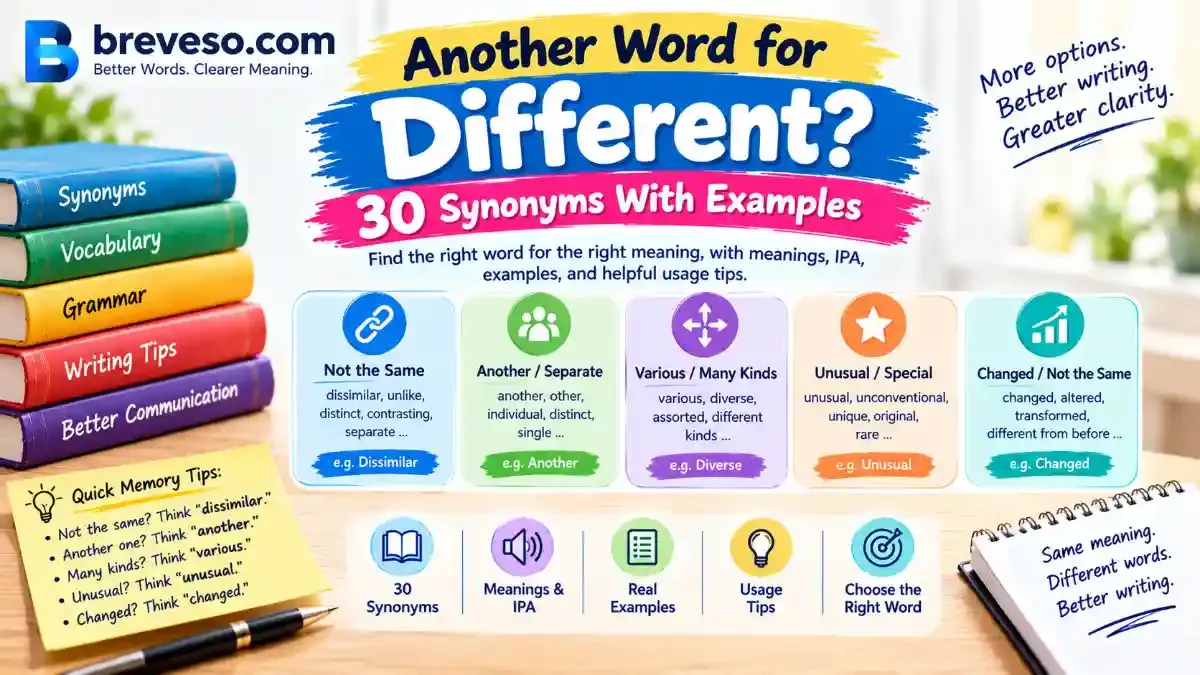
Looking for another word for different? The closest everyday alternatives to “different” are dissimilar, unlike, and distinct. Which one fits depends on what you mean. “Different” can mean not the same, separate, various, unusual, or changed, and each sense has its own best replacements.
Writers often need a stronger or more precise word. You might want a formal word like disparate, a word for variety like diverse, or a word for something unusual like unconventional. This guide sorts the options by meaning so you can pick the right one.
Quick list: dissimilar, unlike, distinct, contrasting, separate, another, various, diverse, unusual, unconventional
Below are 30 alternatives with meanings, IPA, usage notes, and examples. Some are direct synonyms. Others only match one sense of “different,” and the usage notes say which.
On this page
- At a Glance: Different Synonyms and Related Alternatives
- Which Word Should You Use?
- Exploring the Multiple Meanings of “Different”
- Analyzing 30 Different Alternatives in Detail
- Different From vs. Different Than vs. Different To
- Different and Opposite/Paired Word Pairs
- Common Word Partners of “Different”
- Idiomatic Phrases Featuring “Different”
- Word Formation of “Different”
- Common Word-Choice Mistakes
- Frequently Asked Questions
- Conclusion
At a Glance: Different Synonyms and Related Alternatives
| Alternative | Part of Speech | Meaning | Register / Tone | Ideal Context |
| Dissimilar | Adjective | Not alike in appearance or nature | Neutral to formal | Comparing two things |
| Distinct | Adjective | Clearly separate and easy to tell apart | Neutral to formal | Clear differences between categories |
| Contrasting | Adjective | Showing clear differences when placed side by side | Neutral | Colors, styles, opinions |
| Separate | Adjective | Not joined; apart from others | Neutral | Individual items or groups |
| Another | Determiner / pronoun | One more; a different one | Everyday | Replacing one thing with another |
| Various | Adjective | Of several kinds | Neutral | Many types of something |
| Diverse | Adjective | Including many different kinds | Neutral to formal | Groups, cultures, opinions |
| Unusual | Adjective | Not common or expected | Neutral | Things that stand out |
| Unconventional | Adjective | Not following usual customs | Neutral to formal | Methods, ideas, lifestyles |
| Changed | Adjective | Not the same as before | Everyday | People, places, situations over time |
Which Word Should You Use?
| If you want to… | Use | Why |
| Say two things are not alike | dissimilar, unlike | Both simply point to a lack of likeness. |
| Say things are easy to tell apart | distinct | It stresses clear separation. |
| Show a strong, side-by-side difference | contrasting | It suits colors, styles, and views. |
| Say something is another one | another, other | They replace “a different one.” |
| Describe many kinds of something | various, diverse, assorted | They show variety, not just one difference. |
| Praise something as not ordinary | unusual, unconventional, original | They fit new or creative things. |
| Say something has changed | changed, altered | They compare past and present. |
| Write formally about large differences | disparate, divergent, dissimilar | They sound academic and precise. |
Exploring the Multiple Meanings of “Different”
1. Not the Same
- Meaning: Not like another person or thing; unlike.
- Explanation: This is the main sense. It is usually followed by from (or than or to, depending on the region). It works for any comparison.
- Example: My phone is different from yours.
2. Separate or Another
- Meaning: Being another one or a distinct individual item.
- Explanation: Here “different” doesn’t compare quality. It just points to a separate person, place, or time.
- Example: We met on three different days.
3. Various
- Meaning: Of several kinds.
- Explanation: Used with plural nouns, “different” means a range of types.
- Example: The shop sells different kinds of tea.
4. Unusual or Special
- Meaning: Not ordinary; unlike what is usual.
- Explanation: This sense is informal. It can be a compliment, or a polite way to say something is odd, depending on tone.
- Example: The restaurant’s menu is certainly different.
5. Changed
- Meaning: Not the same as before.
- Explanation: The comparison here is with an earlier time, not with another item.
- Example: You look different since you cut your hair.
Sources: Merriam-Webster, Collins Dictionary, Dictionary.com
Analyzing 30 Different Alternatives in Detail
Some of these words are direct synonyms of “different.” Others match only one sense, and the usage notes say which.
Core Synonyms for “Not the Same”
1. Dissimilar
IPA: US /dɪˈsɪmələr/ · UK /dɪˈsɪmɪlə/
Definition: Not alike; having differences in appearance, character, or nature.
- Usage: A direct synonym of the “not the same” sense. It is slightly more formal than “different” and is often followed by to or from.
- Example: The two brothers are dissimilar in almost every way.
2. Unlike
IPA: /ʌnˈlaɪk/ (US and UK)
Definition: Not similar to; different from.
- Usage: A simple, direct synonym. As an adjective it usually follows a linking verb (“The twins are quite unlike”). As a preposition it starts a comparison.
- Example: Unlike his sister, he loves loud music.
3. Distinct
IPA: /dɪˈstɪŋkt/ (US and UK)
Definition: Clearly separate or different in kind; easy to notice or tell apart.
- Usage: A close synonym when the difference is clear. It adds the idea of being easy to identify. It is not a perfect match for “different,” because it also means “clear” in other contexts (a distinct smell).
- Example: Each region has its own distinct accent.
4. Contrasting
IPA: US /kənˈtræstɪŋ/ · UK /kənˈtrɑːstɪŋ/
Definition: Showing obvious differences when compared or placed side by side.
- Usage: A related alternative rather than a general synonym. It works best when two things are placed together, such as colors, opinions, or styles.
- Example: She wore a white scarf with a contrasting black coat.
5. Divergent
IPA: US /daɪˈvɜːrdʒənt/ · UK /daɪˈvɜːdʒənt/
Definition: Moving apart or becoming different from each other.
- Usage: Formal. It is a related alternative that suggests paths, views, or results that move apart over time.
- Example: The two scientists reached divergent conclusions from the same data.
6. Disparate
IPA: /ˈdɪspərət/ (US and UK)
Definition: Made up of parts that are very different and do not belong together.
- Usage: Formal. It is stronger than “different” and suggests things that are hard to combine or compare. It often describes groups or ideas.
- Example: The project brought together disparate teams from across the company.
Variety and Amount
7. Various
IPA: US /ˈveriəs/ · UK /ˈveəriəs/
Definition: Of several different kinds.
- Usage: It matches the “various kinds” sense and is always used with plural or uncountable nouns.
- Example: She tried various methods before one worked.
8. Varied
IPA: US /ˈverid/ · UK /ˈveərid/
Definition: Including many different types or kinds.
- Usage: A related alternative. It describes one thing that includes variety, such as a diet or career.
- Example: He has had a varied career in sales, teaching, and music.
9. Diverse
IPA: US /daɪˈvɜːrs/ · UK /daɪˈvɜːs/
Definition: Showing a great deal of variety; made up of many different types.
- Usage: Neutral to formal. It describes groups of many kinds of people, ideas, or things. It does not fit when you compare just two things.
- Example: The city has a diverse population.
10. Assorted
IPA: US /əˈsɔːrtɪd/ · UK /əˈsɔːtɪd/
Definition: Of different kinds mixed together.
- Usage: A related alternative. It is common for items sold or served together, such as snacks or colors.
- Example: The box held assorted chocolates.
Separate, Another, and Unusual
11. Separate
IPA: /ˈsepərət/ (US and UK)
Definition: Not joined or connected; existing apart from something else.
- Usage: It matches the “separate item” sense of “different,” as in “different rooms.” It does not mean “unlike.”
- Example: The twins sleep in separate rooms.
12. Another
IPA: US /əˈnʌðər/ · UK /əˈnʌðə/
Definition: One more; an additional or different one.
- Usage: It replaces “a different” when you mean “one more or an alternate one.” It is not about being unlike.
- Example: Let’s try another route to the beach.
13. Other
IPA: US /ˈʌðər/ · UK /ˈʌðə/
Definition: Different from the one already mentioned.
- Usage: It matches the sense of “not this one.” It often works where “different” means “some other.”
- Example: I’ll call you some other time.
14. Alternative
IPA: US /ɔːlˈtɜːrnətɪv/ · UK /ɔːlˈtɜːnətɪv/
Definition: Available as another possibility or choice.
- Usage: A related alternative. It describes a different option you could choose instead, not a difference in quality.
- Example: We found an alternative way to fix the problem.
15. Unusual
IPA: /ʌnˈjuːʒuəl/ (US and UK)
Definition: Not common, normal, or expected.
- Usage: The closest everyday word for the “special or odd” sense of “different.” It is neutral and can be positive or negative.
- Example: She has an unusual hobby: collecting old keys.
Unusual or Odd
16. Peculiar
IPA: US /pɪˈkjuːliər/ · UK /pɪˈkjuːliə/
Definition: Strange or unusual in a way that stands out, often specific to one person or thing.
- Usage: It suits a habit, taste, or detail that feels odd to others. It can sound a little negative, so use it with care.
- Example: He has a peculiar habit of talking to his plants.
17. Strange
IPA: /streɪndʒ/ (US and UK)
Definition: Unusual or surprising, especially in a way that is hard to understand.
- Usage: A plain, everyday word for what feels odd or hard to explain. It is stronger than unusual.
- Example: There was a strange noise downstairs.
18. Quirky
IPA: US /ˈkwɜːrki/ · UK /ˈkwɜːki/
Definition: Having strange or unusual habits or features, often in a fun way.
- Usage: Informal and often positive. It suits a person, place, or style with a fun, odd charm.
- Example: The cafe has a quirky style, with mismatched chairs.
19. Offbeat
IPA: US /ˌɔːfˈbiːt/ · UK /ˌɒfˈbiːt/
Definition: Not typical or ordinary; slightly odd in a pleasant way.
- Usage: Informal and often positive. A related alternative for things that are quirky.
- Example: The film has an offbeat sense of humor.
20. Idiosyncratic
IPA: /ˌɪdiəsɪŋˈkrætɪk/ (US and UK)
Definition: Having a way of behaving, or a feature, that is unusual and specific to one person or thing.
- Usage: Formal. It suits a personal habit or style that is hard to copy. Use it when the odd detail belongs to one person.
- Example: Her idiosyncratic way of taking notes made them easy to spot.
Special or One of a Kind
21. Unique
IPA: /juˈniːk/ (US and UK)
Definition: Being the only one of its kind.
- Usage: A related alternative. It is stronger than “different,” because it means nothing else is like it. Don’t use it just to mean “unusual.”
- Example: Every snowflake has a unique shape.
22. Uncommon
IPA: US /ʌnˈkɑːmən/ · UK /ʌnˈkɒmən/
Definition: Not often found or seen; rare.
- Usage: A plain word for what is rare. It is softer than unique, because it does not mean one of a kind.
- Example: Snow in April is uncommon here.
23. Novel
IPA: US /ˈnɑːvəl/ · UK /ˈnɒvəl/
Definition: New and interesting; different from what has been done before.
- Usage: It suits a new idea, method, or plan. It is positive and points to fresh thinking.
- Example: The team tried a novel way to cut waste.
24. Extraordinary
IPA: US /ɪkˈstrɔːrdəneri/ · UK /ɪkˈstrɔːdnri/
Definition: Very unusual or remarkable; much better or greater than usual.
- Usage: It suits a person, event, or result that stands out far above the usual. Use it for big praise, not small differences.
- Example: She made an extraordinary recovery.
25. Special
IPA: /ˈspeʃl/ (US and UK)
Definition: Different from what is usual; better, greater, or more important than usual.
- Usage: A warm, everyday word for what matters more or stands out. It is positive and fits people, days, and things.
- Example: Today is a special day for our family.
26. Singular
IPA: US /ˈsɪŋɡjələr/ · UK /ˈsɪŋɡjələ/
Definition: Very great or noticeable; being the only one of its kind.
- Usage: Formal at times. It can mean one of a kind, or it can stress how strong a quality is.
- Example: The singer has a singular voice that no one forgets.
Unconventional, Original, and Changed
27. Unconventional
IPA: /ˌʌnkənˈvenʃənl/ (US and UK)
Definition: Not based on or conforming to what is generally done or believed.
- Usage: A related alternative. It is slightly formal and works for methods, ideas, and lifestyles.
- Example: The teacher used unconventional methods to explain fractions.
28. Original
IPA: /əˈrɪdʒənl/ (US and UK)
Definition: New and not copied from anything else.
- Usage: A related alternative. It is positive and stresses creativity, not just being unlike something.
- Example: He came up with an original idea for the app.
29. Changed
IPA: /tʃeɪndʒd/ (US and UK)
Definition: Not the same as before.
- Usage: It fits the “changed” sense of “different,” as in “You look different.” It compares the present with the past.
- Example: The town has changed since I last visited.
30. Altered
IPA: US /ˈɔːltərd/ · UK /ˈɔːltəd/
Definition: Made different in some way, often slightly.
- Usage: A related alternative. It suggests a smaller, deliberate change.
- Example: The altered plan saves time.
Sources: Merriam-Webster, Collins Dictionary and Thesaurus, Dictionary.com
Different From vs. Different Than vs. Different To
All three patterns follow “different,” but they are not used equally everywhere.
| Pattern | Where It Is Common | Example |
| different from | Standard in all varieties of English | My answer is different from yours. |
| different than | Common in American English, especially before a clause | It looks different than it used to. |
| different to | Common in British English | His view is different to mine. |
If you are not sure, different from is the safest choice in formal writing.
Sources: Merriam-Webster Usage Notes, Collins Dictionary
Different and Opposite/Paired Word Pairs
| Word | Paired Word | Note |
| Different | Same | The most direct opposite |
| Different | Alike | Often used for people or things |
| Different | Similar | Means close to, but not exactly, the same |
| Different | Identical | Means exactly the same |
| Different | Equal | Used for amounts, rights, and value |
| Unusual | Ordinary | Opposite of the “special” sense |
| Unconventional | Conventional | Opposite for ideas and methods |
| Changed | Unchanged | Opposite for before-and-after comparisons |
| Diverse | Uniform | Opposite for groups and variety |
Not every opposite fits every sense. Same works for “not the same,” but ordinary is the better partner when “different” means unusual.
Sources: Merriam-Webster Thesaurus, Collins Thesaurus
Common Word Partners of “Different”
| Pattern | Common Partners | Example |
| different + noun | kinds, ways, types, people, places, opinions | There are different ways to solve this. |
| adverb + different | completely, entirely, totally, very, quite, slightly | The two plans are completely different. |
| different + preposition | from, than, to, in | The twins are different in size. |
| verb + different | look, feel, sound, taste, seem | The soup tastes different today. |
| no / any + different | no different, any different | This is no different from last year. |
| something different | something different | Let’s order something different. |
Sources: Collins Dictionary, Merriam-Webster
Idiomatic Phrases Featuring “Different”
1. Different strokes for different folks
- Meaning: People have different tastes, and that is fine.
- Example: I don’t like spicy food, but different strokes for different folks.
2. A whole different ballgame
- Meaning: A situation that is completely different from what came before.
- Example: Running a team is a whole different ballgame from working alone.
3. A different kettle of fish
- Meaning: A separate matter that is very unlike the one just mentioned.
- Example: Writing an email is easy, but writing a book is a different kettle of fish.
4. Sing a different tune
- Meaning: To change your opinion or attitude, usually after something happens.
- Example: He laughed at the idea, but he sang a different tune after it worked.
Sources: Merriam-Webster, Collins Dictionary, Cambridge Dictionary
Word Formation of “Different”
Etymology & Structure
“Different” comes from Old French different and goes back to Latin differentem, the present participle of differre, meaning “to set apart.” That Latin verb combines a form of dis- (“apart, away”) with ferre (“to carry, bring”). The word therefore carries the idea of things “carried apart.”
Date and History
“Different” appeared in English in the late 14th century, meaning “not the same, unlike.” The informal sense of “special, unusual” is recorded from 1912.
Word Class Variations
- Adjective: different
- Adverb: differently
- Noun: difference
- Verb: differ, differentiate
- Related noun: differentiation
- Related adjective/noun: differential
Sources: Etymonline, Merriam-Webster
Common Word-Choice Mistakes
- Different with → different from: “My view is different from hers.”
- Differents ideas → different ideas: adjectives do not take a plural s in English.
- What is the different? → What is the difference? Different is the adjective; difference is the noun.
- She sings different → She sings differently: use the adverb in standard writing.
- A very unique idea → an unusual idea (or a unique idea): unique means one of a kind, so it is not a simple synonym of “different.”
- Two diverse tools → two different tools: diverse describes a wide variety, not one difference between two items.
- Seperate rooms → separate rooms: the correct spelling has -par- in the middle.
Frequently Asked Questions
What is the closest synonym for “different”?
Dissimilar and unlike are the closest in the sense of “not the same.” Distinct is close when the difference is clear.
What is a formal word for “different”?
Disparate, divergent, and dissimilar are common formal choices. They suit essays, reports, and academic writing.
What is another word for “different kinds”?
Various, diverse, and assorted all work. Various is the most neutral of the three.
What is another word for “different” when you mean unusual?
Unusual, unconventional, and offbeat fit this sense. Unique is stronger and means one of a kind.
What is the opposite of “different”?
Same is the main opposite. Alike, similar, and identical also work, depending on how close the match is.
What is the difference between “different” and “distinct”?
Different is a general word for “not the same.” Distinct adds the idea that the difference is clear and easy to notice.
Should I say “different from” or “different than”?
Different from works everywhere and is the safest choice. Different than is common in American English, especially before a clause.
Can “different” mean “another”?
Yes. In “We met on a different day,” it means “another day,” not “unlike the first.”
Can “different” be an adverb?
In standard English, the adverb is differently. Using “different” as an adverb (as in “think different”) is informal and nonstandard.
Is “That’s different” a compliment?
It depends on tone. It can be a kind way to say something is interesting, or a polite way to say it is odd.
Conclusion
The closest everyday alternatives to “different” are dissimilar, unlike, and distinct. For variety, various, diverse, and assorted are strong choices. For unusual things, unusual and unconventional work well.
The right word depends on the sense. “Different” can mean unlike, separate, various, unusual, or changed. A word that fits one sense may not fit another, which is why unique and diverse are not always safe swaps.
To choose well, first decide what you are describing: a comparison, a group, something original, or a change over time. Then pick the word from that group. If a simple word is enough, “different” is often still the best choice.
Related guides: Another Word for Akin, Another Word for Float, Another Word for Incognito.

Ali Bismal founded Breveso and writes its synonym guides. He started the site to help readers find the right word without wading through long lists.