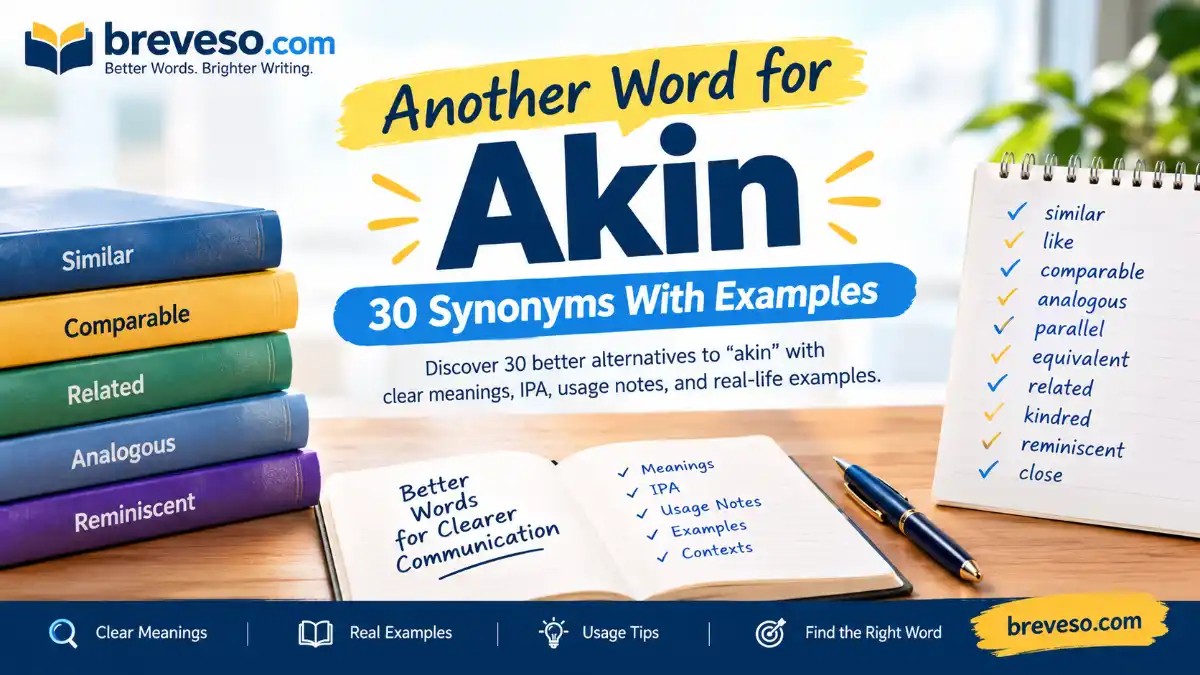
The closest everyday alternatives to akin are similar, like, and comparable. Akin means having the same basic nature or character as something else, and it is almost always followed by to, as in “a feeling akin to relief.” Less often, it means “related by blood.”
The best alternative depends on what you mean. Simple likeness calls for similar or comparable, while formal comparison suits analogous or parallel. Family or shared origin points to related, kindred, or cognate. Something that brings another thing to mind is better served by reminiscent.
Quick list: similar, like, comparable, analogous, parallel, equivalent, related, kindred, reminiscent, close
This article looks at 30 alternatives. Each comes with a meaning, IPA, usage note, example sentence, and the context where it fits best.
At a Glance: Akin Synonyms and Related Alternatives
| Alternative | Part of Speech | Meaning | Register / Tone | Ideal Context |
| Similar | Adjective | Alike in many ways | Neutral | Everyday speech and writing |
| Like | Preposition / adjective | Having the same qualities | Informal to neutral | Casual comparison |
| Comparable | Adjective | Similar enough to compare | Neutral to formal | Size, quality, price |
| Analogous | Adjective | Similar in structure or function | Formal | Science, law, explanation |
| Parallel | Adjective | Matching or running side by side | Neutral to formal | Cases, stories, careers |
| Equivalent | Adjective | Equal in value or effect | Formal | Measures, results |
| Related | Adjective | Connected by family or origin | Neutral | Family, languages, topics |
| Kindred | Adjective | Of the same family or nature | Literary, warm | Feelings, spirits, bonds |
| Reminiscent | Adjective | Bringing something else to mind | Neutral to literary | Style, sound, mood |
| Close | Adjective | Near in nature or relationship | Informal to neutral | Feelings, meanings |
Which Word Should You Use?
| If you want to… | Use | Why |
| Mention shared qualities in daily talk | similar | It is the simplest and most common choice. |
| Compare things fairly, such as price or size | comparable | Items can be measured side by side. |
| Explain one thing by comparing it with another in formal text | analogous | Likeness in structure or function is the point. |
| Show that two cases or stories follow the same pattern | parallel | The image is of two lines that match as they go. |
| State that two things are equal in value or effect | equivalent | Its meaning is stronger than akin. |
| Talk about family or shared origin | related | People, languages, and ideas can all be related. |
| Describe a warm, natural bond between people or feelings | kindred | Its tone is literary and personal. |
| Hint that something makes you think of something else | reminiscent | A mental link is suggested, not a full match. |
| Stress that two things are exactly the same | identical | Akin never means exactly the same. |
Exploring the Multiple Meanings of “Akin”
1. Similar in Nature or Character
- Meaning: Essentially similar, related, or compatible.
- Explanation: This is the most common use today. Two things share a basic quality, though not every detail. A to phrase usually follows.
- Example: The feeling was akin to standing on a high bridge.
2. Related by Blood
- Meaning: Of the same family; descended from a common ancestor.
- Explanation: As the oldest sense, it is formal and rare in modern speech. Writers usually place it after a verb.
- Example: The two families are closely akin.
3. Related in Origin or Type
- Meaning: Sharing a common source, as in languages or species.
- Explanation: Writing about language and science uses this sense often. Two things come from the same root.
- Example: These two languages are closely akin.
4. Showing Affinity or Compatibility
- Meaning: Having a natural link or sympathy with something.
- Explanation: Here akin describes minds, tastes, or spirits that fit well together. Thoughtful and a little literary, it suits careful writing.
- Example: They were emotionally akin, even if their views differed.
Sources: Merriam-Webster; Dictionary.com
Analyzing 30 Akin Alternatives in Detail
Some of these words are direct synonyms of akin, while others are related alternatives that fit only certain contexts. Each Usage note says which is which.
Everyday Alternatives
1. Similar
IPA: US /ˈsɪmələr/ · UK /ˈsɪmɪlə/
Definition: Alike in many ways, but not exactly the same.
- Usage: This is the closest everyday synonym for akin. Neutral in tone, it works in nearly every context. Use it in the pattern similar to, just as you would use akin to.
- Example: Her reaction was similar to mine.
2. Like
IPA: /laɪk/ (US and UK)
Definition: Having the same qualities as another person or thing.
- Usage: As a direct synonym, it fits the pattern “a feeling like grief.” Mostly a preposition, it turns formal as an adjective before a noun, as in “people of like mind.”
- Example: The mood felt like a quiet Sunday.
3. Alike
IPA: /əˈlaɪk/ (US and UK)
Definition: Similar to each other; having the same qualities.
- Usage: Here is a direct synonym that describes two or more things together. Unlike akin, it is not followed by to. You say “The twins are alike,” not “alike to each other.”
- Example: These two designs are very much alike.
4. Comparable
IPA: US /ˈkɑːmpərəbəl/ · UK /ˈkɒmpərəbəl/
Definition: Similar enough to be compared; of about the same quality or size.
- Usage: Close synonym in neutral to formal writing. Often it suggests a fair match in size, price, or quality. Partners include to and with.
- Example: Both cars are comparable in price.
5. Close
IPA: US /kloʊs/ · UK /kləʊs/
Definition: Near in nature, meaning, or relationship.
- Usage: Casual speech welcomes it in phrases like “close to panic,” where it means “almost the same as.” As a related alternative, it is less exact than akin.
- Example: What she felt was close to relief.
Formal and Analytical Alternatives
6. Analogous
IPA: /əˈnæləɡəs/ (US and UK)
Definition: Similar in some ways, so that one thing helps explain the other.
- Usage: Direct synonym in formal writing. Structure or function is usually the shared point. Science, law, and teaching use it often.
- Example: A heart is analogous to a pump.
7. Parallel
IPA: /ˈpærəlel/ (US and UK)
Definition: Matching or similar, as if running side by side.
- Usage: Cases, stories, and developments that follow the same pattern suit this close synonym. Writers place it before a noun or follow it with to or with.
- Example: Their careers followed a parallel path.
8. Equivalent
IPA: /ɪˈkwɪvələnt/ (US and UK)
Definition: Equal in value, meaning, or effect.
- Usage: Stronger than akin, this is a related alternative. Things that are akin are alike, while equivalent things can stand in for each other.
- Example: One mile is roughly equivalent to 1.6 kilometers.
9. Corresponding
IPA: US /ˌkɔːrəˈspɑːndɪŋ/ · UK /ˌkɒrɪˈspɒndɪŋ/
Definition: Matching or similar in position, role, or function.
- Usage: As a related alternative, it points to a counterpart, not a general likeness. It usually comes before a noun.
- Example: Each word has a corresponding picture.
10. Homologous
IPA: US /həˈmɑːləɡəs/ · UK /həˈmɒləɡəs/
Definition: Sharing the same basic structure or origin, even if the function differs.
- Usage: Biology uses this related alternative most, so it is not a general synonym for akin. Its tone is technical.
- Example: A bat’s wing and a human arm are homologous structures.
11. Tantamount
IPA: /ˈtæntəmaʊnt/ (US and UK)
Definition: Equal in effect or meaning to something, usually something serious.
- Usage: Writers use it after a verb with to, often about something negative. Though stronger than akin, it is only a related alternative, not an exact synonym.
- Example: Staying silent was tantamount to agreeing.
Relationship and Origin Alternatives
12. Related
IPA: /rɪˈleɪtɪd/ (US and UK)
Definition: Connected by family, origin, or subject.
- Usage: This is a direct synonym for the blood and origin senses of akin. Related things do not always look alike, though, so the word does not always mean “similar.”
- Example: The two languages are closely related.
13. Kindred
IPA: US /ˈkɪndrəd/ · UK /ˈkɪndrɪd/
Definition: Of the same family, or similar in nature or character.
- Usage: Warm and literary in tone, it is a close synonym for the affinity sense. Look for it in the phrase kindred spirit.
- Example: Both writers felt a kindred bond.
14. Cognate
IPA: US /ˈkɑːɡneɪt/ · UK /ˈkɒɡneɪt/
Definition: Sharing a common origin, especially of words or languages.
- Usage: Language study is where this related alternative fits best, and only in the shared-origin sense.
- Example: English and Dutch are cognate languages.
15. Consanguineous
IPA: US /ˌkɑːnsæŋˈɡwɪniəs/ · UK /ˌkɒnsæŋˈɡwɪniəs/
Definition: Related by blood; descended from the same ancestor.
- Usage: Medical and legal writing use this very formal word. It covers the blood sense only, so treat it as a related alternative. Similarity is never what it expresses.
- Example: Doctors study health risks in consanguineous families.
16. Allied
IPA: /əˈlaɪd/ (US and UK)
Definition: Joined or connected by common aims or close similarity.
- Usage: Close links between fields or groups are the point of this related alternative. Mere likeness is not.
- Example: Botany and ecology are allied fields.
17. Connected
IPA: /kəˈnektɪd/ (US and UK)
Definition: Linked or related to something else.
- Usage: This related alternative says there is a link. Likeness is not part of the message.
- Example: The two events seem connected.
18. Associated
IPA: US /əˈsoʊʃieɪtɪd/ · UK /əˈsəʊʃieɪtɪd/
Definition: Tied together in thought or by a common setting.
- Usage: Weaker than akin, it is a related alternative. A link is shown, but not a likeness.
- Example: Stress is often associated with poor sleep.
Suggestion and Resemblance Alternatives
19. Reminiscent
IPA: US /ˌrɛməˈnɪsənt/ · UK /ˌremɪˈnɪsənt/
Definition: Bringing something else to mind.
- Usage: Use it in the pattern “something akin to,” but follow it with of, not to. An impression is what it points to, not an exact match.
- Example: The song is reminiscent of old folk tunes.
20. Redolent
IPA: /ˈredələnt/ (US and UK)
Definition: Strongly suggesting something, or having a strong smell of it.
- Usage: Literary in tone, this related alternative takes of after it.
- Example: The old hall was redolent of history.
21. Resembling
IPA: /rɪˈzembəlɪŋ/ (US and UK)
Definition: Looking like or being similar to something.
- Usage: Everyday writing often swaps it in for akin to in the phrase “something akin to.” It counts as a close alternative.
- Example: She wore something resembling a crown.
22. Suggestive
IPA: US /səɡˈdʒɛstɪv/ · UK /səˈdʒestɪv/
Definition: Making you think of something.
- Usage: Keep the of phrase with this related alternative. On its own, the word can also hint at something improper.
- Example: The pattern is suggestive of waves.
Affinity and Agreement Alternatives
23. Compatible
IPA: /kəmˈpætəbəl/ (US and UK)
Definition: Able to exist or work together without trouble.
- Usage: Fit matters more than likeness here. It matches the “compatible” part of akin, so treat it as a related alternative.
- Example: Their goals are compatible.
24. Congenial
IPA: /kənˈdʒiːniəl/ (US and UK)
Definition: Pleasant and agreeable because of shared tastes or nature.
- Usage: People or places that feel natural together suit this related alternative.
- Example: She found a congenial group of friends.
25. Consistent
IPA: /kənˈsɪstənt/ (US and UK)
Definition: Staying in agreement with something else.
- Usage: With follows this related alternative. Two things that are consistent do not clash, which differs from being alike.
- Example: His story is consistent with the facts.
26. Congruent
IPA: US /kənˈɡruːənt/ · UK /ˈkɒŋɡruənt/
Definition: In agreement or harmony with something; in geometry, having the same shape and size.
- Usage: Formal writing is the home of this related alternative, and with follows it.
- Example: Her actions are congruent with her values.
Stronger Words Than “Akin”
These four words go beyond akin. Use them only when you mean more than “similar.”
27. Matching
IPA: /ˈmætʃɪŋ/ (US and UK)
Definition: Equal or alike, especially in form, color, or pattern.
- Usage: A close visual or design match is the usual idea. Stronger than akin, it is a related alternative.
- Example: They wore matching coats.
28. Identical
IPA: /aɪˈdentɪkəl/ (US and UK)
Definition: Exactly the same.
- Usage: Not a synonym, because akin allows differences while identical does not.
- Example: The twins have identical voices.
29. Equal
IPA: /ˈiːkwəl/ (US and UK)
Definition: Having the same amount, size, or value.
- Usage: Measure and value are its home ground, not nature or character. Treat it as a related alternative.
- Example: Both parts are of equal length.
30. Interchangeable
IPA: US /ˌɪntərˈtʃeɪndʒəbəl/ · UK /ˌɪntəˈtʃeɪndʒəbəl/
Definition: Able to be swapped without changing anything.
- Usage: Much stronger than akin, it is a related alternative. Things that are akin are alike, but they may not be swappable.
- Example: These two terms are not interchangeable.
Sources: Merriam-Webster; Dictionary.com
Akin vs. Similar vs. Analogous vs. Kindred
These four words are easy to mix up, and each points in a slightly different direction.
| Word | What it stresses | Example | Note |
| Akin | Likeness in basic nature | A feeling akin to joy | Usually after a verb, followed by to |
| Similar | General likeness | A similar plan | Works before or after a noun |
| Analogous | A likeness that helps explain | A system analogous to a river | Formal and technical |
| Kindred | A natural bond or shared nature | A kindred spirit | Warm and literary |
Akin sits between similar and kindred. Thoughtful in tone, it is more careful than similar, yet less personal than kindred. In plain writing, similar is usually the safer choice.
Sources: Merriam-Webster; Dictionary.com
Akin and Opposite/Paired Word Pairs
| Word | Paired Word | Note |
| Akin | Unlike | The plainest opposite for likeness |
| Akin | Dissimilar | Formal opposite of similar |
| Akin | Distinct from | Stresses a clear difference |
| Akin | Alien to | Means foreign or strange to someone’s nature |
| Akin | Unrelated | Opposite of the family and origin sense |
No single perfect opposite exists, because akin covers both likeness and relationship. For likeness, unlike and dissimilar work well. Unrelated fits the family or origin sense, while alien to suits something that does not match a person’s nature.
Sources: Merriam-Webster; Dictionary.com
Common Word Partners of “Akin”
| Pattern | Common Partners | Example |
| akin to + noun | panic, a mistake, a dream | The delay was akin to a small defeat. |
| akin to + -ing | asking, saying, giving up | Quitting now would be akin to giving up. |
| something akin to | relief, joy, a smile | She felt something akin to relief. |
| closely akin | languages, ideas, words | These two ideas are closely akin. |
| more akin to | a hobby, an art, a game | My job is more akin to a hobby than work. |
| adverb + akin | emotionally, spiritually, culturally | Both friends are emotionally akin. |
Sources: Merriam-Webster; Dictionary.com
Idiomatic Phrases Featuring “Akin”
Akin has no true idioms of its own. The phrases below are established expressions, which are common and fixed in how people use them.
1. Something akin to
- Meaning: A thing that is close to something else, but not exactly the same.
- Example: There was something akin to joy in his voice.
2. Akin to saying (or asking)
- Meaning: A comparison used to show that one action is as extreme as another.
- Example: Asking him to wait is akin to asking the sea to stop.
3. Closely akin
- Meaning: Very similar or very closely related.
- Example: Spanish and Portuguese are closely akin.
4. More akin to X than Y
- Meaning: Closer in nature to one thing than to another.
- Example: Her work is more akin to teaching than to sales.
Sources: Merriam-Webster; Dictionary.com
Word Formation of “Akin”
Etymology & Structure
Akin is made from the prefix a- and the noun kin. Dictionaries describe it as a shortening of the older phrase of kin. The noun kin comes from Old English cynn, meaning family, race, or kind.
Date and History
Sources give slightly different dates. Merriam-Webster gives 1525 for the first known use, in the sense “related by blood.” Etymonline places it in the 1550s, while Dictionary.com says it was first recorded in 1580–90. The figurative sense of “joined by nature” came later, in the 1630s according to Etymonline.
Word Class Variations
- Adjective: akin (the main use)
- Comparative and superlative: more akin, most akin
- Related words: kin (noun), kinship (noun), kindred (adjective and noun)
No standard verb or adverb form of akin exists.
Sources: Merriam-Webster; Dictionary.com; Etymonline
Common Word-Choice Mistakes
- An akin idea: an idea akin to this one, or a similar idea. Usually, akin follows a verb.
- Akin with / akin of: akin to.
- Reminiscent to: reminiscent of.
- Tantamount of: tantamount to.
- He is a kin of mine: he is a relative of mine. Kin usually means family as a group.
- Consanguineous ideas: related ideas. Only blood relations suit consanguineous.
- The two coats are akin (when they are exactly the same): the two coats are identical.
Frequently Asked Questions
What is the closest synonym for akin?
Similar is the closest everyday synonym, and comparable and like also work well.
How does akin differ from similar?
Both mean alike, but akin sounds more formal and suggests likeness in basic nature. Similar works in every situation.
Which formal alternative works best?
Analogous and comparable are good formal choices. For related origin, cognate fits.
Is there a literary alternative?
Kindred and redolent both have a literary tone. The first suits people and feelings, while the second suits mood and atmosphere.
Which word means related by blood?
Related is the common word. Consanguineous is the formal and technical one.
Is akin the same as identical?
No. Akin means similar in nature, while identical means exactly the same.
What is the opposite of akin?
Unlike and dissimilar are the usual opposites. For the family or origin sense, unrelated works.
Which word usually follows akin?
To is the standard partner, as in “akin to.”
Can akin describe people?
Yes, it can mean related by family or close in nature, as in “emotionally akin.”
Is Akin also a name or another word?
Yes. As a given name, Akin has nothing to do with the adjective. In Tagalog, it is a different word, a form of the first-person pronoun.
Conclusion
The closest everyday alternatives to akin are similar, like, and comparable. Formal writing welcomes analogous and parallel. Family or shared origin is best handled by related, kindred, and cognate.
Context matters because these words point in different directions. Some stress likeness, others stress relationship, and a few only suggest a link. Words such as identical and interchangeable say much more than akin does.
To choose well, first decide what you want to show. A word like similar covers plain likeness. Related covers family and origin, and reminiscent covers a thought that something brings to mind.

Ali Bismal is the founder and writer behind Breveso.com, where he helps readers find the perfect synonym for every word. What started as a simple love for words turned into a growing library of “another word for ___” guides covering emotions, actions, slang, and everyday language.
Ali believes the right word can sharpen a sentence, and the wrong one can blur it. That is why every Breveso guide is written in plain, simple English, grouped in a way that actually makes sense, and checked for real-world use.
He writes for students, writers, and anyone who has ever stared at a sentence thinking there must be a better word for this. Clean, useful content that answers the question fast, that is the whole mission.